

MSc | Altcoin Analyst • AI • RWA | Seeing what the market hasn’t priced in yet
Onchain
Joined May 2021
- Tweets89.5K
- Following995
- Followers45.7K
- Likes118K





Pinned Tweet
Most $TAO holders are flying blind.
They bought the token.
They watched the price.
They read the threads.
But they have never opened the one tool that shows them everything happening inside the Bittensor network in real time.
It is called Taostats.
It is free.
And after reading this, you will never look at $TAO the same way again.
Here is exactly how to use it.
Step 1: Start at the Subnets page.
This is the heartbeat of the entire network. Every subnet running on Bittensor is listed here with:
- its current emission rate
- the number of active miners and validators
- real-time performance data
The emission rate is the most important number on this page. It tells you exactly how much TAO is flowing into each subnet every block.
High emission means the network is directing significant resources toward that subnet's commodity. Low emission means the market has not yet recognised its value, or the subnet has not yet proven itself.
Watch which subnets are gaining emission share over time. That movement tells you where the network believes the most valuable work is being done, before any headline announces it.
Step 2: Use the Subnet pages to go deeper.
Click any subnet, and you enter a complete dashboard for that individual market.
- The TradingView chart shows you the alpha token price history for that subnet. Alpha tokens are the subnet-specific tokens that sit inside TAO's broader economy. Their price relative to TAO tells you how the market is valuing that subnet's specific commodity.
- The Metagraph is the full list of every miner and validator currently active in the subnet: their UID, their stake, their trust score, their emission share. This is the raw intelligence layer. The miners consistently earning the most emissions are producing the work the validators collectively agree is the most valuable.
- The Sentiment Index gives you a real-time community temperature reading on each subnet. Not price sentiment. Ecosystem sentiment. Whether the participants building inside the subnet believe it is healthy and improving.
Step 3: Check Validators before you stake anything.
This is the step most people skip and regret.
The Validators page on Taostats shows you the performance history of every validator on the network: their VTrust score, their emission consistency, and their weight-setting behaviour across subnets.
VTrust is the metric that matters most. It measures how closely a validator's judgments align with the honest stake-weighted majority across the network. High VTrust means the validator is doing genuine work and being rewarded for it. Low VTrust means the validator is either lazy, copying other validators' weights, or attempting to manipulate the system.
When you delegate your TAO to a validator, you are trusting them with your emissions. Taostats shows you exactly which validators have earned that trust over time, and which ones have not.
Never stake blind again.
Step 4: Use the Blockchain explorer to track real movement.
The Blockchain section of Taostats logs every transfer, every staking transaction, and every extrinsic called on the Bittensor chain in real time.
This is where you track what wallets are actually doing:
- Large staking transactions from unknown addresses
- Subnet registration events that signal a new market is about to go live
- Neuron registration burns that show demand for participation in a specific subnet is accelerating
The people who read on-chain data before the narrative catches up to it are the ones who position correctly before the crowd notices the move.
Step 5: Track your own portfolio inside the Dashboard.
Connect your coldkey address, and Taostats builds you a complete portfolio view:
- Your TAO balance
- Your staking positions
- Your delegation returns
- Your yield over time
The yield calculator is particularly useful. It shows you the actual return you are generating from your staking position in real TAO terms, not in percentage estimates that assume conditions that may not hold.
If your yield is lower than the network average for your validator tier, Taostats shows you that too. Switching validators takes one transaction. The data to make that decision intelligently is right in front of you.
The bigger picture.
Most people holding $TAO are making decisions based on price charts and social media sentiment. Both of those inputs are downstream of what is actually happening inside the network.
Subnet emission shifts.
Validator VTrust changes.
On-chain registration events.
Neuron burn rates.
Alpha token price movements relative to TAO.
All of it is live on Taostats right now. All of it is free. All of it tells you something the price chart cannot.
The investors who understand Bittensor at the data layer will always be positioned ahead of the investors who understand it at the narrative layer.
Taostats is the data layer.
Bookmark it. Open it daily. The network is telling you exactly what it is doing if you know where to look.
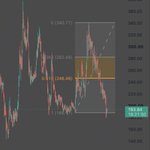
You watched $TAO run from $188 to $340.
Then you watched it hand back every single dollar of that move.
What most people missed is where it landed. Price is sitting on the exact level where the whole rally started.
$188
That is the 100% retracement of the run. It is also the floor of the summer range $TAO built before the breakout.
When a full retrace and old support stack on the same number, it stops being a line on a chart. It becomes the decision.
Here is the map.
Support to defend: $188 on a weekly close
First reclaim: $246, the 0.618 retracement
Trend shift: $282, the 0.382 retracement
Invalidation: a weekly close under $180 opens the 2026 low near $145
Now the momentum.
Daily RSI sits at 33, brushing oversold. Selling is stretched on the lower timeframe.
Weekly MACD just crossed down and weekly RSI sits near 42. The bigger trend has not turned yet.
So this is not a signal to buy blindly. It is a test of the most important floor on the chart.
Zoom out and it gets sharper. Every major $TAO rally since 2024 has topped lower.
Roughly $780, then $750, then $540, then $380, now $340.
But the floor has barely moved. Buyers have defended the $145 to $190 zone since 2024.
Lower highs pressing into a flat floor. One side gives way soon, and the weekly close at $188 is where you find out which.
I would rather be early at support than late at resistance.


2xnmore retweeted

$TAO 🌳👽🦉
While everyone worries that a handful of companies will own the future of AI, Barry Silbert just said the quiet part out loud.
The founder of Digital Currency Group (the firm behind Grayscale) called Bittensor the first crypto AI project to hit "escape velocity."
He said $TAO can do:
500x
He doesn't think Bitcoin can.
His point is simple:
Bitcoin pays people to secure a network.
Bittensor pays people to compete on solving hard problems.
Over a hundred subnets are already running everything from drug discovery to compute and sports prediction.
The incentive layer is live.
This lands right as public anxiety about AI is spiking.
Polls show most Americans are more concerned than excited, with concentration of power ranking among the sharpest fears.
Frontier models sit with a few labs.
Data center buildouts face local backlash over energy and water.
Trust in AI executives is low.
Silbert's bet (via DCG's Yuma) is that an open, competitive network can do for intelligence what Bitcoin did for money: make it harder for any single group to control.
Whether TAO actually snaps back fastest in this selloff is the open question he just put on the table.
Not financial advice. Just the view from the person who built one of the largest institutional on ramps to crypto and is now allocating accordingly.
2xnmore retweeted
My long term target for $TAO is still $1000, my conviction remains intact.
Only the people who understand Bittensor can relate.
2xnmore retweeted
You used to need a whole production team and a five figure budget to make a short film.
Now a single prompt can do it.
But the tools that actually work are locked behind a few companies that can change the rules, raise prices, or shut you out anytime.
That’s the quiet frustration a lot of creators feel right now.
While everyone’s talking about the newest closed video models, something quieter has been happening on Bittensor $TAO.
What Affine actually built
Affine, Subnet 120, launched one of the first public AI video studios on the network.
You type a prompt, and it generates short videos with sound using the open weights MiniMax H3 model.
Clips of roughly 5, 10, or 15 seconds
Different aspect ratios
Help turning a rough idea into a proper prompt
It’s free to try with daily credits.
The team is also running a public competition where people compete to make the generation process itself faster and cheaper, without wrecking the quality.
The best improvements win rewards. The model stays open.
It’s not just one studio
Other subnets are building around the same idea:
Attelier (SN126) is creating a decentralised generative video platform, with open models, inference, and tools so creators and developers aren’t dependent on any single provider.
Video processing and compression subnets, like the work around Vidaio, focus on making high quality video cheaper to handle and store.
The pattern is the same.
Instead of one company owning the model and the infrastructure, independent people compete to improve it.
The best work gets rewarded. Anyone can use the results.
Why this matters for normal people
Most of the viral AI video tools you see are closed. The company can:
Change pricing overnight
Add usage limits
Decide what you’re allowed to generate
Train on your prompts without you really knowing
On these Bittensor subnets, the models are open, the competition is public, and improvement is driven by people who are paid to make it better and cheaper for everyone.
That doesn’t mean the quality is magically better than the best closed models yet.
It means the tools are getting better in the open, and you can use them without asking permission.
Try it yourself
If you’ve been curious about AI video but tired of closed ecosystems, start with Affine’s studio.
Generate a few clips. Compare them to whatever else you’ve used. Watch how the open competition is trying to push the cost down.
The interesting part isn’t just that video generation exists on Bittensor.
It’s that creators and builders can now help make it better, instead of just being customers of someone else’s product.
$TAO powers the incentives underneath all of this.
The more useful the tools become, the more the network gets used.

2xnmore retweeted

BREAKING: A cyberattack hit 178 major organizations, including Zoom, CNN, BBC, Fox News, HSBC, Ledger, Equifax, Salesforce, IKEA and Air France-KLM, by loading malware on the Optimizely Web platform, exposing visitors to scripts built to steal payment data and exploit iOS devices, per security firm Report URI.
Banking and finance was the hardest-hit sector, with 32 organizations affected, including the UK's HSBC across multiple markets such as the US, Hong Kong, Mexico, Singapore, Australia and the UAE.
While everyone worries that a handful of companies will own the future of AI, Barry Silbert just said the quiet part out loud.
The founder of Digital Currency Group (the firm behind Grayscale) called Bittensor the first crypto AI project to hit "escape velocity."
He said $TAO can do:
500x
He doesn't think Bitcoin can.
His point is simple:
Bitcoin pays people to secure a network.
Bittensor pays people to compete on solving hard problems.
Over a hundred subnets are already running everything from drug discovery to compute and sports prediction.
The incentive layer is live.
This lands right as public anxiety about AI is spiking.
Polls show most Americans are more concerned than excited, with concentration of power ranking among the sharpest fears.
Frontier models sit with a few labs.
Data center buildouts face local backlash over energy and water.
Trust in AI executives is low.
Silbert's bet (via DCG's Yuma) is that an open, competitive network can do for intelligence what Bitcoin did for money: make it harder for any single group to control.
Whether TAO actually snaps back fastest in this selloff is the open question he just put on the table.
Not financial advice. Just the view from the person who built one of the largest institutional on ramps to crypto and is now allocating accordingly.
2xnmore retweeted

JUST IN: Nvidia founder Jensen Huang transferred billions in $NVDA shares to his heirs months before he resigned as CEO.
2xnmore retweeted
Thousands of people bought $UNI because it was backed by real estate.
Its CEO has since said it will no longer be positioned as asset backed.
That one sentence is the most important RWA lesson of the year.
Here is what happened, explained simply.
What Unicoin promised
Unicoin was pitched as an asset backed, dividend paying alternative to Bitcoin.
The company says it signed swap agreements for about 40 properties, with a claimed combined value of roughly $3.5B.
Investors bought rights certificates, a promise to receive Unicoin tokens later.
What the CEO said
In a March 2026 interview, CEO Alex Konanykhin said Unicoin is dropping that asset backed, dividend strategy.
His reason is regulation.
Under the SEC's current approach, a token can be treated as a security if the issuer promises the work that drives investors' profits.
A security can only trade on approved venues. So Konanykhin argues that staying asset backed would make the token almost impossible to list.
His fix: move that work to a new Unicoin Foundation, where every coin gets one vote.
What the SEC alleges
In May 2025, the SEC sued Unicoin and its executives.
The SEC says more than 5,000 investors bought rights certificates.
It alleges the company claimed over $3B in sales while raising no more than $110M, and that its assets were worth a small fraction of what was claimed.
It is seeking penalties and bars that would stop Konanykhin from serving as an officer of a public company.
Konanykhin calls the charges fabricated. He says every property was appraised by licensed appraisers, and that the case is driven by holdover staff from the Gensler era.
The court has not ruled. These are allegations, not findings.
The lesson every RWA investor needs
The feature that makes a real world asset token valuable is a real claim on assets or cash flows.
That same feature is what makes it a security.
You cannot fully have both: a token backed by property and paying yield, and a token that trades freely like a commodity.
Serious RWA issuers chose to build inside securities law. Unicoin is now choosing the other path, and giving up the backing to get there.
The questions to ask about any RWA token
1. Can you verify the assets yourself, or only through the issuer's own numbers?
2. Do you hold the token, or a certificate promising it later?
3. Is someone giving price targets? Konanykhin floated over $100 per coin, while adding there is no guarantee.
4. Does the project depend on one person's legal outcome?
5. If the backing disappears, what are you left holding?
What to watch from here
• The court outcome of the SEC case
• The foundation's new strategy, which Konanykhin said would be unveiled at the DC Blockchain Summit
• Whether any top tier exchange lists the token
• When and how rights certificate holders actually get liquid tokens
Real RWA does not run from the word security. It builds inside it.

2xnmore retweeted
You’re selling the coin the man who built Grayscale thinks can go 500x.
Think about who is on the other side of that trade.
He sees inside roughly 300 crypto companies. He built an entire business around Bittensor ($TAO).
And he calls this market the builder days, not the end.
He could be wrong, and he is talking his book.
But fear has always sold to patience at a discount.
The full breakdown is below.

2xnmore retweeted
That happens because people are wired to follow the chart 📈 not the vision and in this case people don’t even try to interact or understand how the ecosystem works and that’s why people sell instead of learning how to generate revenue with the asset itself.. no being in TAO is a mistake, selling TAO is a bigger mistake because with your TAO bag 💼 you generate more $TAO .. 🌳👽🦉
You’re selling the coin the man who built Grayscale thinks can go 500x.
Think about who is on the other side of that trade.
He sees inside roughly 300 crypto companies. He built an entire business around Bittensor ($TAO).
And he calls this market the builder days, not the end.
He could be wrong, and he is talking his book.
But fear has always sold to patience at a discount.
The full breakdown is below.
2xnmore retweeted

Exactly. Follow the money:
Almanac: 100% of a record $109K in fees used to buy back and burn TAO
Lium: ~5,700 TAO bought back on-chain Nov 12
Targon: 1,772 TAO bought Oct 27
Revenue is the headline. Buybacks are the bid.
Subnets are quietly becoming $TAO's best customers.
Bittensor just reported $2.7 million in GPU rentals. But the smaller $109,440 number might tell us more about the future of $TAO.
Almost everyone is looking at the revenue.
Very few are asking where that money goes.
Lium recorded $2.7M in GPU rentals over 31 days, up 87%. Paying customers increased 72% to 2,394.
That is real commercial traction.
But revenue generated inside the Bittensor ecosystem does not automatically become buying pressure for $TAO.
Now look at Almanac, Subnet 41.
It generated $109,440 in October fees, up 32%, and reported using the entire amount to buy back and permanently burn TAO and subnet alpha.
One subnet is demonstrating that customers will pay for decentralised infrastructure.
Another is demonstrating how customer payments can translate into token demand and reduced supply.
Those are two different achievements. And Bittensor needs both.
Here is the question I think the market is overlooking.
What happens if subnet revenues grow from millions to hundreds of millions, but only a small fraction of that economic activity ever reaches the tokens?
Bittensor could become a successful decentralised AI economy without every token capturing an equal share of that success.
That is why I would start tracking three numbers for every serious subnet:
1. Revenue from actual paying customers.
2. How much of that revenue creates verifiable token demand.
3. How much supply is permanently removed versus newly issued.
The third number matters because burning tokens means little if issuance and selling pressure consistently overwhelm the burn.
Lium is showing that demand exists.
Almanac is showing one possible route for capturing that demand.
Neither proves the entire network has solved value capture.
The next phase of $TAO valuation may depend less on how much AI Bittensor produces and more on how much of that economic value actually reaches the token.
That is the metric I want to see OpenTensor reporting every week.
2xnmore retweeted
The $QUBIC team can ship every week.
The chart can bleed every week.
Only one of those actually pays you.
Holding $QUBIC here is like staying in a relationship because of how good the first month was.
The first month was a weekly close near $0.0000054. Today it trades at $0.000000341.
That is a fall of about 94%.
And every comeback has been weaker than the last:
Dec 2024: about $0.000005
Aug 2025: about $0.0000034
Mar 2026: about $0.000001
Oct 2026: under $0.0000008
Each bounce promised things had changed. Each one peaked lower.
So what would it take to stay bullish here?
It cannot be hope, the old highs, or “it’s undervalued.”
It has to be a reason the chart has never priced: real usage, real revenue, real demand for what the network does.
If you have that reason, hold it with your eyes open.
If your only reason is the price you paid, that is not conviction. That is the relationship you cannot leave.
Conviction is believing in what it does. Attachment is remembering what it was.

My long term target for $TAO is still $1000, my conviction remains intact.
Only the people who understand Bittensor can relate.
You used to need a whole production team and a five figure budget to make a short film.
Now a single prompt can do it.
But the tools that actually work are locked behind a few companies that can change the rules, raise prices, or shut you out anytime.
That’s the quiet frustration a lot of creators feel right now.
While everyone’s talking about the newest closed video models, something quieter has been happening on Bittensor $TAO.
What Affine actually built
Affine, Subnet 120, launched one of the first public AI video studios on the network.
You type a prompt, and it generates short videos with sound using the open weights MiniMax H3 model.
Clips of roughly 5, 10, or 15 seconds
Different aspect ratios
Help turning a rough idea into a proper prompt
It’s free to try with daily credits.
The team is also running a public competition where people compete to make the generation process itself faster and cheaper, without wrecking the quality.
The best improvements win rewards. The model stays open.
It’s not just one studio
Other subnets are building around the same idea:
Attelier (SN126) is creating a decentralised generative video platform, with open models, inference, and tools so creators and developers aren’t dependent on any single provider.
Video processing and compression subnets, like the work around Vidaio, focus on making high quality video cheaper to handle and store.
The pattern is the same.
Instead of one company owning the model and the infrastructure, independent people compete to improve it.
The best work gets rewarded. Anyone can use the results.
Why this matters for normal people
Most of the viral AI video tools you see are closed. The company can:
Change pricing overnight
Add usage limits
Decide what you’re allowed to generate
Train on your prompts without you really knowing
On these Bittensor subnets, the models are open, the competition is public, and improvement is driven by people who are paid to make it better and cheaper for everyone.
That doesn’t mean the quality is magically better than the best closed models yet.
It means the tools are getting better in the open, and you can use them without asking permission.
Try it yourself
If you’ve been curious about AI video but tired of closed ecosystems, start with Affine’s studio.
Generate a few clips. Compare them to whatever else you’ve used. Watch how the open competition is trying to push the cost down.
The interesting part isn’t just that video generation exists on Bittensor.
It’s that creators and builders can now help make it better, instead of just being customers of someone else’s product.
$TAO powers the incentives underneath all of this.
The more useful the tools become, the more the network gets used.