

👩🏽🚀 NASA Astronaut aboard the ISS | 🚀Soyuz launch from Kazakhstan 14 July 2026 | 🎖️Colonel United States Space Force | ⚕️Emergency doctor at UT Houston
International Space Station
Joined November 2021
- Tweets507
- Following116
- Followers23.5K
- Likes340



Pinned Tweet
I’ll never forget this sight. Tonight I saw my first aurora from space. Luckily, there is a video to help remember and captured it perfectly. The KP index was over 5 tonight because of a solar event and the sky over Australia lit up and the green snaked across the atmosphere. I was filled with awe and gratitude. It’s a beautiful planet we share.

Hemogenetic Endothelium cells are the precursors for making CAR T cells, which are used to treat acute lymphoblastic leukemia, lymphomas, and multiple myeloma (all types of blood or bone marrow cancers). They are also used to study autoimmune diseases, graft-versus-host disease, and transplant rejection.
There is currently a lack of high quantity production technologies to produce the needed iPSCs for regenerative medicine applications, but microgravity may enable the production of greater numbers. The process and facilities used for the research also have potential for other manufacturing uses in the future. Overall, results could expand commercial use of the International Space Station and future commercial low Earth orbit platforms.
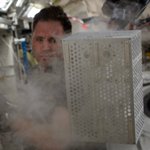
SpaceX 35 departs today. And, with it, much of the science we did over the past month. In this photo @astro_kutryk retrieves samples from cold stowage and you can see the condensation cloud the air.


Training video only! Here is an inside look at medical preparation on space station. In this simulation we practiced running through an ACLS algorithm for an incapacitated crew member, role assignment, CPR, medication access, and communication with the ground.
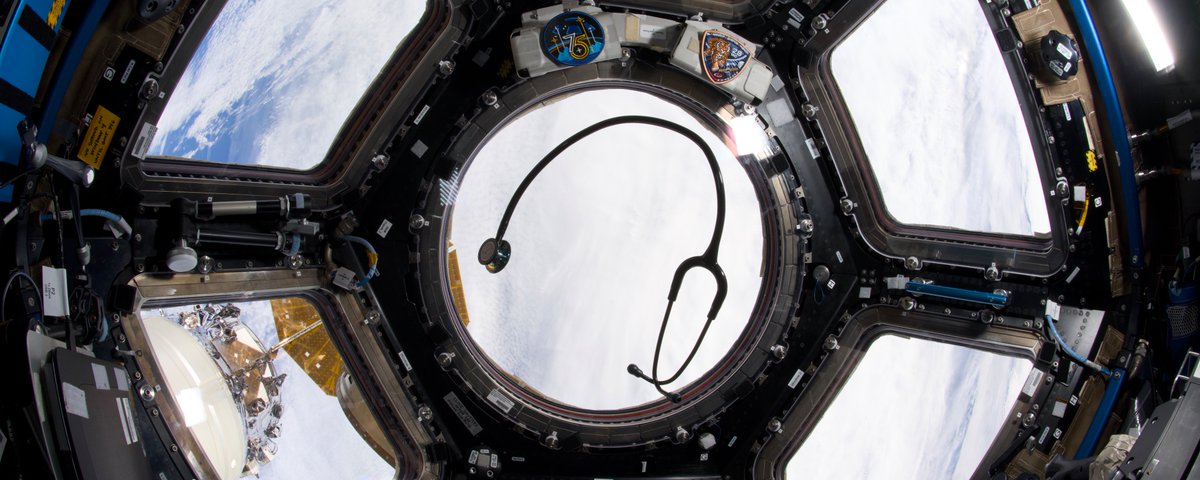
An outside look at the cupola. Do you ever wonder where all those amazing photos come from? Many of them are shot through one of the seven windows of the cupola. You can see the clouds reflecting and moving across the window as Luke Delaney looks out, contemplating life, the universe, and everything.
Fishing boats in the South Pacific light up the ocean with colorful lights to attract fish. They also attract astronauts looking down from @Space_Station.


MVP plant experiment grows susceptible and partially resistant thale cress plants to examine the development of powdery mildew which is a plant disease and helps us understand how the plants respond in space. Results could identify changes in genes based on unique conditions and support development of ways to prevent disease for plants used in life support systems for future missions as we travel to the moon and Mars. 
It's exciting and fun to go outside the space station for a spacewalk. Nonetheless, it's equally fun to make it back to the airlock and see your friends. In this case Jessica Watkins and Luke Delaney were there to film this after our 101st USOS spacewalk and I was pumped to see them!
Anil and @Astro_Kutryk are studying antibiotic resistant bacteria in space with the GEARS study. After sampling different areas of @Space_Station, the bacteria was placed on an antibiotic media and the resistant bacteria were grown for a few days, and then they will be identified by doing PCR in space. We can’t wait to find out what is growing in space!

The new solar arrays are looking good! Amazing photo!

Imaged with a telescope the @Space_Station this eveninig.
😮 Check out the new solar panels and dragon!
@NASA @SPACEdotcom @esa

We caught the flashing lights of Russians thrusters from the MLM module. Hydrazine and Nitrogen tetroxide. If you wait until the end of the video you will see what the module looks like during the day.
From all of us on the @Space_Station. We appreciate your service and we are honored to serve beside you.
Are your kids interested in science? Mine are and I credit a large part of that to @MarkRober. I had the distinct pleasure of talking to him from space and answering some really tough science questions from students.
Check it out and keep tuning in because @NASA has approved a space act agreement with class @crunchlabs to help provide space-related education for a free curriculum he is putting together for students.

How do you measure your weight when you are weightless? Watch and you will find out! A spring inside of this unit is calibrated so that a heavy object at the end oscillates at a different frequency than a lighter object. I ended up being 2 kg less than when I arrived. You often lose 10% body mass in the first two weeks and then slowly gain that back though it can vary a lot from person to person.
I highly recommend!

Do you want to be an astronaut?
Applications are now open to join NASA's astronaut corps. Join us as we expand the frontiers of discovery in low Earth orbit, on the Moon, and beyond — apply by Dec. 3: go.nasa.gov/4iGqLqu
