

Promoting global monetary & financial stability since 1930
Basel, Switzerland
Joined June 2010
- Tweets22.8K
- Following862
- Followers228K
- Likes2K





Pablo Hernández de Cos speaks about deposit insurance in a changing financial landscape at the Annual Conference of the International Association of Deposit Insurers (IADI), one of the global standard setters based at the BIS. Read more at bit.ly/48kBVfP

The payments landscape is changing quickly, with more players, more platforms, more complexity. A keystone #CPMI report emphasises central bank money remains the anchor of trust. Read more: bit.ly/4srwVPL

The BIS global liquidity indicators reveal that the euro’s share of foreign currency credit has increased in both bank loans and international debt securities.
Read more: bit.ly/48gLpZA

Cross-border bank credit grew by 11% year on year at end-June 2026, driven by both loans and banks’ holdings of debt securities.
Read more: bit.ly/48gLpZA

A new #IrvingFisherCommittee survey suggests that central banks are advancing AI adoption in their operations and decision-making, but challenges remain on the way.
Read more: bit.ly/3U4wH4B

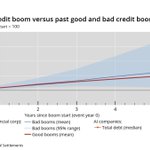
AI-related debt is growing rapidly, even compared with past credit booms. Its financial stability risks depend partly on whether the productivity gains needed to repay it materialise. Read more: bit.ly/4sqAqWA
#BISBulletin

Spillovers from AI financing news to US Treasury and investment-grade corporate bond markets have so far been small and short-lived. Read more: bit.ly/4sqAqWA
#BISBulletin

AI infrastructure is increasingly being built on credit. Long-term debt and off-balance-sheet vehicles are financing the build-out but may also concentrate risks among a small number of firms and investors.
Read more: bit.ly/4sqAqWA
#BISBulletin

Not every chokepoint needs the same fix. Build alternative capacity for persistent dependencies; use inventories, supplier redundancy and flexibility to absorb temporary shocks. Read more: bit.ly/4kh6UAE

Global supply chains can be efficient – and fragile. When critical inputs are concentrated and hard to replace, small disruptions can create major chokepoints.
Read the #BISBulletin to see why resilience starts with identifying the risk.
bit.ly/4kh6UAE

How do news shocks affect inflation? Evidence from large oil and gas discoveries from 1980 to 2019 shows that core prices rise before production begins, driven by non-tradable goods and mainly in economies with inflexible exchange rate regimes. bit.ly/4yBGzAU

Did bank liquidity regulation spur private credit? A new BIS Working Paper finds regions more exposed to Liquidity Coverage Ratio-constrained banks saw stronger private credit growth, with effects comparable to capital regulation #LCR #LiquidityRisk.
bit.ly/4BjTwC8

Now published: Proceedings from the 2026 BIS Annual Conference featuring a BIS paper with insights from Anna Breman, Fatih Karahan, Tiff Macklem and Ida Wolden Bache, as well as four working papers bit.ly/3WhEI6K
#CentralBanking

ALT Image of a banner for the 25th BIS Annual Conference. It features the text: "Central banks and macro-financial stability in a fragmented global economy." A statue and a building with windows are shown on the right.
New working paper: offshore non-deliverable forward markets move onshore FX rates in EMEs, even under capital controls. $1bn of offshore flow shifts the rate ~10bp within minutes; intermediation frictions widen the gap between offshore and onshore prices.
bit.ly/4zz4lOV

Bank for International Settlements retweeted

📺Save the date for the #G30's Annual #IBS2026 co-hosted with the @bankofthailand happening at the IMF-World Bank Meetings in Bangkok this Saturday at 1:30 PM ICT | 2:30 AM EDT.
Save the livestream link here: youtube.com/watch?v=rNi7LDjy…

The macro impact of chokepoint disruptions depends heavily on available substitutes and inventories. An effective policy response requires a tailored approach that considers these factors.
bit.ly/4hXVgb9
#BISBulletin

Rising geopolitical tensions, including trade restrictions and conflicts, are increasingly disrupting global supply chains. Disruptions at critical chokepoints can ripple through the global economy.
bit.ly/4hXVgb9
#BISBulletin

A new BIS Paper traces how money works: from a single payment, a hierarchy of promises are held together by par, elastic credit is disciplined by funding, and public backstops make trust at scale possible. It holds lessons for new forms of money. bit.ly/3TRDMp2

Are stablecoins and bank deposits substitutes? New research finds that higher US bank deposit rates are associated with slower stablecoin growth. Findings suggest that deposit pricing could influence stablecoin adoption and banks’ future funding conditions bit.ly/4ib9fLY

AI promises to transform the economy and accelerate growth. But large-scale automation can sap consumption and hence the profits that reward innovation. Can such a demand bottleneck constrain AI-led growth? New paper: bit.ly/3UlvAgQ
