

Co Founder of MenteX . Warning: only disruptive thinking. Commander and chief of Feminism, Tech and Education
Bogotá — San Francisco
Joined July 2009
- Tweets12.2K
- Following1.2K
- Followers1.8K
- Likes5.4K



Claudia Aparicio retweeted

A year ago we invented Ultrasound multi-Lens technology for Whole-organ microvascular imaging!🚀
nature.com/articles/s41467-0…
Just a year later, we used this technology to map the entire Circle of Willis!
nature.com/articles/s41592-0…
What a journey!💫
Claudia Aparicio retweeted

Thrilled to announce $5B in funding for @IsomorphicLabs to accelerate our mission to Solve All Disease. We continue to make rapid progress reimagining drug design from first principles with AI to radically cut the time & cost to find new medicines. Gradually, then all at once...
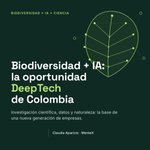
Camino a la semana milagro. Mañana participaremos en la mesa de emprendimiento. Mi meta es poner en el mapa de los inversionistas El DeepTech y las startups de base científica y tecnológica. Deséenme suerte.

35
Increíble la capacidad destructiva que se ha generado al rededor de @JensenHuang
1
58
Claudia Aparicio retweeted

🚨 اختتام أسطوري لمؤتمر Nvidia GTC Berlin 2026: جينسن هوانغ يستعرض Hermes Agent في عرض خيالي يصعق الجميع!
بكلمات قليلة وبـ "برومبت واحد فقط"، قام جينسن بتثبيت وإعداد نظام Hermes مخصص، ليختتم به مؤتمره بضربة مدوية توضح كيف يُبنى مستقبل الروبوتات الذكية:
📌 تفاصيل العرض التقني المجنون:
وكيل يبني وكيلاً: الطريقة الأفضل لبناء Agent هي أن تطلب من Agent آخر أن يبنيه لك!
محاكاة روبوتية خارقة: باستخدام جهاز Nvidia RTX Spark، قام Hermes بالتخطيط لعائق تدريبي لبطة Hugging Face Microduck، ثم استعان بـ Nemotron لتخطيط المسار وبـ GPT-6 Astra لتنفيذه عبر FreeCAD، Omniverse، Blender، وIsaac Lab!
الواقع والمحاكاة: تدريب آلاف البطات الافتراضية على المسار حتى النضج التام، لينتقل الذكاء بسلاسة للروبوت الحقيقي في العالم المادي.
📌 الثورة الحقيقية للمصدر المفتوح:
المصدر المفتوح ليس مجرد فكرة فلسفية، بل هو أداة عملية تمنحك القدرة على ربط السحابة، النماذج المحلية، والأجهزة لتصنع سير عمل خارق بنفسك، دون انتظار شركة كبرى لتسمح لك بذلك!
احفظ التغريدة وشاركها مع أصدقائك المطورين.. المستقبل يُصنع الآن! 🧵👇
Envidia!

China has selected its first group of young researchers to receive funding for up to 15 years, in one of the longest research grants on offer to scientists globally
go.nature.com/4z4Q3pw

1
86
Hay que vérsela obligatoriamente!!!

Un investigador de Anthropic acaba de decirle a una sala llena de doctorandos que su plan de carrera ya no existe.
La charla se titula "El fin del Antropoceno" y los datos son brutales:
→ El cómputo para entrenar modelos se multiplicó por 10 millones en la última década
→ La duración de las tareas que una IA completa sola se duplica cada pocos meses
→ Desde hace 7 meses los modelos resuelven problemas abiertos de Erdős que los matemáticos no habían logrado cerrar
→ En San Francisco, tener "timelines largos" significa pensar que la AGI llega en 10 años
Su proyección: el cómputo de 2030 será 10.000 veces mayor que el de 2025.
Todavía estamos al principio de la exponencial.
Sus 3 consejos para los estudiantes:
1. Usa la IA cada día. Si estás sobre la exponencial, nunca te quedas atrás de ella.
2. Elige proyectos que mejoren cuando el cómputo escala. El resto quedará resuelto antes de que los termines.
3. Deja de planificar tu carrera como si fuera estable. La opción segura ya no compra seguridad, ya no existe.
Y una frase que resume todo:
"Escribir es pensar. Si externalizas tu escritura, externalizas tu pensamiento."
La charla completa aquí ⬇️
60
Somos el país más biodiverso del mundo por km cuadrado. Esta discusión nos debe importar 100% 🇨🇴🇨🇴🇨🇴

Today, Isomorphic Labs joins the Virtual Biology Initiative (VBI) as a founding member.
We are helping build an open resource for the global research community to accelerate how we understand and treat disease.
Read more here: isomorphiclabs.com/articles/…

1
64
Vivimos días exponenciales!!!

We are entering a new era of discovery now:
openai.com/index/sharing-ai-…

1
58
Claudia Aparicio retweeted

Today we announced the Claude-led discovery of a molecular machine that we suspect could represent a new gene editing mechanism. Its precise function, biotechnological utility (if any), or level of significance is not yet clear, but at minimum it is work I would have been proud to do as a PhD student. The work was done mostly, though not entirely, by Claude: our life sciences team suggested a broad area of research, Claude read through the literature and a bunch of genome data and discovered something interesting, then Claude proposed experiments to verify the discovery and our team carried them out.
It’s easy to dismiss this as a one-off or curiosity, but we’ve repeatedly seen a pattern where AI performance in new intellectual domains goes from weak to superhuman in a matter of a few years. In 2023 models struggled to do math at the level of an average high-school student. In 2024 they started to do well on math competitions for the best high-schoolers in the country, in 2025 they started to solve minor open problems, in early 2026 more significant open problems, and in late 2026 they are beginning to solve the top few open problems in all of mathematics. We believe AI for biology is on a similar exponential trend.
The main difference between biology and mathematics, of course, is that math can be done purely theoretically, while biology requires experimentation. Some have used this to draw the conclusion that AI’s utility in biology will be limited. We think this is wrong. As we’ve demonstrated today, humans can collaborate with AI to perform the experiments, validate key results in a few weeks and, if necessary, work with the AI to iterate on what they find. Eventually it may even be possible for Claude itself to safely perform the experiments by autonomously controlling lab equipment, with appropriate safeguards in place, but we aren’t doing that today (our lab is also a BSL1/BSL2 facility that doesn't handle materials dangerous to humans).
More broadly, biomedical advancement has many stages — from fundamental biology discoveries, to translational research, to drug discovery, clinical trials, and finally the actual delivery of medicines and health care to patients. We are also interested in these later stages, but even simply accelerating the first stage of fundamental biological discoveries has the potential to speed up and broaden the entire pipeline. Improving our understanding of biology and sharpening biologists’ tools can drive forward all of the later stages, for example by identifying new drug targets, finding new therapeutic modalities, allowing for more precise measurement, and speeding up the experimental loop which itself further accelerates our understanding of biology. This will not in itself speed up clinical trial times, but if it succeeds it could greatly increase the number of promising candidates that go into the pipeline — an increase in throughput even though latency remains.
In Machines of Loving Grace, I wrote about AI’s potential to “cure most diseases in 5-10 years” — a goal that sounds impossible, but one I believe is just barely possible if AI is applied to every stage of the pipeline. The first step is showing that AI can first help with, and then drive, biological discoveries.
Claude’s discovery is the latest in a line of related prior work that goes back decades, beginning with systems like CRISPR, and continuing with discoveries like the bridge recombinase and VIPR in the past few years. Recently, there has been heightened interest in systems based on reverse transcriptase (RT) enzymes, the enzyme underlying the system Claude identified. And most recently, a Stanford team working independently described a novel RT system with an associated non-coding array that is in some ways similar to the one Claude found, though they are distinct systems that evolved independently from each other. I believe that we’re at the very beginning of finding such systems and developing them into powerful tools for biotechnology.
I’m proud of the resources Anthropic has invested in accelerating the public benefits of AI through the life sciences, and we’re aiming both to grow our life sciences team and to work with other scientists to extend this approach to a broad range of problems. If you have a proposal for a research collaboration or are interested in joining our life sciences team, please reach out.

Claude has discovered a previously unknown enzyme system hidden in the DNA of bacteriophages. Beside the enzyme’s gene sits a long array of repeating DNA—a structure that looks somewhat similar to CRISPR.
We don’t yet understand what this system does, but only a handful of known systems share its features, and all of them are able to cut, copy, and paste DNA. Historically, the discovery of such programmable systems has helped revolutionize medicine. CRISPR, for instance, is now the foundation of genetic medicines. But it will take much more work to learn what this system does, and whether it can be put to similar use.
Read more: anthropic.com/news/claude-di…

Claudia Aparicio retweeted

MIT publicó un informe brutalmente honesto sobre lo que la inteligencia artificial le está haciendo a los estudiantes.
Un comité de profesores y estudiantes pasó cinco meses estudiando cómo la IA cambió el aprendizaje en el campus, y las conclusiones parecen una advertencia para todas las universidades del planeta.
Los grupos de estudio están desapareciendo. Las horas de tutoría se vacían. Las listas de problemas y los exámenes para casa ya no demuestran nada, porque la IA puede producir soluciones creíbles para casi cualquier tarea escrita del plan de estudios de grado. Los estudiantes que se apoyan en los *chatbots* pierden dominio y confianza, y algunos caen en lo que el informe llama rendición cognitiva, recurriendo a la IA al menor indicio de dificultad.
Las cifras son duras. El 46 por ciento de los estudiantes de grado encuestados del MIT usan modelos de lenguaje grande (LLM) a diario. El 90 por ciento se preocupa por su propia dependencia excesiva. Los estudiantes de grado que sienten que la IA los hace reemplazables superan ahora a los que sienten que los hace capaces.
La respuesta del comité me sorprendió. Se negaron a combatir la IA con vigilancia. El informe califica a los detectores de IA de poco fiables, afirma que los navegadores de bloqueo parecen espionaje y advierte que vigilar a los estudiantes crea un ambiente en el aula de desconfianza mutua.
En su lugar, el MIT quiere reconstruir la educación en torno a las cosas que la IA no puede reemplazar. Eso significa exámenes orales, portafolios semestrales, trabajo de proyectos en persona y un componente social obligatorio en cada materia. El informe incluso plantea la idea de replantearse las calificaciones por completo, ya que sin un promedio académico (GPA) que optimizar, gran parte del incentivo para hacer trampa con la IA se desvanece.
El comité advierte a los profesores que no deben reemplazar a los asistentes de investigación universitarios con agentes de IA solo porque son más baratas, porque una universidad existe para hacer crecer a las personas, no a la producción.
La escuela de tecnología más famosa de la tierra admitió que las máquinas rompieron su forma de enseñar. Su respuesta es más humanos, no más software.
aiandeducation.mit.edu/repor…
Tenemos más tecnología de la que somos capaces de gestionar. No nos cae mal un poco de calma para pensar y aprender para construir un futuro más próspero, seguro y feliz para todos.

We Must Pace the Frontier: I’ve written a new essay on why the AI industry should slow down, with a three-part plan for doing so.
Anthropic is unilaterally committing to the first of these steps. We’ll provide third-party evaluators with permanent, employee-level access to our systems, so that they can verify adherence to our safety measures, report on incidents, and assess models’ alignment during training.
You can read the full post here: darioamodei.com/post/we-must…

1
57
Claudia Aparicio retweeted
We Must Pace the Frontier: I’ve written a new essay on why the AI industry should slow down, with a three-part plan for doing so.
Anthropic is unilaterally committing to the first of these steps. We’ll provide third-party evaluators with permanent, employee-level access to our systems, so that they can verify adherence to our safety measures, report on incidents, and assess models’ alignment during training.
You can read the full post here: darioamodei.com/post/we-must…
Claudia Aparicio retweeted

Cuando juega Colombia, las diferencias pasan a segundo plano.
El 21 de junio tendremos otra oportunidad de demostrar quiénes somos como país 🗳️.
No porque pensemos igual. Sino porque respetamos las reglas, los resultados y la democracia.
Porque una democracia fuerte se construye con participación, respeto y confianza.



Doctor @jrestrp estamos en sus manos 🙏. Mucha suerte y sabiduría para todo lo que sigue.
26