

CTO @silexdata focused on AIOps & compute | AI maximalist | Former @Bloomberg and still recovering from health IT/enterprise SWE | Occasional sax player
Nashville, TN
Joined October 2009
- Tweets821
- Following561
- Followers377
- Likes8.1K





Ugh, sorry for the rant, but if anyone suggests that Linux on the desktop is "ready" -- it is not. Tried to spin up Ubuntu 26.04.1 and 26.10 on my Lenovo Thinkpad X1 Carbon Gen 13 and see how the "new" (in the works for how many years now?) TPM hardware support works. It is horribly broken: 1) The iwlwifi driver missing completey on the TPM kernel, so no wifi after install 2) there is some issue with Ubuntu's hardware root-of-trust evaluation and how it probes the Intel ME, which means you still have to use a PIN or passphrase to unlock the disk and 3) when you use the PIN, the Absolute Persistence Module has to be turned off, otherwise the PIN doesn't work and you have to manually enter the recovery code every time.
github.com/canonical/secboot…
github.com/canonical/secboot…
discourse.ubuntu.com/t/the-p…
Yes, I can live without the TPM kernel and hardware-backed encryption, but I shouldn't have to. These are features that have shipped and available in the installer that are just plain broken for a subset of commonly available, modern hardware. The blame is likely the intersection of Lenovo, Ubuntu, and Intel, but this stuff just works on Windows and I can get a working Linux environment with WSL2.
I've been running Linux (along with FreeBSD, NetBSD, OpenBSD, Solaris, etc.) in some form on the desktop since around 2000, but there are still a lot of sharp edges. I moved past hacking XFree86 configs and recompiling kernels years ago -- it is just easier to use a Mac or run Windows.
Again, sorry for the rant.

Was never really a Tailscale fan after trying it briefly. It is super convenient and easy to get going, but almost too easy. Lots of reinventing the wheel including its own SSH daemon that turns out to be roughly equivalent to distributed trust with ssh keys between nodes. Cloudflare's Zero Trust does a lot less of this and just focuses on being a good mesh with some added (but needed) complexity.
I've had a PHP 8.4.26 honeypot up and running since Monday morning, and there still are no signs of RCEs. Just OOMs and worker crashes, but no RCEs, yet.
Might become a Claude Code Desktop convert. Going to be hard to break away from the CLI completely, though.
Derek Lewis retweeted

Can confirm
My OpenAI and Anthropic balances got drained, Google account got limited and drained a bit and OpenCode did email me


Gemini 4 is better than I thought it would be. We have some internal AIOps evals and Gemini 4 is the first Google model to pass one of the more difficult scenarios. Gemini 3.7 and 3.8 failed for various reasons and 3.8 specifically exhibited some misaligned behaviors.
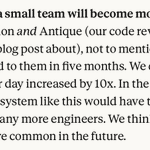
This is definitely the future. Small teams delivering huge change. Anthropic wrote a whole new SCM and migrated its very large Git monorepo to it over the course of 5 months for the entire organization.

There's no way Muse Wonder is Opus 5.5 or Astra level. Looks like Meta benchmaxed another model.

Watch @petergostev put Muse Wonder (Max) by @AIatMeta to the test across one-shot 3D scenes, animated HTML, and front-end designs.
He compares it with Astra, Opus 5.5, GPT-6.1 Sol, Claude Sonnet 5.5, Fable, Kimi, and Mistral, and includes the cost of every generation.
Arena scores for Muse Wonder are coming very soon. Stay tuned, and in the meantime see first impressions from @petergostev.
youtube.com/watch?v=w0fFiXLK…

Big IF true -- >Fable 5.1 & Opus 5.5 performance. Meta has a history of benchmaxing, though.

The Muse Wonder series achieves state-of-the-art results across key benchmarks for personal and professional agents, memory, and coding.
Muse Wonder and Muse Wonder Full apply specialized knowledge to problems people encounter at work and in daily life, from understanding a lease to making sense of financial or health information. Our evaluations include tasks in law, finance, and health that test this ability.

Derek Lewis retweeted

Kind of nuts, H100 price went up from $1.8/h to $2.8/h despite Blackwells, Vera Rubins etc. which are far many times more efficient. Compute shortage is not easing at all.

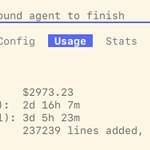
My annualized Claude Code API-equivalent usage is $190K-$220K. The typical enterprise is going to have a hard time stomaching these costs for the average engineer.

I think the average enterprise is going to have a tough time stomaching these costs for individual engineers, so as more organizations try to lean into agentic coding, the pushback will be to only use agentic coding for specialized, well-scoped tasks and accept the use of cheaper models vs frontier like Opus 5.5. Another strategy would be to invest in compute and offload tokens to open models like GLM-5.3 that are more Opus 4.8/5-level. Not hard to justify some B200/B300 nodes against enterprise API pricing.
Had an O'Reilly learning subscription for close to 20 years (back when it was called Safari) and decided to cancel recently. Part of me thinks it is unfortunate, but there's the more pragmatic side that recognizes most of the new content I would read on it is likely AI-generated and that it would be more efficient just to converse with Claude or Codex anything I want to learn about. For select books where I respect the author, I'll continue to buy an ebook or a printed copy.
Wild perf numbers from VR

vLLM now supports NVIDIA Vera Rubin. The early results show more than 7.8x the throughput of GB200 on MiniMax M3 on AgentX.
@inferact, @NVIDIAAI, @RedHat_AI, and the vLLM community have been bringing vLLM up on Rubin since it was announced. Here is where things stand.
🧵 1/5