

Making #Djibouti the #investment, trade, and transport hub of #Africa
Djibouti
Joined February 2013
- Tweets3.5K
- Following942
- Followers19.8K
- Likes625




Pinned Tweet
The welcoming ceremony of the Training of Berbera Port staff in 2014 by Djibouti Ports.
@omar_hadi
This morning Doraleh Container Terminal (SGTD) accommodated the M/V Benjamin Franklin of CMA CGM, with 399.9 meters LOA, and 17-meters draft with a carrying capacity of 18,000 TEUs, and we still have 4 meters under the keel.
The call size is 4,800 moves, equivalent to 8,000+ TEUs. 4 tugboats were deployed with a senior Djibouti pilot to berth the vessel starboardside along side.
@omar_hadi

Djibouti Ports and Free Zones Authority was pleased to take part in the first edition of the Djibouti Beach Festival, held at Heron Beach, a coastal area falling under the jurisdiction of DPFZA.
As part of Djibouti’s maritime domain, our coastal spaces represent valuable assets for the development of the Blue Economy, promoting sustainable use of marine resources, coastal tourism, and new economic opportunities.
We are delighted to welcome this first event within our maritime space and to support initiatives that celebrate the richness and potential of Djibouti’s coastline.
We look forward to seeing future editions extend to other remarkable coastal destinations, including Tadjourah, Ghoubet, Ras Siyan and Arta, further showing the diversity and economic potential of Djibouti’s maritime heritage.
@omar_hadi


DJIBOUTI BEACH FESTIVAL 2026 : LE MINISTRE DU COMMERCE DONNE LE COUP D’E... youtu.be/gO2AdwXB-FU?si=Visp… via @YouTube
@omar_hadi
Today, Chairman welcomed H.E. Abdulkadir Mohamed Nur, Speaker of the House of the People of the Federal Parliament of Somalia, accompanied by H.E. Dileita Mohamed Dileita, President of the Djibouti National Assembly at our Port facilities.
The high-level delegation began their visit with a tour of the Doraleh Container Terminal (SGTD), followed by a visit to the Djibouti International Free Trade Zone (DIFTZ).
Discussions focused on further strengthening port cooperation between Djibouti and Somalia, building on the operational collaboration and knowledge-sharing initiatives already established between DPFZA and Somalia ports.
This cooperation has contributed to technical support, expertise-sharing and operational training for the development of Somali ports:
- Mogadishu Port: Technical assistance with the donation of two tugboats M/T Bab el Mandeb and M/T Moussa Bouh, container-handling equipments with spare parts, the deployment of a technical support team from Djibouti for a period of two years, and training of port duty officers.
- Bossaso Port: Bathymetric survey of the access channel of the port basin; upgrading navigation aids; donation of one tugboat M/T Hassan Gouled Aptidon and Rasyan pushcat; Port tariffs and regulation study.
- Bossasso Airport: Advisory support for Bossasso airport concept design for the runway direction
- Garacad Port: Advisory support for ports operations and ports management.
- Berbera Port: Engineering and operational training for 11 senior staff during 6 months in Djibouti.
- Hobyo Port: Developing the port of Hobyo, site location, metocean studies, conceptual port design; a preliminary road concept design including cost evaluation (CAPEX) for the corridor linking Hobyo-Cadaado-Caabudwaaq to connect Somali region of Ethiopia to the Indian Ocean.
Djibouti Ports and Free Zones and Somalia ports will continue their cooperation through continued experience-sharing, technical exchanges and the strengthening of maritime connectivity between Somalia and Djibouti ports.
We have currently 11 Somali business companies operating in Djibouti's Free Zones, reflecting the growing economic and commercial ties between the two Nations.
@omar_hadi
@ANDjibouti
@Amohamednur
@Golaha_shac_JFS


Chairman received a delegation from PetroChina International (Middle East) Company Limited, led by its Deputy General Manager Hu Weiqiang, at Red Sea World Centre.
Established in 2002, PetroChina International (Middle East) is a wholly owned subsidiary of PetroChina Company Limited, with its parent company being China National Petroleum Corporation.
PetroChina International operates in the Middle East, the Red Sea littoral and East Africa, with a global presence spanning more than 20 countries and major business hubs including Singapore, Hong Kong, Beijing, Dubai, Houston and London.
PetroChina operates across the international energy value chain, including the trading of more than 140 grades of crude oil, natural gas sales, LNG, refined petroleum products, bunkering, renewable energy and biofuel processing and trading. The company reports an annual trading volume of approximately 500 million tonnes of oil with an annual sales revenue of USD 140 billion.
Discussions focused on the development of a 300,000 m³ petroleum storage depot on a 20-hectare site at the Damerjog Industrial Park, and the establishment of an oil refinery.
The delegation was also interested in the regional oil transportation corridor connecting South Sudan to Djibouti through Ethiopia. The initiative aims to provide South Sudan with an additional export route for its two types of crude oil: Dar Blend crude oil,a major export grade of sweet, waxy crude produced in Melut Basin and Nile Blend, a sweet, light-to-medium paraffinic crude oil.
Djibouti's maritime infrastructure and Damerjog's Liquid Bulk Port will be used to access international markets. The project would strengthen regional energy connectivity, diversify export routes and position Djibouti as a key energy transit and trading hub in the Horn of Africa.
@omar_hadi
@official_cnpc
@RSBunkering
@DjiboutiSihd
@djib_mern


The Ethiopian Birr is 1.09 Djf as by today.
This information is addressed to the traders and service providers on the corridor and the ports communities.
@omar_hadi
Red Sea Bunkering is refueling World Trade safety through free navigation at sea.
@omar_hadi
@RSBunkering

This morning, Chairman received H.E. Mrs. Denisa-Elena Ionete, Ambassador of the European Union to Djibouti and IGAD, at the Red Sea World Centre.
Was discussed the strengthening of the existing cooperation between DPFZA and the European Union Economic institutions. New opportunities for mutually beneficial partnerships in infrastructure development, regional connectivity and renewable energy were also identified.
Chairman and H.E Mrs. Denisa-Elena Ionete discussed the importance of safety in maritime security. Chairman renewed support to the European Union’s ASPIDES and ATALANTA operations for strengthening maritime security in the Red Sea and the Bab el-Mandeb Strait, particularly in a context marked by growing regional and international maritime challenges.
The discussions also explored new areas of cooperation, including the use of Damerjog Liquid Bulk Port and the Port of Tadjourah as alternative facilities for naval vessels requiring additional berthing space, alongside the continued provision of bunkering and fresh water supply services. Waste management reception facility for the ships to protect the marine environment in the Red Sea and the Gulf of Tadjourah (protected area by the IMO convention) to be developed.
Further discussions addressed the development of the DESSU corridor, with a view to strengthening regional connectivity, facilitating cross-border trade and improving the movement of goods between Djibouti and neighbouring countries, including Ethiopia, South Sudan, Uganda and to connect the Red Sea to the Great Lake countries for Business and Humanitarian goods.
H. E the Ambassador congratulated DPFZA on the investment in the Djibouti Ship Repair Yard and highlighted that European merchant and naval vessels could be maintained and repaired in Djibouti , offering additional technical support to ships operating in the Red Sea and the Gulf of Aden.
Both sides agreed to develop cooperation in renewable energy, particularly in wind and solar power, as well as marine energy solutions, including tidal energy. Such cooperation could contribute to Djibouti’s energy transition and support the development of more sustainable port and industrial infrastructure.
@omar_hadi
@DenisaIoneteEU
@UEaDjibouti
@MAECIDJIBOUTI
@IsmailOguelleh


Chairman received at Red Sea World Centre Mr. Ahmed ALFALAHI, Managing Director Supply, Trading and Processing of ENOC, Mr. Fahad ASKAR CEO HTL and Omar Kassou General Manager of HDTL Doraleh.
The team of Enoc has visited the Damerjog Oil Jetty and expressed their impressions, describing the oil jetty as a state of the art infrastructure, compared to the Oil jetties HTL is using around the world.
They expressed interest in developing oil storage tanks in Damerjog.
Meanwhile, they have requested the expansion of their oil storage in Doraleh and also for Djibouti Ports and Free Zones Authority to invest in the expansion of the Oil jetty in Doraleh.
The Capex of the railway connection to Horizon Oil Terminal in Doraleh, the connection of the railway to the oil depot in Awash and other storage oil facilities in Ethiopia was discussed.
@omar_hadi
@enoc_official


Chairman received at Red Sea World Centre Mr. Karim Matallah, conseiller (Gestion) et consul of the Canadian Embassy of Djibouti.
Discussions focused on the shipment of Canadian diplomatic cargo which is by air now. The Canadian embassy expressed interest in using ocean freight through Djibouti ports.
Chairman recommended the use of the Djibouti Ports Community System (DPCS) to enhance cargo tracking and ensure better visibility throughout the supply chain, from arrival in Djibouti to final delivery. Also, Djibouti Ports and Free Zones Authority has an office in Addis Abeba for all customers.
The discussions also explored opportunities to increase the presence of Canadian companies within Djibouti’s free zones. The Djibouti International Free Trade Zone currently hosts 12 Canadian companies, which benefit from Djibouti’s strategic location and access to African and international markets through the Cost, Insurance and Freight (CIF) Djibouti model. Under this approach, goods are shipped to Djibouti, where they can be received, stored and redistributed to regional markets, positioning the country as a regional logistics and trade hub.
@omar_hadi
@hasna_barkat
@CanadaDjibouti


Today, Chairman Aboubaker Omar Hadi attended at Red Sea World Centre, the signing ceremony of a Memorandum of Understanding (MoU) between the Djibouti Regional Training Centre (DRTC) and the Port Management Association of Eastern and Southern Africa (PMAESA), under the high patronage of H.E. Said Nouh, Minister of Infrastructure and Equipment; Ms. Mina Houssein, Executive Director of the DRTC; and Col. André Ciseau, Secretary General of PMAESA.
The Djibouti Regional Training Center (DRTC) is an essential institution dedicated to enhancing maritime safety in the region. Established to support the Djibouti Code of Conduct, the DRTC aims to provide training and capacity-building programs for maritime professionals from signatory states and beyond.
The Port Management Association of Eastern and Southern Africa (PMAESA) promotes cooperation among ports, improves operational efficiency, facilitates trade and strengthens maritime connectivity across Eastern and Southern Africa. The member states are Angola, Burundi, Djibouti, Ethiopia, Eritrea, Kenya, Madagascar, Malawi, Mauritius, Mozambique Namibia, Rwanda, Seychelles, South Africa, Sudan, Tanzania, Zambia, South Sudan and Zimbabwe.
The signing of the MoU falls within PMAESA’s Strategic Plan 2024–2028, which positions the Association as a platform for regional integration and enhanced global competitiveness among ports in its member countries.
The agreement establishes a framework for cooperation between the DRTC and PMAESA in developing and delivering training programs for the benefit of member ports. Areas of cooperation include capacity building, regional training programmes, technical expertise, knowledge sharing, port safety and maritime security, crisis management, environmental protection, research and innovation, with the aim of improving port efficiency, sustainability and resilience.
In his remarks, Col. André Ciseau described the agreement as the beginning of a long-term partnership, reflecting a shared commitment to developing human capacities and building stronger, more competitive institutions.
Eng. Mina Houssein reaffirmed the DRTC’s full readiness and commitment to working closely with PMAESA to translate the partnership’s objectives into concrete actions that benefit the States of the region.
Chairman Aboubaker Omar Hadi reminded that maritime trade accounts for 80% of global trade, and stressed the importance of investing in people, developing professional skills and strengthening human capital across the maritime and port sectors. He also highlighted that out of 17 landlocked in the continent, 10 landlocked countries, 800 million consumers, are using PMAESA ports to trade with the rest of the world.
H.E. Said Nouh reaffirmed the Government of Djibouti’s commitment to the development and long-term sustainability of the DRTC, as well as to ensuring that its expertise and infrastructure are fully utilized for the benefit of maritime and port professionals across the region.
H.E expressed the hope that the partnership would quickly translate into joint training programmes, exchanges of expertise and practical initiatives addressing the needs of States and member port authorities.
@omar_hadi
@PMAESAHQ
@CRFM2023


This afternoon, Chairman received Mr. Sotoris Yannopoulos, Chief Executive Officer of BMMI Group, at the Red Sea World Centre.
BMMI Group is an international provider of end-to-end supply chain solutions, integrated facilities management, shipping, logistics and procurement services, serving a diverse range of clients, including governments and international organizations.
During the meeting, BMMI expressed continued interest in utilizing Djibouti’s port and logistics infrastructure, commending the quality of services offered and the capabilities of the Djibouti Ports Community System (DPCS). The Group praised the system’s business intelligence tools for improving transparency and access to information, describing them as a game changer for operational efficiency.
BMMI also emphasized the importance for DPFZA to expand the current 240-hectare first phase of the Djibouti International Free Trade Zone (DIFTZ) to accommodate more businesses and attract additional companies, further strengthening Djibouti’s position as a regional trade and logistics hub.
Chairman encouraged BMMI to adopt the CIF Djibouti model, pre-positioning goods in Djibouti the markets across the region.
@omar_hadi


This morning, Chairman received Mr. Fadul Mohammed Khair Sultan, CEO of Sultan Group, at the Red Sea World Centre.
Discussions focused on the development of business partnerships in four key areas:
1- The discussions explored opportunities for developing petroleum products storage facilities at Damerjog, connected to Damerjog Liquid Bulk Port, which offers modern infrastructure designed to accommodate large-scale liquid bulk operations. The oil jetty has an annual dynamic handling capacity(throughput) of 25 million tonnes,and can serve multiple storage terminals with a total static storage capacity of approximately 2 million cubic metres. This infrastructure offers significant capacity and operational flexibility for regional petroleum markets.
2- It was discussed to develop in Damerjog a trading platform hub of petroleum products for the Red Sea and East African market. The trading business will start with a floating storage owned by Red Sea Bunkering.
3- The discussions further addressed opportunities to create international airlines with headquarters in Djibouti. Thus expanding air connectivity, and strengthen the country’s position as a gateway connecting regional and international markets.
4- The development of a Free Zone land was also discussed.
Mr. Fadul Mohammed Khair Sultan said that He was very impressed by Damerjog Liquid Bulk Port, which he described as a state of the art infrastructure.
@omar_hadi
🤖 Made with AI

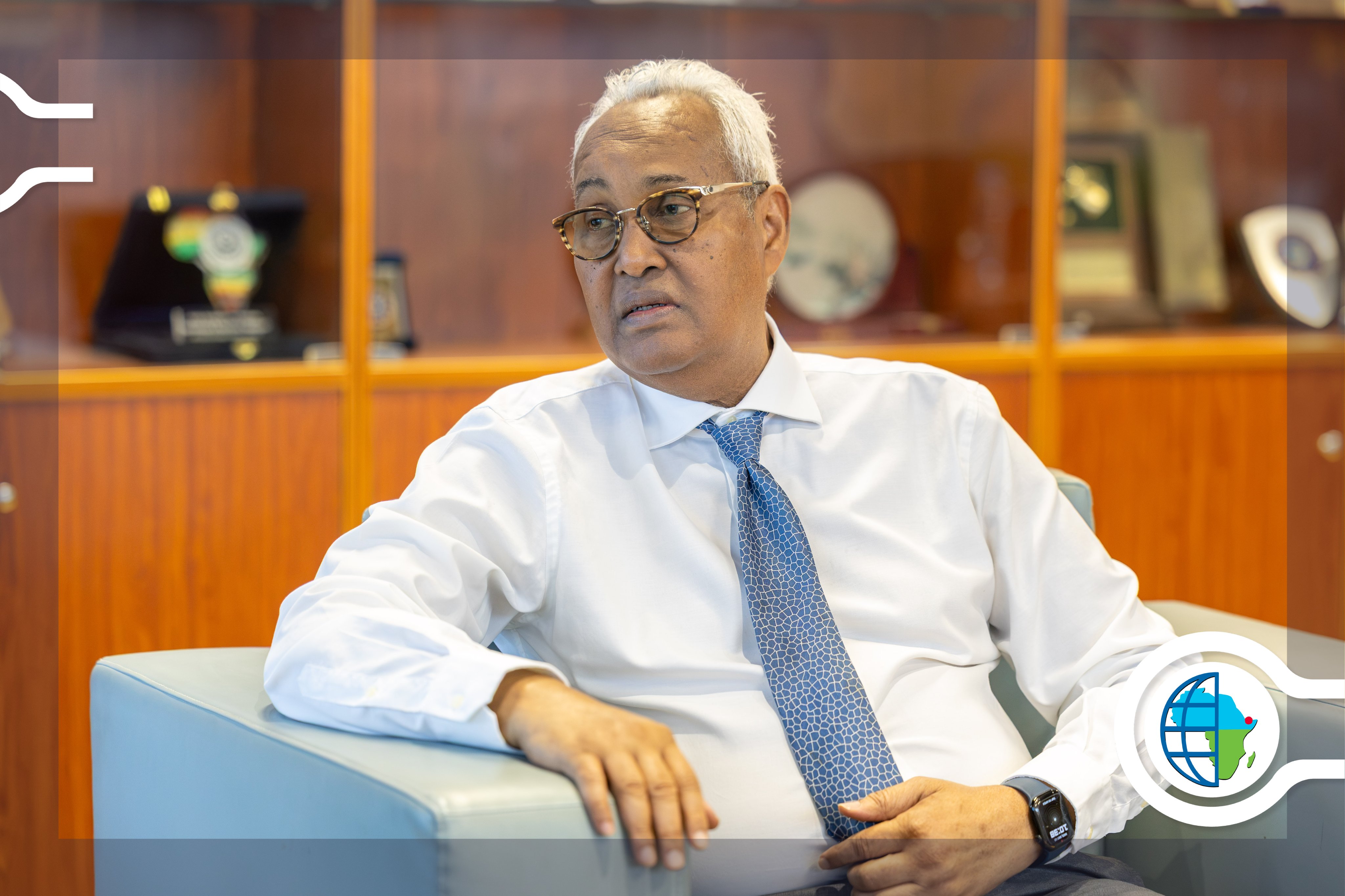


The Red Sea Bunkering floating storage M/T Red Sea II has a storage capacity of 75 000 tons of fuel. This represents 20% of the fix fuel storage existing today in Djibouti at Doraleh.
@omar_hadi
2
500
Today, Chairman received H.E. Abdelrahman Raafat, Ambassador of the Arab Republic of Egypt, leading a delegation from Arab Contractors headed by its CEO, Eng. Ahmed El-Assar, at Red Sea World Centre.
The meeting was on the advancement of major infrastructure projects, building on the cooperation initiated during the visit in December 2025 of H.E. Lieutenant General Engineer Kamel El-Wazir, Deputy Prime Minister for Industrial Development and Minister of Industry and Transport of the Arab Republic of Egypt.
The discussions centred on two key projects:
- The development of a new container terminal with a capacity of 5 million TEUs and a 1,450-metre quay with a design depth of -18 metres at the lowest tide, following the signing of a Memorandum of Understanding signed between Great Horn Investment Holding (GHIH) and Egypt’s state-owned Holding Company for Maritime and Land Transport (HCMLT) .
-The construction of the 90-kilometre RN18 corridor, PK13-Holl Holl- Dasbiyo-Ali Sabieh and Gualilleh including the 7-kilometre connection to Biciidley Airport.
The meeting provided an opportunity to continue engagement with Egyptian partners and explore the role of Arab Contractors, a leading construction and engineering company.
Founded in 1955, Arab Contractors has extensive experience in transport infrastructure, roads, marine works, water and wastewater management, and petroleum-related projects.
Its portfolio includes the construction of a 90-metre bridge connecting the Wuye and Wuse districts in Abuja, Nigeria and more recently the Julius Nyerere Hydropower Plant and Dam 2.1 GW, on River Rufiji in the Morogoro and Coast regions of Eastern Tanzania.
@omar_hadi
@arabcont


Djibouti : Le trafic portuaire tient bon, malgré les turbulences lanation.dj/djibouti-le-traf… via @JournalLa33018
@omar_hadi
Chairman today received H.E. Matrek Abdullah Al Dosari, Ambassador Extraordinary and Plenipotentiary of the Kingdom of Saudi Arabia, at Red Sea World Centre.
Discussions focused on strengthening bilateral economic relations, maritime connectivity, and expanding cooperation in the port sector.
Chairman encouraged the Saudi business community to expand trade with Djibouti, increase their imports-exports, and develop their land within Djibouti International Free Trade Zone, which provides direct access to East Africa and the wider Comesa market of 600 million people.
Chairman mentioned the strategic proximity between the two nations, noting that Djibouti–Jazan is a 24-hour sailing at 14 to 15 knots, while Djibouti–Jeddah is approximately 48 hours at 14 to 15 knots. He also proposed increasing air connectivity with the Kingdom of Saudi Arabia from one to two per week to enhance connectivity for the business community.
The meeting also provided an opportunity to discuss the preparations for the 8th Session of the Djibouti–Saudi Arabia Joint Commission, scheduled to take place in Riyadh, the Kingdom’s capital, in December 2026.
@MAECIDJIBOUTI
@KSAMOFA
@SaudiTransport
@KSAembassydj
@dya_bamakhrama
@omar_hadi


Today, Chairman participated as a panelist in the session “Doing Business and Investing in Djibouti”, held as part of the Economic Mission of the Francophonie in Djibouti, alongside H.E. Mrs. Mariam Hamadou, Minister Delegate in charge of Investment and Private Sector Development; Mr. Youssouf Moussa Dawaleh, President of the Djibouti Chamber of Commerce (CCD); and Me. Hasna Barkat Daoud, Attorney at the Djibouti Bar and Honorary Consul of Canada.
The session addressed Djibouti’s business and investment environment and the advantages offered by its strategic location, port infrastructure and free zones.
Chairman explained that the attractiveness of Djibouti’s free zones lies in the combination of integrated port and logistics infrastructure, Sea–Air Cargo connectivity, the Djiboutian Franc’s peg to the US Dollar, and a business environment designed to facilitate international trade and investment.
The exchanges also focused on the Sea–Air Cargo initiative, a logistics solution combining maritime and air transport to significantly reduce transit times. The service connects Djibouti to 25 African countries and 28 cities, providing an efficient logistics solution for time-sensitive cargo.
Chairman also presented the CIF Djibouti model, which enables companies to establish trading and distribution operations in Djibouti and serve regional markets directly from the country. As a gateway to COMESA, representing more than 600 million consumers, Djibouti offers investors direct access to a large regional market.
This market reach is further expanded by the African Continental Free Trade Area (AfCFTA/ZLECAf), which currently represents 1.3 billion consumers and is projected to reach 2.5 billion by 2050. Physical barriers should be reduced by linking the continent, countries by roads railways and waterways. Even if we achieve that we still have the non-physical barriers which are different customs, regulations in the 54 african countries. We hope that ZLECAf will help finding solutions to those barriers.
With our ports, free zones and logistics capabilities, international companies have a platform to establish, trade and distribute from Djibouti while reaching major African and international markets.
The audience asked a series of questions, particularly about the recent report stating that Djibouti offers the highest salaries in the continent, with an average monthly salary of USD 2,836. They also asked whether these high salaries were offered in the public or private sector.
Chairman said: "I do not think that these salaries are offered in the public sector. In the private sector, the salaries are through negotiations based on competencies and experience.
It is in order to retain Djiboutian talent and competencies in our country. I do not understand why we should pay a Djiboutian less than an expatriate with the same competencies.”
@omar_hadi
@OIFrancophonie
@IsmailOguelleh


Aujourd’hui, le Président de l'Autorité des Ports et des Zones Franches a participé en tant que panéliste à la session « Faire des affaires et investir à Djibouti », organisée dans le cadre de la Mission économique de la Francophonie à Djibouti, aux côtés de Son Excellence Mme Mariam Hamadou, Ministre déléguée chargée de l’Investissement et du Développement du Secteur privé ; de M. Youssouf Moussa Dawaleh, Président de la Chambre de Commerce de Djibouti (CCD) ; et de Maître Hasna Barkat Daoud, Avocate au Barreau de Djibouti et Consule honoraire du Canada.
La session a porté sur l’environnement des affaires et de l’investissement à Djibouti, ainsi que sur les avantages offerts par sa position géographique, ses infrastructures portuaires et ses zones franches. Djibouti est un pays enclavé de part la langue. C'est le seul pays francophone de l'Afrique de l'Est.
Le Président a expliqué que l’attractivité des zones franches de Djibouti repose sur la combinaison d’infrastructures portuaires et logistiques intégrées, de la connectivité Sea–Air Cargo, de l’ancrage du franc djiboutien au dollar américain et d’un environnement des affaires conçu pour faciliter le commerce et les investissements internationaux.
Les échanges ont également porté sur l’initiative Sea–Air Cargo, une solution logistique combinant le transport maritime et aérien afin de réduire considérablement les délais de transit. Ce service relie Djibouti à 25 pays africains et 28 villes, offrant une solution logistique efficace pour les marchandises sensibles aux délais.
Le Président de l'APZFD a également présenté le modèle CIF Djibouti, qui permet aux entreprises d’établir à Djibouti leurs activités commerciales et de distribution et de desservir directement les marchés régionaux depuis le pays. En tant que porte d’entrée vers le COMESA, qui représente plus de 600 millions de consommateurs, Djibouti offre aux investisseurs un accès direct à un vaste marché régional.
Cet accès au marché est davantage élargi grâce à la Zone de libre-échange continentale africaine (ZLECAf), qui représente actuellement 1,3 milliard de consommateurs et devrait atteindre 2,5 milliards à l’horizon 2050.
Les barrières physiques doivent être réduites en reliant le continent, pays par pays, à travers les routes, les chemins de fer et les voies navigables. Même si nous parvenons à réaliser cette interconnexion, il subsistera des barrières non physiques, notamment les différences entre les systèmes douaniers et les réglementations des 54 pays africains. Nous espérons que la ZLECAf contribuera à trouver des solutions à ces obstacles.
Grâce à ses ports, ses zones franches et ses capacités logistiques, Djibouti offre aux entreprises internationales une plateforme leur permettant de s’implanter, de commercer et de distribuer depuis Djibouti, tout en accédant aux principaux marchés africains et internationaux.
Le public a posé une série de questions, notamment sur le récent rapport indiquant que Djibouti offre les salaires les plus élevés du continent, avec un salaire mensuel moyen de 2 836 USD. Les participants ont également demandé si ces niveaux de rémunération concernaient le secteur public ou le secteur privé.
Le Chairman a répondu : « Je ne pense pas que ces salaires soient pratiqués dans le secteur public. Dans le secteur privé, les salaires font l’objet de négociations fondées sur les compétences et l’expérience. C’est notamment pour retenir les talents et les compétences djiboutiens dans notre pays. Je ne comprends pas pourquoi nous devrions rémunérer un Djiboutien moins qu’un expatrié ayant les mêmes compétences. »
@omar_hadi
@OIFrancophonie
@IsmailOguelleh


3
591
This morning the M/T Solo7 has been docked on the Djibouti Ship Repair Yard.
Another one !
@omar_hadi
@IsmailOguelleh
@OIFrancophonie


