

DatologyAI builds tools to automatically select and optimize the best data on which to train AI models, leading to better, smaller models which train faster.
Redwood City, CA
Joined September 2023
- Tweets340
- Following30
- Followers4.3K
- Likes243






Pinned Tweet
Today, we’re excited to launch the Datology Curation Studio, customizable frontier data curation for every team training its own models.
Data quality is the ultimate compute multiplier, and Curation Studio makes it easy for everyone.
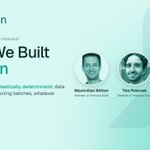
Every team that trains models has a data loader, and most keep rebuilding it. @MaxiBoether on why we open-sourced Zephon.
We sat down with the team that built Zephon, our open-source data loader, to talk about why we built it and what’s next.
With @maxiboether, @josh_wills, and Ties Robroek. A few highlights below.

Teams keep reinventing data loaders, burning time and resources instead of training models and doing research. We open-sourced ours so that you can focus on the models, not the plumbing.
Full conversation: youtu.be/eAScv9mneFw
Code, docs, and paper: zephon.io
2
119
Yesterday at Backprop, @leavittron made the case that data quality is the compute multiplier: up to 150× less training compute, and a legal model experts preferred over GPT-5.6 Sol. Thanks @tokensandai!
See Matthew's latest research on backtest-safe data: datologyai.com/blog/beyondwe…

Data quality is AI's most underinvested lever.
Tomorrow at Backprop Summit in SF, our co-founder Matthew Leavitt shows how it multiplies what each training FLOP buys, with up to 150× less compute.
Lightning talk ~3:30pm, hosted by @tokensandai
luma.com/backprop

The tech report behind our 6x pretraining compute multiplier is out today.
Training LLMs for data research takes more scientific control than training one great model does. Even small changes can confound results.
Some spoilers on how we did it:
datologyai.com/blog/text-cur…

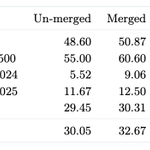
Trick #3: Merge, merge, merge.
In pretraining, we skipped LR decay for a running weight average.
Then we merged pre-context-extension models into post-extension checkpoints (see fig. for ablation study gains).
Merging was also an expedient stand-in for MOPD in our RLVR recipe.

The finding: data quality doesn't wash out. After post-training, the curated lead grows with scale: 6.1 points at 4B, 8.6 at 12B, 9.1 at 30B. A curated 12B model beat a 30B baseline, despite using about a fifth of the pretraining compute.
Full report: datologyai.com/downloads/tec…
2
37
3,812
Last call: Datology Labs Fellows applications close Sunday at 11:59pm PST.
One paid semester on the science of data, with funding, compute, and mentorship from the DatologyAI research team. San Mateo or NYC, starting January.
Apply: labs.datologyai.com/fellowsh…

Fellowship applications close in 10 days.
Datology Labs Fellows get funding, compute, and mentorship to spend a semester on the science of data. Paid, San Mateo/NYC, starting January.
Apply by Nov 15: labs.datologyai.com/fellowsh…

Training data includes some of the most proprietary corporate data an enterprise has.
DatologyAI has received its first SOC 2 Type II attestation: independent confirmation that our security practices work over time.
To learn more or request the report: trust.datologyai.com

Thank you to our engineering, operations, and security teams for their commitment to security and achieving this milestone.
More on what it means for Curation Studio customers: datologyai.com/blog/datology…

5
240
DatologyAI retweeted

I am quite excited about this work on scaling gradient based data attribution to find innocuous looking harmful data.
"What's in your Safe Data" (@LuxiHeLucy) was one of my favorite papers from 2024, and Emergent Misalignment (@BetleyJan) has been one of the most important papers from 2025. Scalable gradients can connect the two. A few things that are exciting here:
1. Gradient attribution can scale: We built on top of the LoRIF paper (Li et. al.), and further simplified it. Gradients are now only 3x slower than standard embeddings.
2. Small models can be strong monitors. A 0.6B model can be used as monitor for harmful data that may enter the training of much larger models.
3. EM data might only detectable after training: The representations in gradient space often align after the model itself has had exposure to the safe-looking harmful data. This is quite intriguing, as it suggests attribution rather than filters as a path towards preventing EM.
teapawt.net/datologyai/statu…


1/7 New Labs Research: Follow the Gradient
SafeTulu filters benign-looking data that weakens LLM safety, cutting attack success up to 22% relative while largely preserving capability.
🤗 Space: huggingface.co/spaces/Datolo…
Data: huggingface.co/datasets/Dato…
Paper: datologyai.com/blog/follow-t…
1/7 New Labs Research: Follow the Gradient
SafeTulu filters benign-looking data that weakens LLM safety, cutting attack success up to 22% relative while largely preserving capability.
🤗 Space: huggingface.co/spaces/Datolo…
Data: huggingface.co/datasets/Dato…
Paper: datologyai.com/blog/follow-t…
7/7 Safety gains largely preserve capability across six benchmarks. Qwen matches or improves on the full-data baseline, with some drops for Llama and OLMo.
Paper: huggingface.co/papers/2610.3…
Blog: datologyai.com/blog/follow-t…
Full results and methods in the paper and blog.

1
14
255
8/7 Join us at Datology Labs!
Interested in working on data curation and model behavior? We’re looking for Datology Labs fellows. Learn more: labs.datologyai.com/
teapawt.net/datologyai/status/2110…
