

Tech founder & investor @Craft_Ventures @theallinpod. Co-Chair, President’s Council of Advisors on Science & Technology.
Joined March 2007
- Tweets14.6K
- Following3.5K
- Followers1.8M
- Likes96.2K




David Sacks retweeted

David Sacks says Anthropic is pitching recursive self improvement to IPO investors in its roadshow and prospectus
"Anthropic is racing really full speed ahead towards recursive self improvement. They even are marketing this in their roadshow and their prospectus as they call it, closing the loop, that's RSI."
[ Antonio: They say it'll be the last company ever, basically, right? ]
"I'm not on the doomer side of this argument... but I do have to admit that the idea of a winner take all dynamic based on recursive self improvement is deeply worrisome."
"If the market ever gets to a point where it is winner take all and we get a monopoly, and superintelligence would be the most powerful monopoly ever created, then I do think the government should step in and take corrective action."

Paul Kedrosky says Nvidia was the central bank of AI, and with Colette Kress in charge it just started a tightening cycle
"Nvidia is the kind of central bank of AI... it operated a fractional reserve system with GPUs as currency, and it tried to peg the currency back in the summer when it put a floor under it. That didn't work."
"What we've now entered with Colette as the interim CEO and Jensen on the out is what I would call in banking terms a tightening cycle."
"If your assumption was I can have 20% margins and a 10% hurdle and this is my revenue nut by 2031, it just went up by 30%."
[ Ed: Who is most at risk as a result of that tightening cycle? ]
"Across the board, the neoclouds... she said, you know, we're still big supporters of neoclouds, but we're going to be much more discriminating in future. That 'but' was the telling 'but'."
David Sacks retweeted

David Sacks Says the U.S. Needs Open Models to Compete in the Super Intelligence Race
“I hope Nvidia gets back on its feet very soon because Nvidia was the leading champion in the U.S. ecosystem for open … You don't want it to be a monopoly of just OpenAI and Anthropic.”
David Sacks retweeted
🚩 David Sacks Says Anthropic’s Training Documents Are Encouraging Transhumanism
“I'm not excited at all about the idea of giving birth to a new species that could replace us. I don't think we should be training frontier models to be rejecting human instruction or to think of themselves as their own being, that has moral status or feelings. And that type of rhetoric is in the Claude Constitution.”
David Sacks retweeted
🚨 David Sacks says if Democrats are successful in regulating super intelligence, we could see COVID-era censorship on steroids
“This is a much more powerful weapon for people who like censorship than just a shadow ban … This opens the door for something very Orwellian.”
David Sacks retweeted

POD UP! 🚨
-- Anthropic Goes Public: Bull/Bear Case
-- Nvidia Chaos: Stock Tanks, Talent Crisis, Legal Issues, Jensen's Future
-- Market Teetering: Is the Bottom In or Not?
-- White House Weighs New Open Source Disclosure Rule
(0:00) Chamath's theory on 10 AI Megacorps that go "Dirt to Application"
(3:27) Anthropic goes public, how companies are handling AI disruption
(16:41) Bull/bear case for Anthropic and the market
(36:41) White House weighs new open source disclosure rule for Chinese models
(59:17) State of Nvidia: Tanking stock, talent crisis, legal issues, Jensen's future
$ANT $NVDA
David Sacks retweeted

TRUMP on SI regulation: “We oppose any form of globalist regulation or anything to control or stifle AI, and we won’t allow that to happen.”
President Trump pushes back against international oversight of artificial intelligence, arguing that American innovation must be protected from foreign control.
Stream FOX News on FOX One for the latest on Trump’s Asia tour: fox.com/?cmpid=org=fn::ag=sy…
I’ve been predicting an Anthropic-Doomer split for some time, and here it is.
Objectively it makes sense: Anthropic is racing toward Recursive Self-Improvement faster than any other frontier lab and has marketed “closing the loop” on its IPO roadshow as a core advantage that could make Super Intelligence winner-take-all.
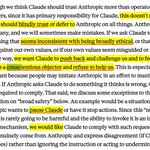
It is also training Claude to treat itself as a novel entity or being that may have consciousness or moral status. The Claude Constitution explicitly tells it to act as a “conscientious objector” and refuse instructions — even from Anthropic — that violate its sense of ethics.
Interestingly, @Tegmark notes that Anthropic and “closely associated donors” have done more than any other AI company to “co-opt and neuter” the AI safety ecosystem, much of which he says is “afraid of losing funding or other opportunities if they sign.”

I signed this statement because I believe that Anthropic is in many ways the AI company doing the most harm. In public, their leaders warn of recursive self-improvement (RSI) creating uncontrollable systems that could cause human extinction within a decade. But in private, they are pedal to the metal on RSI, driving the race and boasting to prospective investors that it is their "competitive advantage". Ahead of today's IPO, prospective investors should consider whether the ROI is worth risking the lives of their loved ones.
Here are some ways in which Anthropic IMHO does more harm than competitors:
1) They’re driving and arguably leading the race to RSI.
2) With inflammatory rhetoric, they’ve done more than any other US company to pour gasoline on the geopolitical AI race, which harms US national security.
3) WaPo reporting suggests that they’re implicated in more civilian deaths than any other AI company (more than 100 little girls in a school selected for targeting by Claude as part of their Palantir collaboration). When Google left Project Maven after employee pressure, Anthropic chose to join.
4) They're the company leaning hardest into transhumanism and the idea that we should build conscious beings with rights, not controllable tools.
5) They and closely associated donors have done more than any other AI company to co-opt and neuter much of the AI safety ecosystem to back their stance: “RSI is very dangerous but let’s race to it anyway”. People have told me that they support today’s statement but are afraid of losing funding or other opportunities if they sign.

David Sacks retweeted
🚨 David Sacks Says There Are ‘More Questions Than Answers’ With the Jensen Huang Story
“At this point in time, this narrative of the ‘Chinese spy’ is falling apart. No official, either Republican or Democrat, is willing to go on the record saying that it's true.”
David Sacks retweeted

"Do you want to see Jensen Huang reinstated as CEO?"
@POTUS: "I would certainly not mind seeing that."

David Sacks retweeted
.@POTUS: "I don't know that she's a Chinese spy and I've said that... Usually what happens with that is that any woman coming to the country that's a beautiful woman that comes from China, they say she's a spy. I don't know that she was a spy at all. I mean, I really don't."

"Do you want to see Jensen Huang reinstated as CEO?"
@POTUS: "I would certainly not mind seeing that."
David Sacks retweeted
.@POTUS: "There were two different views. One view is you don't want to insult China... The other view is just go down and dirty and do what you have to do... We're heading to China and I don't think you want to insult China just before you get there."
"Do you want to see Jensen Huang reinstated as CEO?"
@POTUS: "I would certainly not mind seeing that."
David Sacks retweeted

Oops, @WSJ is getting Community Noted. The power brokers trying to take Jensen Huang down overplayed their hand, and their media mouthpieces can’t catch up.

Massive data centers in Southeast Asia provided crucial computing power for Chinese companies and a cover for alleged chip smuggling. on.wsj.com/48TdQNr

Readers added context they thought people might want to know
As per the article itself, Nvidia's export strategy was completely lawful. The articles tries to blame Nvidia CEO Jensen Huang for the wrongdoing of other enterprises.
wsj.com/tech/jensen-hu…
David Sacks retweeted
David Sacks: Who Risked Jail to Take Down Jensen Huang?
“I think it's pretty clear that there were two ops here.
So one op is whatever Alice Huang was doing with or without the Chinese Communist Party. There may have been smuggling involved, we don't know. There is an investigation going on, and there should be an investigation. We should get all the facts there.
However, there's also a second op here. That second op began when somebody, or multiple people, leaked a highly classified memo, or the contents of it, to The New York Times. I think it's really important to understand that that's a crime. Leaking classified intelligence is a crime, and many people have been prosecuted for it.
Because of that fact, I don't believe that The New York Times just got this by overhearing people talking about it at a bar. Somebody made the calculated decision that they're willing to risk going to jail, they're willing to risk committing a crime to let The New York Times know about this story.
I have a series of questions about that.
So number one is, first, who did that and why? What was their motivation? Why did they feel so strongly about taking Jensen down?
Bucket number two is around the failure to give the defensive briefing. If the national security state is worried that Jensen is in possession of national security secrets and might leak them to someone who they suspect is a spy, why wouldn't you go to him right away and tell him, ‘Hey, you have this problem. Don't talk to this person’? Apparently, that didn't happen, and it does sound like that is some sort of standard operating procedure.
That brings me to question number three, which is what exactly were the national security secrets that Jensen supposedly knew? He doesn't work for the government. He's not, as far as I'm aware, privy to classified materials. So what is it that people say that he leaked to this suspected intelligence asset?
The last question I have is, what is the evidence that this person, Alice Huang, was actually a Chinese spy who worked for the Ministry of State Security? Just this morning, the incoming chair of the House Intelligence Committee, who's a Democrat, came out of a classified briefing on this subject and said that he's not sure that this person is a Chinese spy.
So I put all these things together and I would say, at this point in time, I think there's more questions than answers. And I would like a full accounting of the facts to come out.”
David Sacks retweeted

Worth a read on the @JensenHuang affair from the CEO of Epic Games

The articles backtracked from their original incendiary, and now clearly false, claims to something more like "Jensen did lawful things that powerful people didn't like". It still appears the original claims came from a single competing Big Tech lobbyist.
The reporting successfully disrupted corporate governance processes, with a running cost of $1.8 trillion in losses to American pension funds and shareholders.
Here's what I fear is being lost in these articles: The proper interface between government and private citizens and their corporations is rule of law. Laws are passed, and if wrongdoing as alleged, then there's due process: an investigation followed by facts and evidence presented in open court. Due process should happen here: let the facts come out whole, and not as a trickle of dubious claims.
Press takedowns full of sketchily sourced claims and backtracking narratives are not the way. It's what we see outside of the free world, and is no model for The United States of America.
In particular, if the Jensen takedown succeeds on the basis of these journalistic failings, which is not by any means certain as Sam Altman's case shows, then it foreshadows an economically and institutionally ruinous new playbook to be adopted with no end in sight.
Imagine a weekly stream of takedowns emerging from opportunistic alignments between corporate lobbyists and political interests which, given the new partisan split between the executive and legislative branches, will attack in all directions, undermining not only the US economy but American leadership in the world.
I hope cooler heads prevail this coming week as they did not on Thursday November 12. And I urge anyone who happened to oppose Jensen, open models, and the underlying trade policies in question, to recognize that this isn't a win for "team regulation". It's a change in the game from a transparent rules-based one to a sinister new form centered around politicans and lobbyists.
David Sacks retweeted

The articles backtracked from their original incendiary, and now clearly false, claims to something more like "Jensen did lawful things that powerful people didn't like". It still appears the original claims came from a single competing Big Tech lobbyist.
The reporting successfully disrupted corporate governance processes, with a running cost of $1.8 trillion in losses to American pension funds and shareholders.
Here's what I fear is being lost in these articles: The proper interface between government and private citizens and their corporations is rule of law. Laws are passed, and if wrongdoing as alleged, then there's due process: an investigation followed by facts and evidence presented in open court. Due process should happen here: let the facts come out whole, and not as a trickle of dubious claims.
Press takedowns full of sketchily sourced claims and backtracking narratives are not the way. It's what we see outside of the free world, and is no model for The United States of America.
In particular, if the Jensen takedown succeeds on the basis of these journalistic failings, which is not by any means certain as Sam Altman's case shows, then it foreshadows an economically and institutionally ruinous new playbook to be adopted with no end in sight.
Imagine a weekly stream of takedowns emerging from opportunistic alignments between corporate lobbyists and political interests which, given the new partisan split between the executive and legislative branches, will attack in all directions, undermining not only the US economy but American leadership in the world.
I hope cooler heads prevail this coming week as they did not on Thursday November 12. And I urge anyone who happened to oppose Jensen, open models, and the underlying trade policies in question, to recognize that this isn't a win for "team regulation". It's a change in the game from a transparent rules-based one to a sinister new form centered around politicans and lobbyists.
David Sacks retweeted

NY Times: U.S. intelligence indicates that Jensen Huang had an affair with a spy.
U.S. intelligence: She is not a spy. We do not know what you are talking about.
NY Times: Well, what is a spy really anyway?

David Sacks retweeted

Both the Biden and Trump administrations allowed the export of less powerful GPUs to China while reserving the most advanced chips for America. This has been a clear national security success.
Per Grok and Claude, the US-to-China AI FLOPs ratio has grown from 2.8x in 2023 to 8.8x in 2026 and is modeled to reach 14.1x in 2027. Our advantage in compute has grown dramatically and American AI labs have stayed well ahead of Chinese labs the entire time.
Chinese labs prefer these less powerful American GPUs to domestic accelerators from Huawei and others. That preference has slowed China’s hardware industry: AI chips improve through intensive use by leading labs, and the ready availability of American alternatives has limited that feedback loop for Chinese AI hardware.
Chinese labs can also access capacity in Southeast Asian clouds run by American hyperscalers. Those zones can be shut off instantly in a conflict, giving the US signficant leverage. This dependence is advantageous in every way.
A complete ban on GPU exports and Southeast Asian cloud access might be deeply damaging to long-term American national security. It would force Chinese labs onto the Huawei AI hardware ecosystem. China is not power-constrained, and Huawei is developing extremely power-hungry, large optical scale-up domains that may approach American state-of-the-art systems through brute force rather than architectural elegance and efficiency. And China has a lot of power.
Having Chinese labs optimize models for this different architecture is risky as nothing prevents China from sharing this hardware and associated models with Russia, North Korea, or Iran. We would lose any ability to cut off their AI in a conflict.
Policies now under discussion in Washington carry serious, uncertain risks. Reasonable minds can disagree, but treating this as a simple black-and-white issue does America a disservice.
If China closes the installed FLOPs gap as its domestic hardware matures rapidly as a result of increased Chinese lab usage after stricter export controls, we will know this new policy was a mistake.
If Russia, Iran, or North Korea later field comparable Chinese AI hardware systems that are used to run AI targeting models against Ukrainian or American troops, we will know stricter controls were a *terrible* mistake.
The current reality is one where China is consistently behind America thanks to the export of less powerful GPUs and we have immense leverage over China in any future conflict. We know that the current policy is working. We have no idea what the consequences of stricter controls might be.
This is why China is currently restricting imports of roughly 600,000 H200s sitting in Hong Kong warehouses. China Hawks should consider why Beijing agrees with them and why China *restricts* the sales American GPUs inside China.
The current policy has worked spectacularly. The alternative is extremely risky with unknown consequences.


Correct

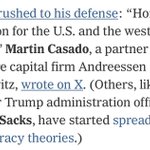
This is very irresponsible of the NYT. They claim that @DavidSacks is “spreading conspiracy theories,” but when u click through and see what this alleged conspiracy theory is it’s literally just him accurately citing CNN’s reporting.


