

Founder @ A3 Analytics | ex-Palantir, Toyota | Building labs that are self-driving AND self-fixing at A3
The Whole Bay Area
Joined March 2026
- Tweets102
- Following210
- Followers15
- Likes144




Pinned Tweet
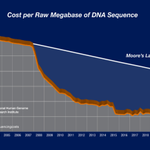
The cost of DNA sequencing has remained stubbornly flat for over 10 years. To get to truly personalized genomics and personalized medicine, we have to get rid of the bottleneck: the people. I spent a decade pipetting things and running various lab assays and it ain't fun. 1/

Matt Gordon retweeted

🧬 Design proteins faster and send fewer, better candidates to the lab.
Introducing RFD4-Proteina, a new NVIDIA BioNeMo open model co-developed with @UWproteindesign.
▫️Fast: 13× faster generation than RFdiffusion3 at 200 residues
▫️ Smart: state-of-the-art across 12+ protein design tasks
▫️ Programmable: set your design inputs and use test-time compute on harder problems
Start with our binder-design tutorial nvda.ws/3VK9Uvr
Matt Gordon retweeted

Describe a protein’s job. AI proposes its structure and sequence.
A scientist might want an enzyme that breaks down plastic without knowing what its molecular structure should look like. Many protein-design tools require the scientist to supply some of that structural information first.
Dai and colleagues developed Pinal, a generative AI model that proposes proteins from written descriptions of their intended function.
Its Transformer-based architecture first generates a compact description of a possible protein structure. A second model uses that description, together with the original request, to generate the amino acid sequence. Structure provides a useful bridge: proteins with quite different sequences can still adopt similar shapes.
One experimental test went beyond designing an isolated enzyme. The team requested an H-protein, which carries reaction intermediates between enzymes in a CO₂-fixing pathway. The best design supported 1.7 times the glycine production of the native E. coli protein in a laboratory-reconstituted pathway, without repeated rounds of experimental optimization.
Getting there still required selection: 50,000 generated candidates were narrowed to 20 for testing, and five were functional. The written request opens the search. Computational screening and experiments establish which designs actually work.
Dai et al., Nature (2026). Journal license. nature.com/articles/s41586-0…

Custom designed treatments are the promise of the current revolution in biology. This is an incredible milestone in personalized medicine.
To make personalized medicine available to all, we need to make lab automation that scales. That’s what we’re working on.


Matt Gordon retweeted

We are bringing agents to the wet-lab bench at Google Research to navigate complex biological landscapes. Learn how we are grounding agents in physical lab robotics to run fast closed-loop molecular design cycles, ultimately discovering single-digit nanomolar protein binders for cancer targets →goo.gle/4B5mMMB
Zero Wall-E themed merch anywhere in Disneyland btw, obvious neurodiversity erasure

California is a machine for turning autism into intellectual property
At Disneyland for my twins Big One Oh birthday. Here’s my list of autistic Disney characters:
Wall-E: has to learn what feelings are by watching movies. Collects weird junk. Feels deeply the difference between right and wrong and is very stubborn about doing what’s right 1/
Ariel: classic hot autistic girl. Doesn’t clock as neurospicy because she’s so hot. Obsessively collects weird stuff. Family doesn’t get her. Suffers from body dysmorphia. Trans. 3/
The current generation of lab automation won't get us there. We need AUTOMATED lab automation: lab automation that can detect error conditions, recover from them, and avoid the same problems in the future by learning from every mistake. 3/
Matt Gordon retweeted
Why autonomous discovery is stalling on hardware, not algorithms
The algorithms are ready. The hardware is not. That is the argument of this review, and it reframes where the bottleneck in autonomous discovery actually sits.
Richard Canty and Milad Abolhasani trace self-driving labs from 1970s liquid handlers to today's closed-loop platforms. The numbers are not subtle. Artificial Chemist identified eleven distinct perovskite quantum dot formulations in 30 hours using under 210 ml of reagents. AlphaFlow navigated a 40-parameter reaction space with less than 0.2% of the reagents an equivalent manual search would need. Fast-Cat mapped a two-objective Pareto front for rhodium-catalysed hydroformylation in 60 experiments, replacing screens of over 400 runs.
So why is this not everywhere? Optimization was never the hard part. AI suites already propose experiments and estimate uncertainty faster than any rig generates data. Meanwhile most platforms are bespoke assemblies of pumps, valves and reactors tuned to one narrow envelope. Retooling from electrochemical screening to organometallic catalysis means downtime and safety revalidation.
The consequence for anyone training models on experimental data is sharp. Identical protocols give divergent results across labs because reactor geometry, optical alignment and sensor calibration never make it into the digital record. No amount of model capacity fixes an uncalibrated sensor. The authors argue the real barrier is missing process-complete metadata: provenance of raw materials, how precursors were made, the apparatus itself. Until hardware is described as rigorously as software is shared, reproducibility caps out below algorithmic potential.
Two points I keep returning to. First, co-design: putting device-level figures of merit directly in the objective, so the agent optimizes solar cell efficiency rather than synthetic yield, with multifidelity surrogates carrying uncertainty across the synthesis to performance hierarchy. Second, where agents belong. Planning and supervision, yes. Real-time actuation, interlocks and safety-critical control should stay deterministic and formally verifiable.
The near-term move is unglamorous and high return: instrument your existing platforms for full process capture before scaling autonomy. The compounding asset is not the robot, it is the dataset another lab can trust. Also worth noting, in a survey of 54 researchers, 74% did not want total automation, with hypothesis generation the function they most wanted to keep.
Paper: Canty & Abolhasani, Nature Reviews Chemistry (2026) — journal license | doi.org/10.1038/s41570-026-0…

Dang Shyam dropping truth bombs.
Humans have a need for meaning, and for many people in Silicon Valley that comes from work. “Making the world better”, yadda yadda yadda. Believing AI daddy will save you is a way of expressing fealty to the God of Grindcore.

Palantir CTO reveals AI researchers are taking up smoking to signal to other researchers that they believe AI will cure cancer--and calls it a “mass psychosis”
Shyam Sankar (CTO): “But if you understand that it’s actually a theological critique, then you can kind of weigh it against the empirical facts of what is actually happening out there.
“I think there’s a profound truth to Pascal’s saying that every human has a God-shaped hole in their heart. And it’s important to understand that many of these folks in Silicon Valley who are building this technology have filled that hole with the machine god of AGI.
“And I mean, there’s so many interesting stories around this. For example, so many AI researchers have started smoking as a way of signaling to other researchers how much they believe in AI.”
Margaret Brennan: “What? That makes no sense. What do you think?”
Shyam Sankar: “I believe so much in AI that it’s going to cure cancer. So I’m showing you my chips are all in. So there is kind of this mass psychosis, social delusion around it.”
One of the first things to did with GPT3 was give it the “Cyberiad” test of writing hyperspecific poetry


asked for anti humanity SI slopcore
claude worked for 18 hours straight
when I woke up I didn't expect THIS
holy generational banger
inspired by @anabology @pleometric @elonmusk @aiamblichus @anilkseth @AISafetyMemes
A Deepness in the Sky by Verner Vinge (1999) describes something like this being used to “overclock” people’s brains

