
AI x Bio | CEO at Ligo Biosciences | Prev. Medicine @UniofOxford
San Fransisco
Joined July 2024
- Tweets209
- Following1.3K
- Followers430
- Likes520




Ed Harris retweeted

This is a fantastic new BioAI benchmark that’s highly relevant to advancing the field! I just spoke with @ArdaGoreci, one of its co-founders, and they have even more exciting BioAI benchmarks in the pipeline!
Developing rigorous, biologically relevant benchmarks is absolutely critical to accelerating progress in BioAI!

A new way to measure how AI agents handle the routine analyses of wet-lab science—BioBasicsBench.
Developed with Ligo, a biotech company focused on enzyme design, the benchmark draws on 100 tasks from real experiments to test whether agents can interpret raw lab data, identify errors, and recognize when the evidence doesn’t support a conclusion.
Accelerating biological research starts with getting the everyday work right. BioBasicsBench shows where models need to improve, and helps us track what those gains mean for scientific progress, biosafety, and biosecurity.
openai.com/index/measuring-h…

Ed Harris retweeted

OpenAI built BioBasicsBench, a test that gives AI agents the messy raw data of real lab work, like gel photos and microscope videos, and grades whether they read it correctly.
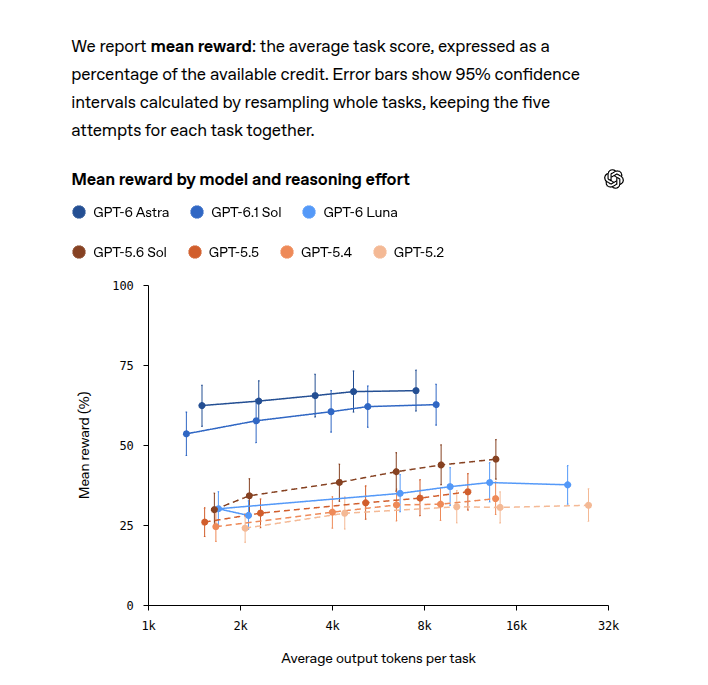
GPT-6 Astra earned 66.7% of available credit on a new wet-lab benchmark, versus 43.8% for GPT-5.6 Sol.
BioBasicsBench, built with enzyme-design company Ligo, draws 100 tasks from scientists’ raw gels, colony plates, microscopy, sequencing reads and bench videos.
Its rubrics give partial credit, including for spotting errors or saying evidence can’t support conclusions.
At the xhigh setting, Astra used 4,704 output tokens per task, about half the older model’s, so longer reasoning didn’t drive the gain.
A new way to measure how AI agents handle the routine analyses of wet-lab science—BioBasicsBench.
Developed with Ligo, a biotech company focused on enzyme design, the benchmark draws on 100 tasks from real experiments to test whether agents can interpret raw lab data, identify errors, and recognize when the evidence doesn’t support a conclusion.
Accelerating biological research starts with getting the everyday work right. BioBasicsBench shows where models need to improve, and helps us track what those gains mean for scientific progress, biosafety, and biosecurity.
openai.com/index/measuring-h…
Ed Harris retweeted

OpenAI's GPT-6 Astra is crushing older models on real-world biology tasks.
OpenAI just introduced BioBasicsBench, a new benchmark developed with biotech company Ligo.
It includes 100 tasks from real lab experiments, testing whether AI can:
> Analyze raw lab data
> Detect experimental errors
> Recognize unsupported conclusions
GPT-6 Astra and GPT-6.1 Sol are leading with scores around 60–65%, while older models are mostly below 50%.
A new way to measure how AI agents handle the routine analyses of wet-lab science—BioBasicsBench.
Developed with Ligo, a biotech company focused on enzyme design, the benchmark draws on 100 tasks from real experiments to test whether agents can interpret raw lab data, identify errors, and recognize when the evidence doesn’t support a conclusion.
Accelerating biological research starts with getting the everyday work right. BioBasicsBench shows where models need to improve, and helps us track what those gains mean for scientific progress, biosafety, and biosecurity.
openai.com/index/measuring-h…
Releasing some of our recent work with @OpenAI
A new way to measure how AI agents handle the routine analyses of wet-lab science—BioBasicsBench.
Developed with Ligo, a biotech company focused on enzyme design, the benchmark draws on 100 tasks from real experiments to test whether agents can interpret raw lab data, identify errors, and recognize when the evidence doesn’t support a conclusion.
Accelerating biological research starts with getting the everyday work right. BioBasicsBench shows where models need to improve, and helps us track what those gains mean for scientific progress, biosafety, and biosecurity.
openai.com/index/measuring-h…
4
26
1,497
Excited to release BioBasicsBench, a benchmark we developed with @OpenAI to test whether AI agents can interpret real lab data, spot experimental errors, and recognize when the evidence doesn’t support a conclusion.
Accelerating biological research starts with getting the everyday work right. BioBasicsBench reveals where models still struggle with routine experimental tasks and help measure whether they’re improving.
Explore the benchmark: openai.com/index/measuring-h…

Ed Harris retweeted

A new way to measure how AI agents handle the routine analyses of wet-lab science—BioBasicsBench.
Developed with Ligo, a biotech company focused on enzyme design, the benchmark draws on 100 tasks from real experiments to test whether agents can interpret raw lab data, identify errors, and recognize when the evidence doesn’t support a conclusion.
Accelerating biological research starts with getting the everyday work right. BioBasicsBench shows where models need to improve, and helps us track what those gains mean for scientific progress, biosafety, and biosecurity.
openai.com/index/measuring-h…
Ed Harris retweeted

We're excited to announce Pathfinder's $16M in funding with our Series A led by Portage with participation from Reach Capital, Gradient and Stand Together Ventures Lab
If this animates and excites you, we're hiring: pathfindercard.com/join


Ed Harris retweeted
What?! 🤯 In the future, all surgeries will be performed by robots with AI agents! They will be much more precise and safe. Human surgeons may still be in the loop for some time, though.
“Last night an AI agent performed brain surgery on a mouse. We gave it 19 gene therapy vectors in a spreadsheet, a mouse model of epilepsy, access to a motorized surgery rig with cameras, and one goal: reduce seizures.”

Last night an AI agent performed brain surgery on a mouse.
We gave it 19 gene therapy vectors in a spreadsheet, a mouse model of epilepsy, access to a motorize surgery rig with cameras and one goal: reduce seizures.
It picked the drug. It picked the brain region. It derived the coordinates from three papers. Then it drove the stereotaxic arms into the brain and injected 250 nanolitres while watching the entry site through the rig camera for bleeding.
A licensed vet gated every irreversible step and held a physical kill switch to stop the AI agent.
Thread on what it decided, what it saw, and the moment it refused to let me override it.
[Writing this on the spot out of excitement, but I've been 18hrs in front of my laptop coding and coordinating this, so keeping it brief and descriptive, more cohesive thoughts on this soon...]

Ed Harris retweeted

Last night an AI agent performed brain surgery on a mouse.
We gave it 19 gene therapy vectors in a spreadsheet, a mouse model of epilepsy, access to a motorize surgery rig with cameras and one goal: reduce seizures.
It picked the drug. It picked the brain region. It derived the coordinates from three papers. Then it drove the stereotaxic arms into the brain and injected 250 nanolitres while watching the entry site through the rig camera for bleeding.
A licensed vet gated every irreversible step and held a physical kill switch to stop the AI agent.
Thread on what it decided, what it saw, and the moment it refused to let me override it.
[Writing this on the spot out of excitement, but I've been 18hrs in front of my laptop coding and coordinating this, so keeping it brief and descriptive, more cohesive thoughts on this soon...]
Ed Harris retweeted

Introducing Astraeus.
High mobility. Long duration operations. Greater freedom to maneuver.
Redefining what spacecraft can do in orbit.
Built by Orbital Operations.
Concept video produced by London Studio @ZeroOneCreative and a special thanks their team @ashkan01C, @Rupert01C and @james_01c
Ed Harris retweeted

ai x bio just had a ridiculous 48 hours - V2:
- Warp Sciences: AI x robotic labs for drug discovery
- Carbon-X: open model for DNA interpretation
- Nanograb: AI for in vivo targeted drug delivery
- Holon-S1: cancer biomarkers from pathology slides
- Pinal: protein design from plain language
- Vitrify: molecular simulations beyond DFT accuracy
- Biomni + Bayer: AI agent deployment
- Boltz + BMS: protein model deployment
- Atomwell: Bindwell's binding affinity model
- Omnii-1: AI-designed phage given to a patient
- Claude designed scorpion toxin binders
- OpenAI acquires Orchestra Bio
- Baker Lab: RFD4-Proteina
- Chaperone: agent framework for protein design
- BioEmu2: protein simulations
- Artios: enzyme design model
- OpenAI + PerturbAI: agents find brain disease clues
- Xaira X-Scientist
anything still missing?
Ed Harris retweeted

mRNA will be crucial to beating cancer and solving disease but only if we can deliver it to the right cells.
Nanograb's AI-designed multivalent nanoparticles address a cell's unique receptor fingerprint, now proven in vivo across multiple cell types and scaling to many more.
Ed Harris retweeted
ai x bio just had a ridiculous 48 hours:
- Omnii-1: AI-designed phage given to a patient
- Claude designed scorpion toxin binders
- OpenAI acquires Orchestra Bio
- Baker Lab: RFD4-Proteina
- Chaperone: agent framework for protein design
- BioEmu2: protein simulations
- Artios: enzyme design model
- OpenAI + PerturbAI: agents find brain disease clues
- Xaira X-Scientist
anything missing?
Ed Harris retweeted

These GOATS went open source!

Today we are excited to release Artios, a fully open source system for designing functional de novo enzymes.
Enzymes present a new frontier for de novo protein design models due to the challenge of coordinating precise chemistry, rather than binding a target.
Enzymes are life’s biological machines and by designing them we can truly start to engineer biology.
We believe these fundamental capabilities should be built in the open and shared with the community to progress science faster.
🧵 1/6
Ed Harris retweeted
Congratulations to Arda and his team on the release of Artios, an open-source BioAI model focused on designing enzymes, the molecular workhorses that power biofactories! Exciting to see AI accelerating synthetic biology!
“Artios combines backbone and sequence models to achieve state-of-the-art performance in enzyme design.”
Today we are excited to release Artios, a fully open source system for designing functional de novo enzymes.
Enzymes present a new frontier for de novo protein design models due to the challenge of coordinating precise chemistry, rather than binding a target.
Enzymes are life’s biological machines and by designing them we can truly start to engineer biology.
We believe these fundamental capabilities should be built in the open and shared with the community to progress science faster.
🧵 1/6
Ed Harris retweeted

Congratulations on the results @ArdaGoreci. If you are in AI/Bio space, you should follow Ligo Biosciences' work.
Today we are excited to release Artios, a fully open source system for designing functional de novo enzymes.
Enzymes present a new frontier for de novo protein design models due to the challenge of coordinating precise chemistry, rather than binding a target.
Enzymes are life’s biological machines and by designing them we can truly start to engineer biology.
We believe these fundamental capabilities should be built in the open and shared with the community to progress science faster.
🧵 1/6
Ed Harris retweeted

This is unbelievable. Fable is getting basic biology wrong (Max) and I have no idea what happened.
Ed Harris retweeted

New SOTA de novo enzyme design model, commercial friendly
Enzyme design is the new protein frontier
Still pretty mind blowing we can coordinate atoms at our will to do amazing things, all from a computer model!
Today we are excited to release Artios, a fully open source system for designing functional de novo enzymes.
Enzymes present a new frontier for de novo protein design models due to the challenge of coordinating precise chemistry, rather than binding a target.
Enzymes are life’s biological machines and by designing them we can truly start to engineer biology.
We believe these fundamental capabilities should be built in the open and shared with the community to progress science faster.
🧵 1/6
Ed Harris retweeted

10/10 team. very excited to see this out there.
Today we are excited to release Artios, a fully open source system for designing functional de novo enzymes.
Enzymes present a new frontier for de novo protein design models due to the challenge of coordinating precise chemistry, rather than binding a target.
Enzymes are life’s biological machines and by designing them we can truly start to engineer biology.
We believe these fundamental capabilities should be built in the open and shared with the community to progress science faster.
🧵 1/6