

Gavekal is one of the leading independent providers of global investment research. It also advises a select range of funds and offers software solutions.
Hong Kong, Beijing
Joined January 2010
- Tweets5.2K
- Following17
- Followers39.7K
- Likes18


Pinned Tweet
Want to read daily commentary on #GlobalMacro & #ChinaMacro #EconomicsResearch from one of the world's leading independent providers? Or advice on #AssetAllocation?
Sign up for a 1-month free trial to
@Gavekal Research at web.gavekal.com/form/subscri… #InvestmentResearch
Headline US-China trade figures have declined substantially in recent years as a result of multiple trade wars. But in this interview, China strategist Thomas Gatley explains that the trade decoupling is not what it seems: exporters have devised strategies to evade the tariffs, meaning actual US-China trade is stronger than it appears—a finding with implications for China’s other trade disputes.
Barring the post-Covid rebound, global goods trade volumes are growing at the fastest pace in 15 years, defying tariffs and the Iran war. Artificial-intelligence spending has accelerated the rebound, contributing close to half of all trade growth in 1H26. Two major risks threaten this growth: first, if AI capex dries up, global trade would lose a powerful engine, leaving East Asian exporters particularly vulnerable. Second, the tolerance for absorbing more Chinese exports is diminishing. Protectionism would disrupt production and squeeze margins, compounding any slowdown.

The reaction of markets after the Democratic Party won control of both houses of the US Congress in Tuesday’s midterm elections suggests investors expect big shifts in the two narratives that have dominated financial markets in 2026: the AI capex boom, and the US war against Iran and its impact on global energy prices. In this video interview, Gavekal US chief economist Will Denyer examines how these all-important narratives are set to evolve in the post-election environment.
With US treasury bonds having gotten more reasonably valued, Chief US economist Will Denyer says that both nominal bonds and TIPS deserve a place in balanced portfolios. In this video interview, he explains how the two instruments offer protection against different economic outcomes, with TIPS preferred in an inflationary bust and nominal treasuries in a deflationary downturn. While the relatively high risk of an inflationary bust currently favors TIPS, he argues that a further rise in market inflation expectations could prompt a hawkish Federal Reserve response, creating a tactical opportunity to shift toward nominal treasuries.
Indonesia’s equity market has suffered a sharp sell-off after MSCI warned that persistent concerns over ownership transparency, market manipulation and weak regulatory enforcement could see the country stripped of its emerging market status. In this video interview, emerging markets analyst Rohan Daswani discusses whether Jakarta’s latest reforms can restore investor confidence, the risks of further capital outflows and currency weakness, and what Indonesia’s troubles mean for other emerging markets.

The question for investors and policymakers is whether price pressures will spread through the economy, pushing up long-term inflation expectations, as some Federal Reserve officials fear. If rising inflation is largely driven by energy supply disruptions and markets remain confident in the Fed’s commitment to its inflation target, long-term inflation expectations will likely remain well anchored.
However, if the rise in inflation broadens and becomes more persistent due to the AI investment boom and a tighter US labor market, long-term inflation expectations could drift higher, and likely more so than in 2021-22: research.gavekal.com/teaser/…
US manufacturing capacity and production are both improving, but the country remains far from being able to meet more of its domestic demand. In this video interview, US economist Tan Kai Xian explains why labor shortages, compounded by tight immigration policies, are a bigger obstacle to expanding US manufacturing than a lack of physical capacity. With Washington pressing other countries to curb excess production, the risk is that trade restrictions drive US inflation even higher, rather than deliver the intended revival in domestic manufacturing.
So far, India has cushioned the impact of the energy shock by forcing state-owned refiners to bear losses from selling fuel at below-market prices. This strategy will prove unsustainable if oil prices do not fall within the next few months, forcing a choice between higher retail fuel prices and greater fiscal support.

Already the inflation outlook is worsening amid fears that a weak monsoon will push up food prices. That could compel the Reserve Bank of India—which earlier this month hiked rates for the first time in three years—to respond more aggressively. That, in turn, may snuff out the nascent recovery in private-sector investment.
With less than four weeks to go before the US midterm elections, the Democratic Party is odds-on to win the House of Representatives and may take control of the Senate too. In this video interview, Gavekal chief US economist Will Denyer looks at what the expected electoral swing to the Democrats is likely to mean for the possibility of impeachment hearings, fiscal policy, tariffs, financial regulation and legislation on artificial intelligence.
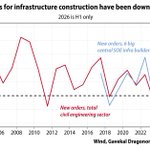
China’s infrastructure investment fell -5.4% YoY in the year through August, a decline that has been reflected in the order books of major state-owned infrastructure builders. The drop is driven by several factors, not least underwhelming returns on infrastructure projects and heightened central-government scrutiny of investment.

Such factors are unlikely to change soon, and infrastructure spending could even become a persistent drag on growth. For more analysis of China’s infrastructure investment, see: research.gavekal.com/teaser/…