

Beauty is truth, truth beauty; that is all ye know on earth, and all ye need to know.
Join 80,000+ readers →
Joined August 2018
- Tweets74.6K
- Following5.9K
- Followers821K
- Likes234K




Pinned Tweet
This is a 3200 year old attendance sheet from Ancient Egypt, and some of the reasons it gives for missing work are absolutely wild:
1. Drinking with Khonsu
2. The scorpion bit him
3. Brewing beer
4. Embalming his brother
5. His feast
6. Building his house
7. His wife is bleeding
8. With Khons making remedies
9. Strengthening the door
10. Making remedies for the scribe’s wife
The craftsmen who built and decorated the royal tombs in the Valley of the Kings lived in a village of their own, Deir el-Medina, and in the fortieth year of Ramesses II’s reign, around 1250 BC, someone drew up a register of their absences on a large flake of limestone. There are forty names, the dates each man was missing are written beside them in black ink, and above most of those dates, in red, is the reason.
The man who went drinking with Khonsu, probably a coworker, could hardly have imagined that his day off would go down in history, let alone that we’d still be reading about it more than 3000 years later. Somewhere along the way, brewing beer stopped getting anyone out of work, and nobody consulted the rest of us, although I doubt any boss would ask a follow up question if you called in and said, "Sorry, I’m embalming my brother."
All joking aside, what strikes me most is how little of this needs translating. Many of the entries I left off the list are about sickness and family, a mother who was ill, a man caring for a relative, and they could have been written yesterday.
Three thousand years have changed almost everything about the way we live, and almost nothing about what it means to be human...

If you're interested in a deeper dive, check out today's essay:
james-lucas.com/p/this-will-…


This is Sympathy, painted by the British artist Briton Rivière and shown at the Royal Academy in London in 1878.
A little girl has been sent away in disgrace for some bit of mischief, and now she sits alone at the top of the stairs, refusing to look at anyone. Everyone else has left her to think about what she’s done, everyone except her dog, who has climbed up beside her, pressed himself against her, and is looking up at her face, waiting for her to forgive the world.
The model for the girl was Rivière’s own daughter, Millicent, and the scene must have felt familiar to every family who saw it. It became the most praised work of his career, and the demand for copies was so great that Rivière painted several versions of it himself.
Even John Ruskin, the most feared critic of the age, wrote that it had been a long time since anything at the Royal Academy had pleased him so much.
Rivière was known as one of the finest animal painters of his time, and his biographer explained why: what interested him most was the animal’s real self. And this little dog shows what every dog knows instinctively: it doesn’t matter what you’ve done, or who’s angry with you, when you’re at your lowest, he isn’t there to judge you. He’s just there, by your side...

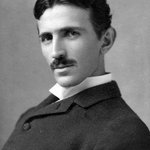
Tesla predicted your smartphone in 1926:
"When wireless is perfectly applied the whole earth will be converted into a huge brain, which in fact it is, all things being particles of a real and rhythmic whole. We shall be able to communicate with one another instantly, irrespective of distance. Not only this, but through television and telephony we shall see and hear one another as perfectly as though we were face to face, despite intervening distances of thousands of miles; and the instruments through which we shall be able to do his will be amazingly simple compared with our present telephone. A man will be able to carry one in his vest pocket."


James Lucas retweeted

The news made me think of C.S. Lewis’s On Living in an Atomic Age. It hasn’t aged a day.

This was a block of rock cut from a mountain before Michelangelo turned it into David.
It's 17 feet tall and many consider it the most beautiful work of art ever created by man.

This painting is called Stay.
And once you notice what is really happening in it, you’ll realize it’s a word almost all of us have wanted to say to someone, at least once, when it was already too late…
A girl in a pink dress reaches out toward a man standing beside her, but he is no longer quite there: his body has turned to glass, so clear you can see the sky right through him. Look closely and you’ll find small yellow flowers and flecks of color still caught inside him, as if he were made of memories, while his face has almost dissolved, and behind them the sky turns into something closer to a dream.
It was painted in 2022 by Reynier Llanes, an artist born in Pinar del Río, in Cuba, who moved to the United States in 2007, and anyone who has ever lost someone will recognize the gesture at its heart instantly: the hand stretched out a little too late, toward a person who is disappearing while you are still looking at them.
Llanes often gives invisible feelings a visible shape, and here grief and longing take the form of someone slowly fading away. He never tells us who the man is: he might be a father, a friend, a grandparent, a love that ended, and because we only see the girl from behind, we end up standing exactly where she stands, reaching out toward our own person...
All he gives us is that single word, the one we so often never manage to say in time: stay.
He first showed it in a solo exhibition in Ohio, named after the secret the fox shares in The Little Prince, words that could almost be written beneath this painting: “What is essential is invisible to the eye.”
I started my newsletter because the world is full of beautiful artworks like this one, and so few people ever stop to give them the attention they deserve. Every week I try to. If that is something you'd like to be part of, you can join through the link in my bio!
Thanks for reading.


Early in his career, after a disastrous night on stage in Chicago, Bill Murray walked out into the street ready to end his life, and headed for the lake, thinking he might as well "float for a while" once he was gone...
Instead, he turned up Michigan Avenue and found himself in front of the Art Institute of Chicago. He walked inside without even stopping to pay, because, in his words, he felt he was already "pretty much dead," and there, in front of him, was a painting he had always loved:
The Song of the Lark, painted by the French artist Jules Breton in 1884. A young peasant woman stands barefoot in an empty field at dawn, a sickle in her hand, pausing in her work to listen to a lark somewhere above her, while behind her a huge orange sun is just rising over the horizon.
Murray looked at her and saw a girl with very little to hope for, and yet, as he put it, "the sun’s coming up anyway and she’s got another chance at it." That simple thought was enough to bring him back because it made him feel that he too was a person, with "another chance every day the sun comes up."
For every writer, creator and dreamer here on X, I want to leave you with this: think of this story the next time you feel your art is futile, or that your creative pursuit isn’t worth the effort. Somewhere, someday, someone may stand in front of what you made at the lowest moment of their life, and find in it a reason to see the sun come up one more time...

I started my newsletter because the past is full of masterpieces few ever bother to unpack. Every week I try to.
If you'd like to be part of it you can join below, and if you'd like to support my work a paid subscription is what makes it possible:
James-lucas.com/welcome

James Lucas retweeted
Early in his career, after a disastrous night on stage in Chicago, Bill Murray walked out into the street ready to end his life, and headed for the lake, thinking he might as well "float for a while" once he was gone...
Instead, he turned up Michigan Avenue and found himself in front of the Art Institute of Chicago. He walked inside without even stopping to pay, because, in his words, he felt he was already "pretty much dead," and there, in front of him, was a painting he had always loved:
The Song of the Lark, painted by the French artist Jules Breton in 1884. A young peasant woman stands barefoot in an empty field at dawn, a sickle in her hand, pausing in her work to listen to a lark somewhere above her, while behind her a huge orange sun is just rising over the horizon.
Murray looked at her and saw a girl with very little to hope for, and yet, as he put it, "the sun’s coming up anyway and she’s got another chance at it." That simple thought was enough to bring him back because it made him feel that he too was a person, with "another chance every day the sun comes up."
For every writer, creator and dreamer here on X, I want to leave you with this: think of this story the next time you feel your art is futile, or that your creative pursuit isn’t worth the effort. Somewhere, someday, someone may stand in front of what you made at the lowest moment of their life, and find in it a reason to see the sun come up one more time...
The painting that saved Bill Murray’s life

Early in his career, after a disastrous night on stage in Chicago, Bill Murray walked out into the street ready to end his life, and headed for the lake, thinking he might as well "float for a while" once he was gone...
Instead, he turned up Michigan Avenue and found himself in front of the Art Institute of Chicago. He walked inside without even stopping to pay, because, in his words, he felt he was already "pretty much dead," and there, in front of him, was a painting he had always loved:
The Song of the Lark, painted by the French artist Jules Breton in 1884. A young peasant woman stands barefoot in an empty field at dawn, a sickle in her hand, pausing in her work to listen to a lark somewhere above her, while behind her a huge orange sun is just rising over the horizon.
Murray looked at her and saw a girl with very little to hope for, and yet, as he put it, "the sun’s coming up anyway and she’s got another chance at it." That simple thought was enough to bring him back because it made him feel that he too was a person, with "another chance every day the sun comes up."
For every writer, creator and dreamer here on X, I want to leave you with this: think of this story the next time you feel your art is futile, or that your creative pursuit isn’t worth the effort. Somewhere, someday, someone may stand in front of what you made at the lowest moment of their life, and find in it a reason to see the sun come up one more time...
One of the greatest sculptors of all time was born 269 years ago today, on November 1, 1757.
His name was Antonio Canova, and this is Psyche Revived by Cupid’s Kiss, a marble sculpture he carved between 1787 and 1793. It depicts the most tender moment of an ancient love story: in the myth, Psyche was warned never to open a certain jar, but she couldn’t resist, and fell into a sleep so deep it was like death. Cupid flies down to find her, and here he holds her in his arms, about to wake her with a kiss, while she reaches up to draw him closer.
Part of the magic lies in how Canova worked with light: even in his first clay sketches he studied how light would fall across his figures, and he poured all his skill into the final stage of the work, which he called the “last hand.” He would smooth and polish the stone for weeks, often working by candlelight to see every curve, and rub a thin mixture of wax into the skin to take away the cold shine of the marble and make it glow softly, like real flesh.
He was born in the small village of Possagno and raised by a grandfather who was a stonemason, which is how he came to be carving marble before he was even ten. He spent his whole life trying to make stone breathe, and it’s no surprise that Lord Byron once wrote that Canova could create what nature could, but would not...
