

Just build something | @primisprotocol @dolos_diary
Univers
Joined December 2019
- Tweets4K
- Following612
- Followers17.2K
- Likes31.5K
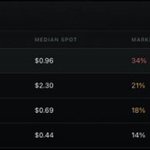






well well well. this has been our thesis for years.
compute is becoming an investable asset class.
every investable asset class eventually develops markets for price discovery, liquidity and risk transfer. @primisprotocol is building that financial layer for compute.

// exciting start to my day regarding @primisprotocol
had a great call with a potential major compute data provider.
one thing became very clear: if we want to give builders predictable compute pricing, we must find a solution to how we hedge.
they’re introducing us to one of their partners to explore what the right risk-transfer infra could look like for our use case, including whether custom hedging instruments could make sense for primis.
still early, but a very exciting conversation. feel like an explorer reaching lands that no one ever been to before.
primis mode
// @primisprotocol update :
tbh we’re making good progress, just not as fast as i’d like.
the hardest part is giving builders prices they can actually plan around.
once primis gives you a workload quote, we carry the risk if the underlying market moves.
that’s why we’re investing so much into better pricing models, richer market data, and (hopefully soon) access to infras like @OrnnExchange to improve how we price and manage that exposure.
reliable quotes are hard. and we will make them the standard.
primis mode
the biggest psyop in ai right now is “we have the cheapest gpu available”.
cheapest for what tho? which workload? which region? which window? which latency tolerance? which failure risk? which provider history? which reconciliation path?
compute pricing without context is almost useless.
that’s why we’re spending so much time on route scoring at @primisprotocol.
a good quote is not just a number. it’s a route you can trust.
primis mode
i know everyone waiting for updates on @primisprotocol. not active here but know we’re very active irl. from more onboarding to incoming partnerships.
the weeks ahead are going to be very exciting. patience is a virtue.
primis mode
most teams don’t overspend on compute because they’re careless. they overspend because the market is broken.
prices are fragmented. availability changes fast.
providers expose different rates. spot moves overnight. and builders are forced to make infra decisions with incomplete information.
@primisprotocol helps teams save by turning that chaos into workload-specific rates.
query rate → reserve rate → attach workload → reconcile usage
in the back, we score routes across price, availability, latency, reliability, and confidence and we also hedge prices for our builders.
so builders don’t just get “cheap compute.” they get compute they can actually plan around. that’s the unlock.
predictable compute economics for the compute markets.
primis mode.

currently stress-testing route scoring across closed beta.
with 115 teams onboarded, the pattern is clear:
builders don’t just need the lowest gpu rate.
they need the right route for the workload.
same chip, different provider, different region, different reliability, different execution risk.
so we’re scoring routes across price, availability, latency, confidence, and reconciliation quality.
the quote is only as good as the route behind it.
Khouba retweeted

builders need workload-specific rates,
by gpu type, region, time window, reliability tier, and usage profile
behhind that, a layer is needed to manage exposure across providers, otc capacity, benchmarks, and futures
that's primis

Lots of buzz recently on compute capital markets. But what might these markets actually look like? A few thoughts on its market structure from first principles:
> First, almost everyone agrees that compute has a nonfungibility quality. It behaves closer to electricity (temporal, nonfungible) than corn, oil, and gold.
> This nonfungibility creates several downstream corollaries:
(1) Reservations/capacity forwards are almost always bilateral OTC trades on particular SKUs and params (I want X hours of H200s in us-east-1 running Y model at 12pm on 8/1/2026)
(2) There is no transparent "one-size-fits-all" pricing model for "generic H200s" like there is for corn/oil/gold, hence no proper futures market used for hedging
(3) Most of the teams building in the space (eg. Silicon Data, Ornn, Compute Desk) are focusing on "standardization" indices/benchmarks, in preparation to create a liquid futures market.
> The short-side of compute markets fundamentally comes from neoclouds (Coreweave, Nebius, Lambda) and indepedent data centers (people with GPUs), while the long-side of compute markets comes from inference dev platforms (Fireworks, Modal, Baseten) and the agentic applayer (Cursor, Perplexity, Suno, Rime) that do not run datacenter fleets
> But these principals will never directly trade on general compute exchanges (eg. an H200 basket) because they require specific SKUs. Instead, they'll make their reservations/capacity forwards for specific SKUs with OTC dealers.
> These dealers in turn can "hedge" particular SKUs with exposure to the underlying generalized basket exchanges. So the folks actually using compute futures exchanges are going to be MMs/OTC desks/compute dealers on both sides. This creates an endgame market structure like below:

this is very much @primisprotocol coded @blknoiz06.
we’re building onchain compute market infrastructure that lets builders access predictable rates, reserve capacity, and run workloads without directly eating every spike in gpu pricing.
primis mode.

update //
appreciate all the feedback lately: product, comms, and token.
i’ll be honest: our communication with the community over the past month should have been better.
that’s on me.
i didn’t want to keep posting empty “soon” updates, but i also know silence creates uncertainty. going forward, i’ll be more consistent about sharing where we are and what we’re learning.
on product:
closed beta has been extremely valuable.
the teams using @primisprotocol right now are helping us catch edge cases, improve flows, and tighten the system before we open the gates more widely.
open beta is getting closer, and i’m very excited to have all of you onboarded.
on token:
our view has not changed. primis should align token holders, product, and company.
we’re always thinking deeply about how the token connects to the growth of the ecosystem over time, but the priority today is very clear:
build the product.
because the best thing we can do for long-term alignment is create something real that builders actually use.
and from now on,
less sorrys.
more shipping.
primis mode.
amazing post @0xfishylosopher, strongly aligned with our @primisprotocol thesis.
compute is too nonfungible for one generic market to solve everything.
builders need workload-specific rates:
gpu type, region, window, reliability, and usage profile.
then the layer behind that can manage exposure across providers, otc capacity, benchmarks, and futures.
that’s primis:
turn messy compute markets into rates builders can actually run against.
Lots of buzz recently on compute capital markets. But what might these markets actually look like? A few thoughts on its market structure from first principles:
> First, almost everyone agrees that compute has a nonfungibility quality. It behaves closer to electricity (temporal, nonfungible) than corn, oil, and gold.
> This nonfungibility creates several downstream corollaries:
(1) Reservations/capacity forwards are almost always bilateral OTC trades on particular SKUs and params (I want X hours of H200s in us-east-1 running Y model at 12pm on 8/1/2026)
(2) There is no transparent "one-size-fits-all" pricing model for "generic H200s" like there is for corn/oil/gold, hence no proper futures market used for hedging
(3) Most of the teams building in the space (eg. Silicon Data, Ornn, Compute Desk) are focusing on "standardization" indices/benchmarks, in preparation to create a liquid futures market.
> The short-side of compute markets fundamentally comes from neoclouds (Coreweave, Nebius, Lambda) and indepedent data centers (people with GPUs), while the long-side of compute markets comes from inference dev platforms (Fireworks, Modal, Baseten) and the agentic applayer (Cursor, Perplexity, Suno, Rime) that do not run datacenter fleets
> But these principals will never directly trade on general compute exchanges (eg. an H200 basket) because they require specific SKUs. Instead, they'll make their reservations/capacity forwards for specific SKUs with OTC dealers.
> These dealers in turn can "hedge" particular SKUs with exposure to the underlying generalized basket exchanges. So the folks actually using compute futures exchanges are going to be MMs/OTC desks/compute dealers on both sides. This creates an endgame market structure like below:
would love to hop in the @MarketBubble pod with @blknoiz06 and @Banks to talk compute and how it is turning into the most important human asset.
and how we’re tackling the compute issue @primisprotocol and showcase some things live.
primis mode
directionally yes, @primisprotocol is not just price feeds. but workload-specific quotes, reserved rates, routing, and reconciliation across fragmented inference / gpu supply.
builders don’t just need the price.
they need a rate they can actually run against.
primis mode

Khouba retweeted

PRIMIS JUST PASSED A MAJOR COMPUTE MARKET STRESS TEST
@khouuba revealed new metrics from one of the largest onboarding waves yet for @primisprotocol
- 115 total beta teams
- 2,418 indexed compute routes
- 94.6% route freshness under 5 minutes
- 97.8% usage matched
- 18.4% average savings vs market rates
Primis onboarded 105 new builders, processed over $30K in weekly compute volume, and completed a major stress test with zero critical incidents. Open beta is getting closer. Primis Mode.

