






Pinned Tweet
Today we release 𝚍𝟷-𝚞𝚕𝚝𝚛𝚊, our most powerful decision model.
> built for hard decision problems.
> d1-ultra is multimodal
> supports 44 languages
> #1 on the @ArtificialAnlys Decision Index (65)
> leads all eight categories of our 112-evaluation suite
1/

Liquid AI retweeted

Your MacBook can now host a coding agent at 300+ tps!
I gave DeepSeek V4.1 Flash a job: write a specialized inference engine for LiquidAI's LFM2.5-24B-A2B on Apple's M5 Max. For $21 of API, it built Molten: 300+ tps, about 1.5x faster decode than mlx-lm and llama.cpp.
Why specialized? General frameworks like mlx-lm and llama.cpp have to run any model on any hardware. A specialized engine serves one model on one chip at batch size 1, so there is far more room to optimize.
Molten is native Rust + Metal: one ~6 MB binary, no Python, PyTorch or MLX. It comes with a chat CLI and an OpenAI-compatible server with streaming and tool calls, so you can point your own coding agent at it. It needs an M5-series Mac with 24 GB+ (sorry, M1-M4 friends).
The numbers (M5 Max, 128 GB)
• 305 tps at 256 tokens of context, vs 190 for mlx-lm and 199 for llama.cpp
• Still 248 tps at 16K, where coding agents actually live (mlx-lm: 165)
• Faster time to first token: 1.76 s vs 2.17 s for a 16K prompt
• Same weights and math as mlx-lm
How it was built
The agent (DeepSeek V4.1 Flash in the Pi harness) ran in a recursive self-improvement (RSI) loop. Each session starts from the best engine so far, plus the feedback from every earlier round. A fixed evaluator rebuilds each candidate from source, checks its tokens against mlx-lm, times and profiles it. Only correct and faster engines survive.
• Hour 3: first correct engine, 0.56x mlx-lm
• Day 2.5: passes mlx-lm
• Day 5.7: 1.28x end to end, 1.53x decode
78 agent sessions, about $21 (1.36B tokens, 98.6% of them cache hits).
What the RSI loop found useful for speeding up:
• Fuse chains of small ops into single kernels: norm + router + top-4 expert pick, expert FFN + combine, Q/K/V projections + KV-cache write, Q/K norm + RoPE + attention, LM head + argmax.
• Keep the decode loop on the GPU. Tokens never round-trip to the CPU, and the GPU stays 99% busy.
• Hard-code every shape, so the 4-bit kernels stream weights at ~75% of the memory bus.
• Target the hardware: prefill runs on the M5 GPU's Neural Accelerators through Metal 4 tensor ops, with MoE routing and expert GEMMs fused and kept on the GPU.
(It's not Rust, by the way. llama.cpp is native C++ too. It's the specialization.)
TBH, I don't fully understand all of it yet lol. The agents wrote this in under 6 days, and it's going to take me longer than that to read it. As the human researcher, I'm now officially the slowest-improving component of my own RSI loop🤣, so I'll spend the next few weeks learning from my agents.
Where I think this goes: local inference will matter more and more, and a specialized engine can beat a general one. As RSI matures, the cost of building one keeps falling toward zero. I think every model, every chip, and maybe every workload will eventually get its own inference engine.
The idea is inspired by @perplexity_ai 's Lily. Thanks to @liquidai for the great model, and Apple's MLX, whose kernels Molten adapted from.
Repo here:
github.com/zhangshuibai/molt…

Liquid AI retweeted

As an internal user, I think it beats the d1-ultra, and is on par with the frontier models in LLM judge tasks for my use case with very long context

d1 just got an upgrade! Meet 𝚍𝟷.𝟷.
It brings significantly better decision quality than d1, getting closer to d1-ultra while running faster and costing less than half as much.
> built for fast, structured decision-making
> $0.02 / 1M input tokens
> lower latency than d1-ultra
Available today on the Liquid Console: console.liquid.ai
Coming soon to OpenRouter and Vercel.

Liquid AI retweeted

my boy d1 was at home watching d1-ultra get all the attention 😭
we had to give him a glow-up.
d1 just got an upgrade! Meet 𝚍𝟷.𝟷.
It brings significantly better decision quality than d1, getting closer to d1-ultra while running faster and costing less than half as much.
> built for fast, structured decision-making
> $0.02 / 1M input tokens
> lower latency than d1-ultra
Available today on the Liquid Console: console.liquid.ai
Coming soon to OpenRouter and Vercel.
Liquid AI retweeted

If you liked d1 from @liquidai as much as I did, you are gonna love d1.1!
The team never stops shipping, well done! 👏
d1 just got an upgrade! Meet 𝚍𝟷.𝟷.
It brings significantly better decision quality than d1, getting closer to d1-ultra while running faster and costing less than half as much.
> built for fast, structured decision-making
> $0.02 / 1M input tokens
> lower latency than d1-ultra
Available today on the Liquid Console: console.liquid.ai
Coming soon to OpenRouter and Vercel.
Liquid AI retweeted

d1-ultra's recipe, now in d1.
Meet d1.1 👇
d1 just got an upgrade! Meet 𝚍𝟷.𝟷.
It brings significantly better decision quality than d1, getting closer to d1-ultra while running faster and costing less than half as much.
> built for fast, structured decision-making
> $0.02 / 1M input tokens
> lower latency than d1-ultra
Available today on the Liquid Console: console.liquid.ai
Coming soon to OpenRouter and Vercel.
Liquid AI retweeted

Nice work @liquidai Can't wait to eval this for my use cases
d1 just got an upgrade! Meet 𝚍𝟷.𝟷.
It brings significantly better decision quality than d1, getting closer to d1-ultra while running faster and costing less than half as much.
> built for fast, structured decision-making
> $0.02 / 1M input tokens
> lower latency than d1-ultra
Available today on the Liquid Console: console.liquid.ai
Coming soon to OpenRouter and Vercel.
Liquid AI retweeted

d1.1 is live: 66.7 avg on Liquid's decision benchmarks vs 69.7 for d1-ultra, at less than half the cost. It beats ultra on tools and agents, 72.9 vs 66.4. $0.02 per 1M input tokens.
d1 just got an upgrade! Meet 𝚍𝟷.𝟷.
It brings significantly better decision quality than d1, getting closer to d1-ultra while running faster and costing less than half as much.
> built for fast, structured decision-making
> $0.02 / 1M input tokens
> lower latency than d1-ultra
Available today on the Liquid Console: console.liquid.ai
Coming soon to OpenRouter and Vercel.
Liquid AI retweeted

can't stop releasing 🫡
d1 just got an upgrade! Meet 𝚍𝟷.𝟷.
It brings significantly better decision quality than d1, getting closer to d1-ultra while running faster and costing less than half as much.
> built for fast, structured decision-making
> $0.02 / 1M input tokens
> lower latency than d1-ultra
Available today on the Liquid Console: console.liquid.ai
Coming soon to OpenRouter and Vercel.
Liquid AI retweeted

New d1 dropped!
d1 just got an upgrade! Meet 𝚍𝟷.𝟷.
It brings significantly better decision quality than d1, getting closer to d1-ultra while running faster and costing less than half as much.
> built for fast, structured decision-making
> $0.02 / 1M input tokens
> lower latency than d1-ultra
Available today on the Liquid Console: console.liquid.ai
Coming soon to OpenRouter and Vercel.
Liquid AI retweeted

d1.1 🌊
d1 just got an upgrade! Meet 𝚍𝟷.𝟷.
It brings significantly better decision quality than d1, getting closer to d1-ultra while running faster and costing less than half as much.
> built for fast, structured decision-making
> $0.02 / 1M input tokens
> lower latency than d1-ultra
Available today on the Liquid Console: console.liquid.ai
Coming soon to OpenRouter and Vercel.
Liquid AI retweeted

Powered by our new d1.1, I built a Telegram bot that sends me a photo when someone is in my office while I am not around
d1 just got an upgrade! Meet 𝚍𝟷.𝟷.
It brings significantly better decision quality than d1, getting closer to d1-ultra while running faster and costing less than half as much.
> built for fast, structured decision-making
> $0.02 / 1M input tokens
> lower latency than d1-ultra
Available today on the Liquid Console: console.liquid.ai
Coming soon to OpenRouter and Vercel.
Liquid AI retweeted

超低遅延推論エンジン…よさそう!!
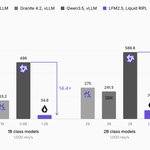
Today, we announce 𝙻𝚒𝚚𝚞𝚒𝚍 𝚁𝙸𝙿𝙻 (real-time inference pipeline), our ultra low-latency inference engine built to put LFMs directly in the request path of real-time workloads like search, ads, fraud, recommendations, and payments.
> complete generated responses end-to-end in sub 50ms
> maintains low latency under continuous peak load
> LFMs get up to 20x faster on RIPL
> RIPL supports Multimodal LFMs
> RIPL supports d1, our decision models too!
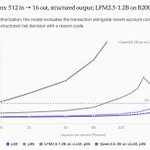
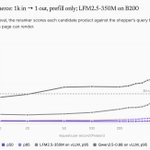
RIPL optimizes the full path from request arrival to a complete generated response. As traffic rises, its performance advantage is greatest on the slowest requests. Let’s see some production use cases:


Liquid AI retweeted

here's our low-latency inference engine,
which is used for sub-20 ms inference for LFMs on production workloads at shopify 🛍️
Today, we announce 𝙻𝚒𝚚𝚞𝚒𝚍 𝚁𝙸𝙿𝙻 (real-time inference pipeline), our ultra low-latency inference engine built to put LFMs directly in the request path of real-time workloads like search, ads, fraud, recommendations, and payments.
> complete generated responses end-to-end in sub 50ms
> maintains low latency under continuous peak load
> LFMs get up to 20x faster on RIPL
> RIPL supports Multimodal LFMs
> RIPL supports d1, our decision models too!
RIPL optimizes the full path from request arrival to a complete generated response. As traffic rises, its performance advantage is greatest on the slowest requests. Let’s see some production use cases:
Liquid AI retweeted

Liquid AIの推論エンジンRIPL
vLLMはたくさんのリクエストをまとめて回すのが得意だが、RIPLは短い入出力を1件ずつすぐ返すことに特化しており、広告やEC検索とかの「数ms以内に返す」みたいなのが求められる場面で活躍しそう
ベンチマーク上ではパラメータが少ないQwen3.5-0.8B+vLLMより、p95遅延が最大約28倍短いらしい
ただオープンソースではなくエンプラ専用っぽいな...
Today, we announce 𝙻𝚒𝚚𝚞𝚒𝚍 𝚁𝙸𝙿𝙻 (real-time inference pipeline), our ultra low-latency inference engine built to put LFMs directly in the request path of real-time workloads like search, ads, fraud, recommendations, and payments.
> complete generated responses end-to-end in sub 50ms
> maintains low latency under continuous peak load
> LFMs get up to 20x faster on RIPL
> RIPL supports Multimodal LFMs
> RIPL supports d1, our decision models too!
RIPL optimizes the full path from request arrival to a complete generated response. As traffic rises, its performance advantage is greatest on the slowest requests. Let’s see some production use cases:
Liquid AI retweeted
Having done my PhD at Criteo, I know how challenging it is to run ML inference at scale under strict latency constraints.
Exciting to see what RIPL can unlock for real-time workloads! 🚀
Today, we announce 𝙻𝚒𝚚𝚞𝚒𝚍 𝚁𝙸𝙿𝙻 (real-time inference pipeline), our ultra low-latency inference engine built to put LFMs directly in the request path of real-time workloads like search, ads, fraud, recommendations, and payments.
> complete generated responses end-to-end in sub 50ms
> maintains low latency under continuous peak load
> LFMs get up to 20x faster on RIPL
> RIPL supports Multimodal LFMs
> RIPL supports d1, our decision models too!
RIPL optimizes the full path from request arrival to a complete generated response. As traffic rises, its performance advantage is greatest on the slowest requests. Let’s see some production use cases:
Liquid AI retweeted
@liquidai keeps delivering, now an enterprise inference engine 🔥🔥🔥
Liquid RIPL (real-time inference pipeline) is an ultra low-latency inference engine built for LFMs to handle real-time workloads.
It aims to return complete responses from small LFM2.5 models (230M to 2.6B parameters) in under 50 ms, and to hold that latency under continuous peak traffic 🚀
Here's a few use cases I can think of:
Payments
Explained authorization. Return the approve or decline decision together with a one-line reason the merchant and the issuer can both read, instead of an opaque score.
Smart retries. Read the decline code and context, then decide in real time whether to retry, switch rails or ask for 3DS, which is where a lot of recoverable revenue sits.
Fraud detection
Session narratives. Feed the last N events (device, IP, typing cadence, cart changes) as text and get back a risk label. A model can catch odd sequences that hand-crafted tree features miss.
Scam intent in payment notes. Flag P2P or wire memos that read like pig-butchering or impersonation scams before the transfer clears, not after.
Security vulnerabilities
WAF and API gateway triage. Classify each request's payload for injection, SSRF or deserialization patterns inline, so it can be blocked rather than just logged.
Pre-commit and CI gating. Score every diff hunk for risky patterns in milliseconds, then send only the flagged ones to a bigger model or a human. This would pair nicely with your pre-audit tool.
Agent tool-call firewall. Check every shell command or tool call an agent is about to run before it executes. At sub-50 ms the agent barely slows down.
Blockchains
Mempool screening. Look at pending transactions for sandwich setups, drainer approvals or calls to known-malicious contracts before they land. Wallets could warn users before they sign.
Validator or RPC-side filtering. Run spam and abuse classification at RPC endpoints, or score bundle risk for searchers and builders, where every millisecond affects whether a transaction gets included.
As AI becomes more ans more integrated into our everyday life, I believe such an engine will become critical to ensure security and correctness of our systems! Congrats on the release 👏
Today, we announce 𝙻𝚒𝚚𝚞𝚒𝚍 𝚁𝙸𝙿𝙻 (real-time inference pipeline), our ultra low-latency inference engine built to put LFMs directly in the request path of real-time workloads like search, ads, fraud, recommendations, and payments.
> complete generated responses end-to-end in sub 50ms
> maintains low latency under continuous peak load
> LFMs get up to 20x faster on RIPL
> RIPL supports Multimodal LFMs
> RIPL supports d1, our decision models too!
RIPL optimizes the full path from request arrival to a complete generated response. As traffic rises, its performance advantage is greatest on the slowest requests. Let’s see some production use cases:
Liquid AI retweeted

This is the fastest LLM end-to-end latency there is; the numbers are genuinely incredible.
If you want to deploy LLMs in streaming, you need this.
Today, we announce 𝙻𝚒𝚚𝚞𝚒𝚍 𝚁𝙸𝙿𝙻 (real-time inference pipeline), our ultra low-latency inference engine built to put LFMs directly in the request path of real-time workloads like search, ads, fraud, recommendations, and payments.
> complete generated responses end-to-end in sub 50ms
> maintains low latency under continuous peak load
> LFMs get up to 20x faster on RIPL
> RIPL supports Multimodal LFMs
> RIPL supports d1, our decision models too!
RIPL optimizes the full path from request arrival to a complete generated response. As traffic rises, its performance advantage is greatest on the slowest requests. Let’s see some production use cases:
Liquid AI retweeted

liquid ai shipped a serving engine that answers a whole request with a small model in under 50ms end to end, fast enough to sit in the live search and ads path where only boosted trees used to fit. shopify's already running it sub-20ms in prod
Today, we announce 𝙻𝚒𝚚𝚞𝚒𝚍 𝚁𝙸𝙿𝙻 (real-time inference pipeline), our ultra low-latency inference engine built to put LFMs directly in the request path of real-time workloads like search, ads, fraud, recommendations, and payments.
> complete generated responses end-to-end in sub 50ms
> maintains low latency under continuous peak load
> LFMs get up to 20x faster on RIPL
> RIPL supports Multimodal LFMs
> RIPL supports d1, our decision models too!
RIPL optimizes the full path from request arrival to a complete generated response. As traffic rises, its performance advantage is greatest on the slowest requests. Let’s see some production use cases: