







Lawrence Livermore National Laboratory retweeted

Postdocs, don't forget! Applications are due Nov. 20 for the Fernbach Fellowship in computational math, scientific computing, CS, data science, and/or scientific ML. computing.llnl.gov/Fernbach

ALT six people stand in a group outside
Through LLNL’s VETS program, veterans and military members will find mentorship and encouragement throughout their careers at the Lab. On #VeteransDay, we salute all who have worn the uniform and served our nation.
What if a lab could keep experimenting after scientists went home, working from their instructions and using the results to help determine what to try next? Explore how super intelligence and robotics are advancing autonomous labs to accelerate discovery: livermorelab.info/4sQ28fE
Congratulations to Livermore’s 2026 postdoctoral team for taking second place in the annual Bay Area Research SLAM! The event brought together postdocs from four national laboratories to share their research. livermorelab.info/4An79z0

Lawrence Livermore National Laboratory retweeted

It was incredible to welcome @Livermore_Lab to the @AuburnU campus. We were blown away by the synergies and similarities in our work to keep the nation safe in this fast-moving digital world. Special thanks to Anup Singh, Nate Gleason, Jovana Helms, Eric Schwegler and Rosaline Cohen Benno and the whole team for a great visit.


What happens during a “shot” at @Livermore_Lab's National Ignition Facility?
@lasers_llnl delivers the real-world scientific insights essential to maintaining America’s nuclear deterrent as the strongest and most credible in the world. livermorelab.info/3VdxNLI

On Tuesday, Nov. 17, from 6–7:15 p.m. at @LPCOfficial, join @Livermore_Lab's Lisa Poyneer and Aaron Lemmer for an exciting presentation on “Sharpening Our View of the Cosmos: Adaptive Optics in Action." Learn more: livermorelab.info/4j0MMBQ

What happens when additive manufacturing meets target fabrication engineering?
An impossibly small, sub-millimeter scale cone that can be manufactured 10 times faster than before, enabling new target configurations for experiments at @lasers_llnl. livermorelab.info/4A9f3fk

Lawrence Livermore National Laboratory retweeted

The National Ignition Facility is "one of the most critical national security assets in America." energy.gov/nnsa/articles/ins… @NNSANews @ENERGY @Livermore_Lab

ALT The target chamber of the National Ignition Facility comes alive with laser light for a fraction of a second during a shot.
From protecting critical infrastructure to natural disaster preparation, accurate weather predictions offer strategic national-security advantages. Explore how LLNL researchers are deploying emulators to provide faster and more accurate global simulations: livermorelab.info/4sIepTl

What happens when a cyberattack disrupts the power grid?
Join @Livermore_Lab's Nate Gleason on Nov. 11 for an exciting lecture on the technologies being built to prevent a cyber intrusion from becoming a physical consequence. luma.com/lprchbdo

LLNL employees gathered for the 2026 Run for HOME! With a 5K fun run, 1-mile walk, costume contest and opportunities to connect with local nonprofits, this annual tradition celebrates the many ways employees make a difference through giving and community engagement.

ALT Employees gathered for the annual Run for Home event at LLNL.

ALT Employees gathered for the annual Run for Home event at LLNL.

ALT Employees gathered for the annual Run for Home event at LLNL.
Inside the gut, on the surface of the skin, and lining your ears, mouth and nose are colonies of millions of microbes. At LLNL, researchers are using that microbiome to predict disease in military service members and civilians. livermorelab.info/4ze90WB

Is dark matter in the room with us?
It makes up about 85% of the universe’s matter, yet we can’t see it directly. In celebration of Dark Matter Day, LLNL's Greg Sallaberry explores its ghostly presence and how scientists are searching for answers.
Using El Capitan's exascale capabilities, researchers developed detailed simulations of the seafloor and ocean to enable highly accurate tsunami forecasts. In a new episode of the Big Ideas Lab, explore how LLNL is pushing the boundaries of supercomputing: livermorelab.info/4zfcbgU
What exactly is the human gut?
LLNL's Nick Be explores how his team replicated the gut in three dimensions, with all its spectacular architecture and activity, on a fluidic chip the size of a microscope slide. livermorelab.info/47h9wXr
A LLNL-developed gamma-ray spectrometer is on the world’s first sample return mission to the Martian sphere. The sensor will help reveal the evolutionary history of the Martian moons Phobos and Deimos. livermorelab.info/4e5KgYl

A devastating tsunami could reach coastal communities in minutes.
What if scientists could accurately forecast its impact in seconds? Using El Capitan, LLNL researchers and collaborators demonstrated just that in simulated earthquake scenarios. livermorelab.info/4zfcbgU
Respiratory diseases can balloon from a few cases to epidemics or pandemics, making them a consideration in national security planning and preparation. Explore how scientists at LLNL are revealing patterns that could improve diagnosis and guide therapy. livermorelab.info/4zYyDuM

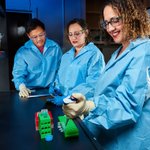
ALT Lawrence Livermore scientists Dina Weilhammer (right), Feliza Bourguet (middle), and Nicholas Hum (left) prep samples for analysis to study Rift Valley fever virus behavior and immune response.
From your phone to fighter jets, rare-earth elements are hidden inside nearly every piece of modern technology. In the Big Ideas Lab podcast, explore how scientists at LLNL are using bacteria to recover these elements: livermorelab.info/4hPhKw9
