

This is the NASA History Office's official X account. We're happy that you share our passion for aerospace history.
- Tweets25.4K
- Following164
- Followers1.2M
- Likes11.6K





ALT View of the Enterprise orbiter as it glides through the sky over the California desert on ALT free flight 5.

ALT King Charles shakes hands with astronaut L. Gordon Fullerton after the 5th free flight of Enterprise in October 1977. Fred Haise is in the foreground with his back to the camera. Behind Charles is Dryden Center Director David R. Scott, and on the right in the background is astronaut John Young. Credit: NASA

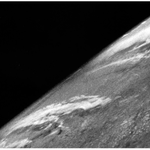
ALT A grainy black and white photo of a small portion of Earth seen with the blackness of space, taken on October 24, 1946. White clouds are visible over the gray of the Earth's surface.

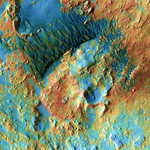
ALT Sand dunes shaped like blue-black flames lie next to a central hill within an unnamed, 120-kilometer (75-mile) crater in eastern Arabia Terra. False colors depict the nature of the ground surface: Areas in bluish tints have more fine sand at the surface, while redder tints indicate harder sediments and outcrops of rock. Credit: NASA/JPL/Arizona State University

ALT Western Arabia Terra: This false-color image was made by combining photos taken at infrared wavelengths during local daytime and late at night. The camera was THEMIS, the Thermal Emission Imaging System, aboard NASA's Mars Odyssey orbiter. Broadly speaking, the colors indicate surface materials, with redder colors showing where rocks and hardened sediments are commonest. Tints of greens and blues map the places where finer-grain materials like sand, silt, and dust cover the surface. Credit: NASA/JPL/Arizona State University

ALT Rabe Crater lies among hundreds of thousands of other impact craters in the rough-hewn southern highlands of Mars. Spanning 108 kilometers (67 miles), Rabe is halfway between the martian equator and the south pole, and west of the giant impact basin Hellas. Two features help set Rabe Crater (and several more in its vicinity) apart from most other craters on Mars. Rabe has a flat floor with a pit sunk into it, plus a large field of dunes. A pair of visible-wavelength images together with numerous infrared ones created this false-color THEMIS view that captures portions of both the pit and the dune field. The colors portray the overnight surface temperatures: bluer colors indicate cold places, redder tints warm ones. Credit: NASA/JPL/Arizona State University

ALT The highlands of Terra Sirenum. The infrared imaging gives scientists clues about the nature of the surface. THEMIS photographs patches of ground twice per Martian day—once in late afternoon and then again just before night ends—two times when contrasts in surface temperature are strongest. In this false-color mosaic, THEMIS researchers have colored in blues and greens the areas that are cold at night, while nighttime-warm regions appear in reds, oranges, and yellows. The tints distinguish areas covered in dust and sand (cool colors) from exposures of bare rocks and deposits free of fine-grain material (warm colors). Credit: NASA/JPL/Arizona State University


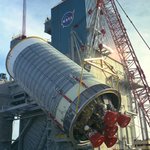
ALT A Saturn V stage is lifted onto the A-2 Test Stand at NASA Stennis (1965).

ALT In this scene at sunset in January 2020, crews at Stennis Space Center lift and install the first core stage of NASA’s Space Launch System (SLS) rocket onto the B-2 Test Stand.

ALT Official astronaut portrait of Ronald E. McNair taken in 1978. A model of a space shuttle appears behind his shoulder.

ALT A heavy beard covers the face of astronaut Walter M. Schirra Jr., Apollo 7 commander, as he looks out the rendezvous window in front of the commander's station on the ninth day of the Apollo 7 mission. (October 20, 1968)

ALT Astronaut Walter Cunningham, Apollo 7 lunar module pilot, wears sunglasses in the brightly lit Apollo Command Module as he writes with a space pen on the ninth day of the Apollo 7 mission. (October 20, 1968)

ALT Astronaut Donn F. Eisele, Apollo 7 command module pilot, smiles through a heavy growth of beard as he is photographed during a momentary pause on the ninth day of the Apollo 7 mission. (October 20, 1968)

ALT In this night-time scene, a United Launch Alliance Atlas V rocket with the Lucy spacecraft aboard launches from Space Launch Complex 41. The launch occured in the early morning of Saturday, Oct. 16, 2021, at Cape Canaveral Space Force Station in Florida.

ALT A dramatic view of Saturn and its rings as viewed by the Cassini spacecraft in October 2016.


ALT NASA's Cassini spacecraft captured this natural color view of Saturn almost a month after the planet's August 2009 equinox. The shadow cast on the planet by the rings remains narrow. Credit: NASA/JPL/Space Science Institute

ALT Saturn's rings obscure part of Titan's colorful visage in this image from NASA's Cassini spacecraft. The south polar vortex that first appeared in Titan's atmosphere in 2012 is visible at the bottom of this view. Credit: NASA/JPL-Caltech/Space Science Institute

ALT Saturn's largest and second largest moons, Titan and Rhea, appear to be stacked on top of each other in this true-color scene from NASA's Cassini spacecraft. The north polar hood can be seen on Titan appearing as a detached layer at the top of the moon on the top right. This view looks toward the Saturn-facing side of Rhea (949 miles or 1528 kilometers across). North on Rhea is up and rotated 35 degrees to the right. Images taken using red, green and blue spectral filters were combined to create this natural-color view. The images were acquired with the Cassini spacecraft narrow-angle camera on June 16, 2011, at a distance of approximately 1.1 million miles (1.8 million kilometers) from Rhea and 1.5 million miles (2.5 million kilometers) from Titan. Image scale is 7 miles (11 kilometers) per pixel on Rhea and 9 miles (15 kilometers) on Titan. Credit: NASA/JPL-Caltech/Space Science Institute

ALT A blue hue, present in the northern hemisphere of Saturn is seen here by NASA's Cassini spacecraft. The changing blue hue marks winter at Saturn and is likely due to reduction of ultraviolet sunlight and the haze it produces, making the atmosphere clearer and increasing the opportunity for Rayleigh scattering (scattering by molecules and smaller particles) and methane absorption. This view looks toward the unilluminated side of the rings from about 44 degrees below the ring plane. Images taken using red, green and blue spectral filters were combined to create this natural color view. The images were taken with the Cassini spacecraft wide-angle camera on July 29, 2013. Credit: NASA/JPL-Caltech/Space Science Institute

ALT Cover of the "Analysis of Apollo 8 Photography and Visual Observations" special report published in 1969. It features the Earthrise image taken by the Apollo 8 crew.

ALT Apollo 7 lifts off from Cape Kennedy Launch Complex 34 at 11:03 A.M., EDT on Oct 11, 1968. The astronauts aboard are Astronauts Walter M. Schirra,Jr. Commander; Donn F. Eisele, Command Module Pilot; and Walter Cunningham, Lunar Module Pilot.

ALT Margaret Hamilton poses in a command module mockup in 1969. Credit: MIT Photo Service

ALT The wheels of the Space Shuttle Atlantis touch down on the dry lakebed at Edwards Air Force Base to mark successful completion of the STS 51-J mission.