

An innovation consulting firm that believes ideas are not enough. We help get your best opportunities to market faster.
Toronto
Joined September 2008
- Tweets4.3K
- Following1.3K
- Followers1.7K
- Likes523







Normative retweeted

Brian Lee from @normativedesign chatted with @mikecommito and @SteveMGravel this week on the pod. He discussed his early days working as a process engineer at Vale to starting and scaling teaBOT, an on-demand tea robot start-up. 🎧
spoti.fi/3iyReIk
apple.co/3mnJ9rb
Ever wondered what the 'Fail fast, learn fast' approach looks like? 📖
🧵A thread on some steps to guide you through it:
#productlaunch #customervalidation #innovation #testing #hypothesis #MVP
1
1


Anthony Bennett stresses that mentorship for junior developers can actually be a win-win situation, as it fosters a learning environment for the mentee and enables the mentor to focus on high-value tasks 👌
#technology #innovation #developers #future #mentorship #engineering

1
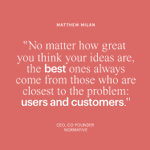
The best ideas come from those closest to the problem: No matter how great you think your ideas are, the best ones always come from those who are closest to the problem: users and customers. Until you have evidence of product/market fit, your idea is just an idea.
1
1
What are your thoughts? Read more here: normative.com/blog/the-ideas…
Laura Ospina on why evidence-based customer journey mapping can be a significant tool for your business and new innovation opportunities 🎊
#productdesign #customers #innovation

1
4) Another method is co-creation. Customers are the experts of their own experience, giving you the evidence needed to identify and highlight their needs, questions, feelings and thoughts throughout their journey.
1
5) If you'd like to learn how to leverage the right evidence for creating customer journey maps, read more here: normative.com/blog/how-evide…
3) One way to observe those behaviours is through ethnographic research. It’s not the only method, but it does allow us to get up close and personal with how people think and feel in response to specific experiential stimuli.
1
1) Every customer experience tells a story. Like all stories, it has a beginning, a middle and an end. With so many moving parts, the best way to capture such experiences is to think of customer experience as a ‘journey’, and visualize it in the form of a map.
1