

Timely features, news analyses and op-eds on EU policy and politics – available in print monthly and digital daily.
Brussels
Joined February 2009
- Tweets37.2K
- Following1K
- Followers38.3K
- Likes1.6K
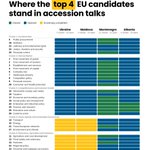


The European Commission will present its yearly enlargement package tomorrow, showing which candidates are on track for membership and which are lagging. It also introduces a new tool: roadmaps with action plans and finish timelines for the frontrunners.
Its 2026 review comes at a complicated moment.
Right-wing parties are gaining ground ahead of a string of national elections next year, which could shift political winds carrying the EU’s enlargement push.
Here’s what to watch before the reports drop: buff.ly/lLp2Nc0

What must an EU Rare Diseases Action Plan contain to become a flagship policy?
We put the question to MEP Stine Bosse (Renew, Denmark) at the Health Summit in Brussels.
Today around 30 million Europeans live with a rare disease. How do we tackle it? Binding targets? Dedicated funding?
Listen to her answer below.
#PMHealth #RareDiseases #EUHealth #EuropeanParliament
On Oct. 25, long-reigning Serbian autocrat Aleksandar Vučić saw his 14-year rule challenged by the electoral success of a student-led civic movement.
But how did a leaderless movement born on university campuses organize itself, withstand the pressures of a hostile establishment and ultimately defeat a strongman who had spent years consolidating control over state resources and the national media?
Read Federica Di Sario's story from Belgrade: buff.ly/BS0Uehg

🔬 From secure satellites to materials tested under extreme forces, Europe's labs are developing tomorrow's security technologies.
But can the EU turn scientific breakthroughs into operational capabilities?
@pausoler98 went inside the EU's research center in Ispra to find out.
Read more here: buff.ly/E3SU3HY

Europe has laid the foundations for a clean hydrogen market. Now it needs to deliver.
European Investment Bank Vice President Marko Primorac points to Europe's strengths in technology, manufacturing and policy support, but warns that high costs and uncertain demand still hold the sector back.
Primorac mentions EIB-backed projects such as OMV in Austria, Iberdrola in Spain and Galp in Portugal, and calls for infrastructure built gradually around industrial clusters and instruments that mobilize private capital.
"The coming years will be defined not by the number of projects announced, but by those that reach investment decisions, construction and operation," he writes.
Read the op-ed: buff.ly/nLTmsg5

Dublin is home to one of the European Union’s largest concentrations of data centers. Last year, they consumed 23% of Ireland’s electricity. Now Dublin and Ireland have become ground-zero for a debate spreading across the EU: as data centers use more and more power, who gets priority on the grid?
“Grid queues are growing everywhere, and they are getting to a point where they are way too big to be reasonable,” said Paweł Czyżak, the founder and CEO of AI and energy think tank Ornaq. “If data centers start colliding with housing or other important societal needs, then it becomes a big social backlash issue, and then you won’t build anything at all.”
Read the full story by @pedersschaefer: buff.ly/06xeoWd

Von der Leyen proposed Canada become an “associate member.” But years of critical minerals talks have yet to produce a real investment.
Ahead of Thursday’s Montreal summit, our reporter Arno Van Rensbergen went to Canada’s industrial heartland to see who’s cashing in.
Read more: buff.ly/lIiillB

Across Europe, anger is spilling onto the streets over rising costs, housing crises, corruption and failing public services.
In Paris, reporter Federica Di Sario examines a youth-led uprising exposing a generation’s growing frustration with inequality and a government accused of not listening.
Read more: buff.ly/yKj4iFx

The EU is overhauling its carbon market to meet the 2040 climate target. But the reform risks weakening the very tool that has guided industrial capital for two decades.
Ursula Woodburn, director of @ClimateCLG, warns that the European Commission's proposal would dilute the emissions cap and add free allowances, while the European Parliament's draft report goes further still.
That could mean €90 billion less spent on decarbonization technologies by 2040, according to a new study by Strategic Perspectives.
Read the op-ed: buff.ly/WIPkAV7

Serbians woke up on Monday to a new political era, as snap parliamentary elections resulted in the ousting of Aleksandar Vučić, the country’s long-standing leader, and the victory of a student movement campaigning on a platform of direct democracy, reports Federica Di Sario from Belgrade.
Read more: buff.ly/MQo9hoj

New members could strengthen Europe’s defenses — but they could also bring new security risks into the bloc.
From military mobility and defense production capacity to candidates’ ties with Russia and China, the EU faces a difficult balancing act as it prepares for its next wave of enlargement.
Read more in The Parliament Magazine: buff.ly/Bc0WtGd

Budapest could cut ties with Rosatom, a Russian state-owned nuclear corporation, as a contractor for the new nuclear power plants meant to replace Hungary’s four soon-to-retire plants in Paks that cover a third of Hungary’s electricity consumption, Reuters reported on Oct. 21.
As we reported last month, new generation Russian-designed reactors could lead to long term structural dependency on Russian nuclear fuel and tech just as Europe breaks away from it.
To know more, read the full story on our website: buff.ly/9TrTaty

The EU wants a bigger role in the Arctic as geopolitical competition intensifies. Its new strategy puts security higher on the agenda, but key questions remain: who will pay, how will it be delivered, and at what cost to the environment?
Our latest analysis: buff.ly/XgoBA6R

The EU is continuing to push for safe AI. But it looks increasingly unlikely that the big players like the United States or China will sign on to an international agreement.
So why is the EU still pushing for a deal?
Read the full story by @pedersschaefer here: buff.ly/zYIEkRa
Fact-checking is indispensable. But inherently reactive.
Rebuttal of foreign information manipulation and interference often comes too late, and corrections do not always change minds, argues Farah Duquesne Weber, CEO of Sierra Tango.
Democratic institutions need their own credible narratives, told in a human voice. German Foreign Minister Johann Wadephul's short videos, Estonia's cyber volunteers and Sweden’s Psychological Defence Agency offer models.
With too much caution, Duquesne Weber writes, institutions cede ground and lose touch with the societies they serve.
Read the op-ed: buff.ly/wq5XnmR

The EU is continuing to push for safe AI. But it looks increasingly unlikely that the big players like the United States or China will sign on to an international agreement.
So why is the EU still pushing for a deal?
Read the full story by @pedersschaefer to find out: buff.ly/zYIEkRa

In Romania’s mountains, human-bear encounters are on the rise.
The government is turning to hunting to reduce conflict, while conservationists argue that better prevention measures could keep all sides safe.
Read the full story by @pedersschaefer: buff.ly/hE7fInB
What’s it like to chase a Eurojob in the era of AI? Fewer entry-level jobs, endless internships and a growing pool of master’s graduates are making it harder to break into the EU bubble.
Read more here: buff.ly/t4C7W2U
Video by Jakub Janas and Anja Košir
In Romania’s mountains, human-bear encounters are on the rise. The government is turning to hunting to reduce conflict, while conservationists argue that better prevention measures could keep all sides safe.
Read the full story by @pedersschaefer: buff.ly/hE7fInB

Amid weaponized supply chains and market distortions, the U.K. is not the source of the continent's challenges but part of the answer, writes Caroline Read, deputy ambassador at the U.K. Mission to the European Union.
Brussels' Industrial Accelerator Act risks fragmenting production networks spanning the Channel, from cars and nuclear power to hydrogen, she argues.
According to her, on the digital economy, "technological sovereignty should be measured by security, resilience and control, not simply geography and ownership."
The EU, she writes, must work with committed partners so it need not choose between competitiveness and cooperation.
Read the op-ed: buff.ly/zUJgFFl
