professor of computer science @Stanford @stanfordnlp, co-founder of @togethercompute, https://xitter.cf/t.co/7R5THVnJ6u, @simile_ai, pianist
Stanford, CA
Joined October 2009
- Tweets1.4K
- Following424
- Followers128K
- Likes2.9K



Pinned Tweet
What would truly open-source AI look like? Not just open weights, open code/data, but *open development*, where the entire research and development process is public *and* anyone can contribute. We built Marin, an open lab, to fulfill this vision:

Recent weeks have made it clear that AI excels at solving research problems. How good is it at proposing *interesting* research problems? Thanks to the ratings of 29 experts across math, stats, CS, physics, we found 1/3 were interesting, and we fully expect this to improve. This raises important questions about the desired relationship between {humans,AI} in {academia,industry}...

AI is now taking on some of the hardest open problems that scientists have posed. But research is broader than solving problems. Can AI also propose research questions that experts find genuinely interesting?
We built After42 to find out. Experts judged 45 of its 135 final questions genuinely interesting, across mathematics, statistics, theoretical computer science, and physics, with wide variation across subfields.
The key idea: develop questions by trying to solve them.
We also asked whether AI can judge which questions are interesting. We find that model judges' top choices align with expert consensus but do not consistently capture individual experts' preferences.
We release the expert-assessed questions as an open resource for researchers to discuss, refine, and pursue, as a step toward integrating AI into the broader research enterprise.
after42.org
The final stretch...

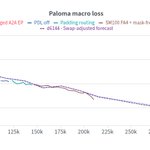
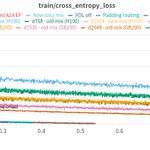
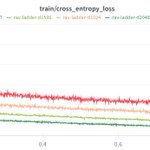
Marin's 535b is now >80% through pretraining! Here’s loss vs. our scaling-ladder forecasts. The sharp drop comes with the 4K→16K context switch, so we're kind of cheating the forecast. (This was planned.) We'll re-eval at 4k too. forge.coreweave.com/wandb/ma…

ALT Forecast versus observed loss: Hero’s evaluation loss falls below both scaling-ladder forecasts, reaching 1.528 at step 314,999. A sharp drop accompanies the switch from 4K to 16K context near step 258,000, making subsequent values not directly comparable with the 4K forecasts. The cooldown mixture begins at step 312,192.
Percy Liang retweeted

I’m starting a new early-stage AI fund, doing what I love: partnering with founders from company formation on bold bets, long before consensus.
The fund’s LPs will include Sequoia, Jeff Dean, Sachin Katti, Philip Wong (my Stanford professor and Chief Scientist adviser to TSMC), and others whose work has shaped our industry and how I think about AI’s future.
I’ll remain a partner at Sequoia and keep serving on my boards on Sequoia’s behalf.
Sequoia has been my home for the past 11 years. I joined as the youngest investor the firm had ever hired. I grew up here. Through years of intense debate and shared work, I found lifelong mentors and friends who took me under their wing and taught me this craft. They taught me to aim high and take big swings. I’ll carry that into what I build: outsized ambition, relentless truth-seeking and curiosity, and a refusal to become complacent.
Working alongside founders has made me want to build something of my own: a firm shaped from day one around the convictions I’ve developed over the past decade.
Life has taught me not to take time for granted. This is how I want to spend mine.
Why now
We’re seeing a new way of building companies in today’s AI era. Research and products often advance together. A breakthrough can open a market or accelerate a business far faster than expected. Some companies require extraordinary capital and compute early on. Others reach meaningful scale with remarkably small teams. The rules for how big these businesses can get, and how fast, are being rewritten.
But early on, the technology is unproven, the resources required enormous, and the vision seemingly implausible.
This is what I love most: seeing the potential right from the beginning, and helping founders realize their full scale of ambition.
More than ever, it starts with an extreme willingness to believe early, with bold, independent conviction in a founder’s technical insight before any product or market validation. Then, it means helping founders take the biggest swings, giving the rare, long-term patience to see those bets through uncertainty, ambiguity, and turbulence, and serving as a level head when the stakes are highest.
I learned this kind of partnership at Sequoia. It’s the foundation of the firm I’m building.
Believing before consensus
My fascination with AI’s potential took root at Stanford in the early-to-mid 2010s, studying computer science and working in Andrew Ng’s lab. The friendships I formed connected me to a community whose people and ideas would help shape modern AI and build some of our generation’s defining companies. What stayed with me was the gap between what those people saw was possible and what the wider world could imagine.
I’m drawn to founders pursuing ambitions that sound impossible today.
I start with a simple question: “What if everything goes right?”
Then we work backward together to make it happen.
In 2023, Deepak and Abhinav set out to build a general-purpose robot brain at @SkildAI, before physical AI was a consensus bet. Their sim-to-real breakthroughs gave me conviction where earlier robotics approaches had fallen short. But the data flywheel required deployment at scale. We made commercialization as urgent as research and brought in strategic partners like NVIDIA and SoftBank to support the ambition. Three years in, Skild is advancing the frontier of physical AI with nine figures in annualized revenue.
In 2024, Ioannis and Misha founded @reflection_ai with an insight into scaling reinforcement learning. As that grew into the ambition to build a Western frontier lab for open models, the hard question was how a startup competes with labs spending tens of billions. An introduction to NVIDIA and many compute calls and recruiting events later, the team has built Beam, now one of the leading US open models.
In 2025, Anna and Azalia, the co-creators of AlphaChip, founded @RicursiveAI to design models and hardware together. From day one, we made early customers and ecosystem partners a priority. Today, they are showing order-of-magnitude improvements on real workloads, working with some of the industry’s most consequential players, and reaching a defining inflection point.
The ambition keeps growing as these companies scale.
@linear has always had a kind of magic to it. Now it’s the system a new generation of AI companies builds on, for teams and agents alike.
@tavus saw early that we’d one day talk to AI the way we talk to each other. Today, it’s building the human computing interface for a world of AI colleagues.
@Mach_Industries began as hydrogen experiments in an MIT dorm room. It has since become one of the most exciting next-generation defense companies.
Making the ambition possible
Being a first believer is only the beginning. Compute falls through. A deep-pocketed incumbent makes your mission its top priority. A breakthrough changes the opportunity and the capital required overnight.
These are stomach-churning moments, and early belief carries a responsibility to help make the bet work.
This is the partnership I love: turning the full ambition into concrete steps. Raising capital, securing compute and strategic partners, recruiting exceptional people, and winning the first customers together. Thinking several moves ahead while solving what’s in front of us. And as breakthroughs open new possibilities, helping founders dream even bigger.
Thank you
To the founders I’ve worked with: thank you for trusting me and Sequoia to be your first partner and first believer. It’s been the joy of a lifetime, and I can’t wait to keep building together.
Thank you to Alfred and Pat for your leadership of Sequoia and your support of my next chapter. To Roelof, for bringing me into Sequoia and believing in me from the beginning. Alfred and Roelof, you have been mentors in investing and in life. So much of what I know, and the investor I’ve become, comes from your guidance and generosity over the years. To Bill, for the close partnership and wealth of knowledge, always wrapped in humility. To Shaun, for showing me how to think deeply and imaginatively. To Michael Moritz, for inspiring 22-year-old me to dream big. To Doug, for teaching me to keep things simple. To Bogie and Jess, for bringing joy to the everyday and perspective on what matters. And to all my Sequoia teammates, for the friendship, camaraderie, and lessons I’ll carry with me.
To my family, especially my husband and my brother, who have each started companies of their own: thank you for giving me the courage to take this leap.
Let’s get to work!
Percy Liang retweeted

Introducing Slingshots // FOUR: 14 projects across eight top institutions. Self-improving agent systems and harnesses, maximally-open models and training data, applications for research and decision-making – plus kernels and more. Say hello to the batch 🧵
Percy Liang retweeted

Together Post-Training is live
Turn open models into custom models you own, with SFT or RL.
You define the data, rewards, environments and the training loop itself. We run the hard infrastructure underneath it, tuned for quality and speed.
Percy Liang retweeted

1/4 Today, we’re releasing Mercury 3. Mercury 3 is by far our most powerful model and the most intelligent diffusion LLM ever released. It outperforms GPT-6 Luna and Haiku 5.5 on quality while running at 1000+ tok/sec.
🤖 Made with AI
Percy Liang retweeted

I've been thinking about where the data for the next generation of open models will come from.
The internet gave us a remarkable commons for pretraining. Posttraining is different: it consumes tasks, not documents. And that commons doesn't exist. Not yet. openathena.ai/blog/there-is-…

Percy Liang retweeted

Releasing FLAT: Flash Linear Attention on TPUs 🚀
Pallas training kernels for Linear Attention, Mamba-2 and GLA. On one TPU v6e, forward + backward is up to 3x faster than FLA on an H100 for GLA, and 1.5x faster for Mamba-2.
🧵

Most classes teaching the algorithms, but a lot of ML is about the empirical intuitions that develop from experience. This class systemizes this process. Assessment is next experiment prediction.

Deep learning is often taught as a sanitized collection of facts and math. But work at the frontier of AI is messy and empirical.
Our new class, Deep Learning Alchemy, aims to teach the art and science of deep learning in the hands-on spirit of Language Modeling From Scratch.
Students build intuition by running experiments on small LMs, then test it through prediction quizzes: given an unseen code diff, can you predict what happens?
deep-learning-alchemy.github…
My co-instructor @kothasuhas and I think there's significant demand for classes that treat students as serious learners who want to be assessed for what they’ve learned, and so we're trying a new exam-heavy approach to the class (7 exams, 85% of the grade, with the remaining 15% in-person discussion assessments).
We’ve designed the class so students can use AI agents to run their experiments and do their assignment, but they then have to demonstrate that mastery on exams without access to the assignment, and any partial credit on the exam has to come through citations to the assignment, incentivizing them to know what’s in their write-up.
The same assignments and quizzes are public for anyone to try (lecture recordings will be released through @StanfordOnline with some delay). We have some very fun assignments and quizzes covering both classic topics (like NQM, run-to-run stochasticity, and scaling laws) and new and timely topics like muP or hyperball. Made by some real experts like @TristanThrush and @wen_kaiyue
Try some quizzes below!

Percy Liang retweeted

Life update: I defended my PhD at @StanfordAILab and recently joined @OpenAI!
Extremely thankful to my advisors (@chelseabfinn & @percyliang), collaborators, friends, and everyone else who supported me along the way. ❤️
Very excited for this next chapter!

Percy Liang retweeted

Today, we’re expanding @SnorkelAI’s Open Benchmarks Grants by 10x to a $30M commitment:
- Funding a more diverse, robust, and continuously-updated ecosystem of open benchmarks
- Launching the Open Benchmarks Red Team to continually test and strengthen them
- Introducing the Snorkel Research Fellowship to support independent contributors developing new evaluation methods
Since our launch earlier this year, we’ve been humbled to partner with the teams behind Terminal-Bench, TB-Science, ARC-AGI-3, OSWorld 2.0, Agents’ Last Exam, Continual Learning Bench, Senior SWE-Bench, SlopCodeBench, and more. Alongside these teams, we’ve helped design evaluation methodologies, develop task construction pipelines, and scale quality control. OBG-funded benchmarks have appeared on the latest model cards from every major frontier lab; have helped to index and measure frontier progress and alignment; and have contributed to guiding the frontier of AI development.
Benchmarks have always been guideposts for—and drivers of— AI progress: setting a metric and then “hillclimbing” against it is the core of how AI works! But when benchmarks fall behind frontier capabilities, our ability to evaluate and align these systems does as well. They become too simple, static, or correlated, and the risk of “benchmaxxing” increases.
We need more diverse, robust, and continuously-updated benchmarks, developed by a broader ecosystem of researchers and domain leaders.
We’re incredibly excited to accelerate frontier evaluation with Open Benchmarks Grants— raising the ambition and investment in robust, open, and independent measurement. Read our full announcement and apply here: benchmarks.snorkel.ai/fronti…

What is the probability that Astra today can generate/forecast a particular new paper past its cutoff date? Naive sampling is intractable (tail probability is astronomically small).
The key idea of priced guidance is that you can lower bound this probability via a dialogue between the model (Astra) and a guide LLM (Astra with the paper), where we can precisely account for the bits of information sent from the guide to the model. One can also can think of this as a new eval for frontier models.


If you would like to learn more, everything is on GitHub (github.com/marin-community/m…), hang out with us in Discord (discord.com/invite/J9CTk7pqc…), where we have active discussions. We also have biweekly meetings where we deep dive into various parts of the stack, open to anyone in the Marin community.

There is a dizzying number of model announcements lately. The Marin Project is not about just producing another model. It’s not even about opening up a static recipe for training a top model. It’s about opening up the dynamic process of discovery - the process knowledge of how to make hypotheses, what to monitor, how to react to experimental results…the science (to the extent we can call it science yet) behind frontier model development.