Win capitalism, lose at life?
Or was Marx just not very good with money..? đ
Either way, a great passage to send to anyone who accuses you of financial frivolity.
"The whole aim of practical politics is to keep the populace alarmed (and hence clamorous to be led to safety) by an endless series of hobgoblins, most of them imaginary."
â H. L. Mencken, In Defense of Women (1918)
Ruth Chang suggests if weâre stuck in a hard life choice, we shouldnât fool ourselves into thinking there must be a âbestâ path; often there are simply different paths, which will change us in different ways. We can move forward by introspecting deeply on who we wish to become...
Today on Philosophy Break: Ruth Chang on Making Difficult Life Decisions philosophybreak.com/articlesâŠ
In his Philosophical Investigations, Wittgenstein suggests the meaning of a language is always rooted in a distinctive âform of lifeâ. If alien intelligences live and perceive the world differently enough, understanding their messages may be forever beyond our reach.
Today on Philosophy Break... Wittgenstein: If a Lion Could Talk, We Could Not Understand Him philosophybreak.com/articlesâŠ
âWhen plunder becomes a way of life for a group of men in a society, over the course of time they create for themselves a legal system that authorizes it and a moral code that glorifies it.â
â FrĂ©dĂ©ric Bastiat, Economic Sophisms (1847)
âThe anthropologists got it wrong when they named our species Homo sapiens (âwise manâ). In any case itâs an arrogant and bigheaded thing to say, wisdom being one of our least evident features. In reality, we are Pan narrans, the storytelling chimpanzee.â
â Terry Pratchett
How are we supposed to live when the world feels broken?
The Stoics, Toni Morrison, C.S. Lewis, and Jane Goodall on facing uncertain times with collective strength and understanding, rather than isolated fear and despair... philosophybreak.com/articlesâŠ
âEverybodyâs hurt,â James Baldwin reminds us. âWhat is important, what corrals you, what bullwhips you, what drives you, torments you, is that you must find some way of using this to connect you with everyone else aliveâŠ
philosophybreak.com/articlesâŠ

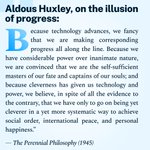
ALT âBecause technology advances, we fancy that we are making corresponding progress all along the line. Because we have considerable power over inanimate nature, we are convinced that we are the self-sufficient masters of our fate and captains of our souls; and because cleverness has given us technology and power, we believe, in spite of all the evidence to the contrary, that we have only to go on being yet cleverer in a yet more systematic way to achieve social order, international peace, and personal happiness.â â The Perennial Philosophy (1945)
The gargantuan scope of the universe need not diminish us, argues the philosopher Robert Nozick. We can identify our lives as part of this vast and continuing natural process. philosophybreak.com/articlesâŠ
The philosopher Iris Murdoch thought our inner lives are too often clogged by the âfat, relentless egoâ. By contemplating beauty in nature and art, however, we can deflate this ego (a process Murdoch describes as âunselfingâ) and open our eyes to reality.
Today on Philosophy Break... Iris Murdoch: âUnselfingâ is Crucial for Living a Good Life philosophybreak.com/articlesâŠ
In Against Narrativity, the philosopher Galen Strawson challenges the popular idea that living well requires a coherent life story. Human life far exceeds the narratives we construct, he argues, and some of us donât experience ourselves narratively at all. philosophybreak.com/articlesâŠ