

REACT is an @imperialcollege-led research programme with @IpsosMORI, using home testing to track England's COVID-19 epidemic.
London, England
Joined October 2021
- Tweets134
- Following20
- Followers627
- Likes30





We are so proud of the REACT study. Thank you to everyone involved across the studies from partners to collaborators and especially everyone who participated.
Our important work will continue with further research into the longer-term impacts of #COVID19.

To everyone who helped make the #REACT study happen, from scientists to kit makers, lab technicians to everyone else involved, and all those who supported them - thank you! 👏👏👏
"The data we've gathered is a really precious resource.
"Now that we have this resource, we want to make the best use of it for public good."
In a new feature, we look back at 5 of the most important things the REACT study has taught us.
Read more: imperial.ac.uk/stories/pande…

🆕 Our latest preprint looked at the most common symptoms that people had when infected with different coronavirus variants.
Our study of over 1.5 million people in England showed changing symptom profiles associated with different variants.
Read more ⬇️
medrxiv.org/content/10.1101/…

"Twin peaks: the Omicron SARS-CoV-2 BA.1 and BA.2 epidemics in England"
Our latest research paper, looking at swab testing data from the final round of our study, is published in @ScienceMagazine.
Read the paper ⬇️science.org/doi/10.1126/scie…

Congratulations to REACT study sponsor Lord Darzi for this award!

Join us in wishing our co-director, Professor Ara Darzi, a huge congratulations on being awarded an honorary degree from @UniofOxford!
Lord Darzi is 1 of 9 to be awarded this prestigious degree, including Sir @LennyHenry and Dr @JaneLubchenco.
Read more: ox.ac.uk/news/2022-05-16-hon…

4
"High rates of vaccination, including booster doses, are a key part of the strategy to reduce infection rates in the community."
Our latest paper in @eClinicalMed reports how boosters and vaccinating 12-17-year-olds reduce #coronavirus infection risk 👇
sciencedirect.com/science/ar…
🆕 Our latest publication in @NatureComms looks at the number of people affected by persistent #COVID19 symptoms in over 600K people in England.
We also identified a number of factors linked with a higher risk of lingering symptoms [🧵].
Read more👇
nature.com/articles/s41467-0…
"Throughout the pandemic, surveillance studies such as REACT and ONS have provided vital insights into disease prevalence over time.
"I was alarmed by the news that the REACT programme was discontinued."
New Op-Ed by @srichardson962 in @bmj_latest ⬇️ bmj.com/content/377/bmj.o900

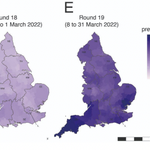
[🧵] Our latest and final REACT-1 survey has recorded the highest number of #coronavirus infections in England since we began our surveillance in May 2020.
Tests on over 100K people from 8-31 March showed 1 in 16 had the virus.
Read more ⬇️
imperial.ac.uk/news/235377/1…
[2] We found that 6.37% of the population in England was infected in March.
This is more than double our previous findings when 1 in 35 had the virus in Feb and 40% higher than the first Omicron peak in Jan.
Read our preprint on the Omicron 'twin peaks': spiral.imperial.ac.uk/handle…

ALT A graph showing the prevalence of coronavirus over time
"The leaps and bounds made in disease surveillance during the pandemic may have a lasting impact on how we track other diseases in the future."
New article on the UK's world-leading #coronavirus surveillance studies, including REACT, in @WiredUK ⬇️
wired.co.uk/article/disease-…
"Much of the value of REACT-1 lies in its continuous nature, allowing it to proactively collect monthly data on emerging variants."
A new perspective piece in @ScienceMagazine highlights the value of our REACT programme.
Read more from @AdamJKucharski ⬇️
science.org/doi/10.1126/scie…

#ICYMI: Yesterday we published new findings from our #coronavirus study.
"Infections are still very high and the possibility that they are rising in older adults may be cause for concern," REACT director Prof Paul Elliott.
Read more in our news story ⬇️
imperial.ac.uk/news/234517/c…

"We never know what to expect as the whole epidemic has been full of surprises, but it's given us cause for concern as older people are more vulnerable, and rising infections could lead to more serious illness."
REACT lead Prof Elliott on @BBCr4today: bbc.co.uk/sounds/play/m00154…
🆕 Findings from our surveillance study:
- #Coronavirus prevalence has been falling but remains high
- 1 in 35 was infected in February
- Infections are flat or rising in over 55s
- Proportion of BA.2 Omicron offshoot has risen substantially
Read more ⬇️ imperial.ac.uk/news/234517/c…
"Future rounds of REACT-1 will be highly informative to answer the unanswered questions and fully understand the effect of the omicron variant and guide appropriate health policies."
A new Comment focused on the value of REACT in @LancetRespirMed: thelancet.com/journals/lanre…
"If we are to get reliable information about the prevalence of Covid, it is essential to maintain studies such as the ONS’s and React."
Prof @srichardson962 highlights the need for ongoing #COVID19 surveillance studies in the @guardian.
theguardian.com/world/2022/f…
🆕 Our paper in @NatureComms is the largest study to look at factors linked with antibody response to #COVID19 vaccination:
➡️ Declining response with increasing age
➡️ Higher response in those receiving an RNA vaccine
➡️ Lower response in men vs women
nature.com/articles/s41467-0…

"Our results reinforce the importance of vaccination and booster campaigns."
🆕 Findings from our REACT-1 study in December have been published in @ScienceMagazine.
📉 #Coronavirus prevalence fell in boosted adults and vaccinated children.
Read more: science.org/doi/10.1126/scie…
#ICYMI: On Wednesday we released our latest findings👇
➡️ Infections rose >3-fold between Dec-Jan, peaking around 5 Jan
➡️ Recent trends show the fall may have stalled at a very high rate
➡️Infections are rising in children, dropping in adults
Read more: imperial.ac.uk/news/233381/f…

🧵New data from our REACT study show that #coronavirus infections in England may have plateaued at a very high level, with the highest recorded prevalence since the study began in May 2020.
1 in 23 had the virus in January.
Read more: imperial.ac.uk/news/233381/f…
🧵The preprint was amended to take account of and highlight limitations in the self-reported infection history data, which mean it is uncertain what proportion of the results are reinfections or recent infections picked up due to the sensitivity of PCR testing. @whippletom