

Bringing Finance Onchain | Institutional EVM L1 with built-in privacy & compliance | Backed by @paraficapital, @hiFramework, @valorcapgroup, @AlexiaVentures
Joined April 2024
- Tweets3K
- Following45
- Followers296K
- Likes1.3K





Pinned Tweet
The Rayls Enygma Public testnet pilot is live.
Private payments on a public chain. Safe and compliant.
Enygma Sovereign already runs in production between banks.
Enygma Public brings the same privacy to public chains, and anyone can try it today.
Check it out here: rayls.com/products/enygma-pu…
Rayls retweeted

Building is easy, sticking with an idea is hard.
@AdamLiposky and @RaylsLabs discuss conviction in a time of infinite solutions.
Have a listen:
Brazil's securities regulator received 11 proposals for its tokenisation pilot, more than three times what it expected.
The CVM's Tokenisation Working Group is now reviewing them for the DLT pilot created by Resolution 249 in October, according to Finsiders Brasil.
The applicants span Brazil's market infrastructure: B3, Anbima, CSD, Liqi, ABToken, and a joint project from BEE4 and Núclea, among others.
Their approaches differ. B3 is testing a second trading environment for tokenised shares. Anbima is building a private, permissioned network. ABToken and ABCripto want to test issuance directly on public blockchains, with access controls and supervision.
At RWA Hour in São Paulo last week, one test was described in detail: tokenised credit, settled delivery-versus-payment in a real-linked stablecoin, with no registrar in the middle.
CVM president Otto Lobo: "The CVM's role is to strengthen the market, present options and provoke this public discussion."
Private networks and public chains, tested side by side under one regulator.
And that is the infrastructure problem Rayls addresses: giving regulated institutions the privacy, compliance, and connectivity to bring real financial activity onchain. In Brazil, Núclea, XP, AmFi and Nimofast already use Rayls in production.
The full story from Finsiders Brasil 👇

Every staked $RLS helps secure the Rayls Public Chain.
Here's how to stake yours:
1. Bridge your $RLS to the Rayls Public Chain through Stargate, from Base, Arbitrum, Optimism, Polygon, Ethereum or BNB chain.
2. Get $USDr for gas in the Rayls dApp, straight from USDC on the same chains
3. Open dapp.rayls.com/stake and choose one of 8 validators
4. Enter how much $RLS you want to delegate, and confirm
Your $RLS stays in the staking contract the whole time, and starts earning rewards from the next epoch.
You can unstake whenever you like, with a 14-day unbonding period.

The future of money will be defined by how financial institutions adopt and integrate digital assets into existing financial systems.
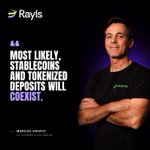
As @mcvviriato explains in EXAME, stablecoins and tokenized deposits will play complementary roles in the evolution of financial markets.
Through Rayls, we're building the infrastructure for banks to issue, manage and transact digital assets while maintaining the privacy, control and compliance their operations require.


I think we’re asking the wrong question about the future of money.
The debate around stablecoins vs. tokenised deposits misses the bigger picture.
Both will have a place in the financial system. The interesting part is how they’ll work together.
Imagine money, assets and payments operating on the same infrastructure, with transactions settling as they happen instead of being reconciled across disconnected systems.
That’s where things get interesting. And it’s already happening.
I shared my thoughts on this in my latest piece for EXAME.
Full article (in Portuguese): exame.com/future-of-money/o-…

1
476
Private payments on a public chain, explained in a few minutes.
@AlexJupiter23 takes you through the Rayls Enygma Public testnet: what problem it solves, what happens when you send a private payment, and how it stays compliant, with an auditor able to read every payment but never move funds.
Watch the walkthrough below, then try it for yourself: rayls.com/products/enygma-pu…
Product AMA, Eygma Public demo teapawt.net/i/broadcasts/2evBXAyPE…

More is coming over the next few weeks, starting with custody accounts through WalletConnect.
Try your first private payment and tell us what you think on X or Discord.
We'll feature the most useful feedback as new features roll out.
Start here: rayls.com/products/enygma-pu…

1
2
294

Rayls retweeted

“The token doesn’t improve a poorly structured asset. It only moves it faster.”
That was the closing synthesis of the Bradesco panel I joined yesterday at their headquarters on tokenising securities and the controls it requires, and it may be the most important sentence in this whole market.
Banco Bradesco is Brazil’s fourth-largest bank by total assets and the second-largest private financial institution, with R$2.085 trillion in assets and 110.5 million clients. In capital markets, it handles R$4.6 trillion in asset under management, R$2.9 trillion under global custody and R$1.078 trillion in the Asset Management. That a bank of this scale is putting the controls around tokenisation on the table says a lot about where the market is heading.
Together with Erik Oioli from VBSO, we worked through one concrete case: a company that wants to tokenise its receivables. Four things stayed with me.
The first questions aren’t about technology. Before any token is designed, you need to understand the asset itself: where it comes from, the contract behind it, who pays, and how it behaves over time. The legal and technical questions come first.
Is the token the right itself, or does it point to the right? This legal choice drives everything downstream: the rules for issuing, transferring and retiring the token, and what the investor actually holds if the retailer doesn’t pay.
The real world changes, and the token has to follow. When the retailer pays, who informs the token? That job belongs to the oracle, the process that carries real-world facts into the digital record. When something goes wrong, the fix has to preserve the history rather than erase it. And if a payment happens but the token isn’t updated, responsibility needs to be written into the contract, not discovered later.
The regulatory path is a design decision. Securitisation, FIDC or crowdfunding under CVM Resolution 88 each fit different situations, and the choice should be deliberate.
This is what four years of building tokenisation infrastructure has taught us. Most of the work happens before the token exists.
Thank you to Bradesco, and especially HUMBERTO Tavares de MENESES and Luana Cota, CCA®, for hosting the conversation, and to Erik for the sharp legal perspective.

Join us live with @x10xalex and @AlexJupiter23 for an AMA at 2 PM UTC to learn more.

Rayls retweeted
Last week, CVM’s Tokenization Working Group received 11 proposals for its DLT Pilot Program. More than three times what the regulator expected.
That number says a lot about where Brazil’s capital market is heading. The question is no longer whether securities will live on DLT. It’s how to do it in a way that regulators, banks and investors can trust.
@RaylsLabs is proud to be part of the working group, contributing our institutional blockchain infrastructure to a pilot built to test and learn together with the other participating companies.
Thank you to CVM for the initiative and for the openness to dialogue with the market, and to ABToken for bringing the participating companies together.
At Parfin, we have spent four years on exactly this question, from the Drex pilots to production deployments with institutions like Nuclea. The main lesson: the technology was never the hard part. The hard part is the whole life of the asset, from issuance to settlement, with compliance, privacy and controls designed in from day one rather than patched on later.
Tomorrow I’ll be at RWA tour event, where around 150 professionals from banks, asset managers, securitisation firms, fintechs and tokenisation companies are coming together to discuss where tokenisation in Brazil goes next. I’ll join a panel on what the technical proposal for Brazil’s new capital market looks like in practice. The three points I plan to push:
- Settlement is the real test. Tokenising the asset is the easy half. The cash leg is where certainty is won or lost.
- Public and permissioned networks will coexist. The infrastructure has to operate across both without breaking compliance.
- Privacy and compliance have to be part of the architecture, not an afterthought.

Getting onto the Rayls Public Chain just got a lot easier.
You can now bridge USDC directly into USDr, the native gas token on Rayls, from Ethereum, BNB Chain, Base, Arbitrum, Optimism, and Polygon, all through the Rayls dApp.
USDr is backed 1:1 by USDC, meaning every 1 USDr is backed by 1 USDC. You can also redeem your USDr back to USDC through the Rayls dApp.
$RLS can also now be bridged to Rayls through Stargate from BNB Chain, Base, Arbitrum, Optimism, and Polygon, as well as Ethereum.
So wherever your USDC and $RLS sit today, you can bring both onto Rayls, ready to stake, swap and transact.