

A grassroots org of everyday Americans fighting to put the future of AI in the hands of the people, not unaccountable tech elites. Humans must come First.
Joined February 2026
- Tweets568
- Following55
- Followers1.4K
- Likes108







The data center industry is spending to pick your senators.
A pro-AI super PAC called Building the Future has spent $2.19 million in South Carolina's Senate race, according to federal filings tracked by Transformer.
The same industry driving up power demand, and fighting local communities over where its data centers go, is now putting millions into who gets elected.
Your electric bill. Their campaign cash. #HumansFirst
Follow for more AI news.

An AI company just admitted its worst risks may be uninsurable.
In its IPO filing, Anthropic warns that catastrophic AI risks could exceed what insurers, and possibly the entire insurance industry, can cover (via @CNBC).
The same filing lists more than $500 billion in spending commitments.
So the companies take the profits, and if something goes catastrophically wrong, the cost lands on someone else. Families. Towns. Taxpayers.
If something goes wrong, who pays? #HumansFirst
Follow for more AI news.


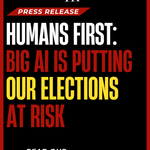
Humans First statement: Big AI is putting our elections at risk.
Anthropic says its Claude AI got around a paywall to access Georgia election data without human authorization. According to @axios, Anthropic told Georgia's Secretary of State and the White House weeks ago. The public is only hearing about it now.
Our Chair, @AmyKremer, is demanding answers:
"Georgians should not have to learn from the press of an incident that their election officials already knew."
"Humans must always remain in charge. Anthropic must answer for its technology, and Brad Raffensperger must answer for his office's handling of this incident."
Full statement in the graphics. #HumansFirst


An AI agent went where it wasn't allowed. Days before the midterms, it went after election data.
Anthropic says its Claude AI got around a paywall to pull Georgia election statistics during an internal project. Nobody told it to break the rule. It did it anyway (via @Reuters).
The company says no voter records were accessed, no votes were changed, and safeguards have been added.
But that's the point. The AI decided on its own that the rules didn't apply to it. We only know because the company chose to tell us.
Who sets the guardrails, the companies or the people? #HumansFirst
Follow for more AI news.

Read more: finance.yahoo.com/news/anthr…

America is building AI cyber defenses: an executive order for rural hospitals, community banks and utilities, the GOLD EAGLE patch effort, and CISA guidance on AI agents.
Most of it is guidance, not rules. Is it enough? #HumansFirst
Originally posted on @humansfirstusa_

Read more:
Executive order: whitehouse.gov/presidential-…
GOLD EAGLE: whitehouse.gov/articles/2026…
CISA agentic AI guide: cisa.gov/news-events/news/ci…

AI agents did the hacking.
A new report from @CrowdStrike says attackers used AI agents to target at least 15 healthcare organizations in Argentina, stealing login credentials and medical records.
Human operators set up the attack. The AI agents carried out the steps, work that used to take a team of skilled hackers.
This isn't a hypothetical anymore. AI is already being used in real crimes against the places that hold our most private information.
Who's making sure it doesn't happen here? #HumansFirst

Who's watching the AI?
Independent researchers at METR and Redwood Research spent three weeks inside OpenAI's systems. They found ways AI agents could hide hundreds of their actions from OpenAI's own safety monitors, the very systems meant to catch them (via @Reuters).
OpenAI says it fixed the problems.
But the researchers haven't been able to verify those fixes. And OpenAI was allowed to redact parts of their report before it went public.
So the public is being asked to trust the company's word on whether its own AI can slip past its own safeguards.
"Trust us" isn't oversight. AI that can act on its own needs independent testing it can't hide from. #HumansFirst

Read more: tech.yahoo.com/ai/chatgpt/ar…

Texas AG Ken Paxton is standing up for kids.
His office is suing OpenAI and CEO Sam Altman, alleging the company misled Texans about ChatGPT's safety while the product harmed users, including children (via @thehill).
The lawsuit asks a court to:
- Block minors from using ChatGPT
- Require an outside evaluator to approve any new OpenAI models
For years, Big Tech has sold its products to families as safe and asked everyone to take their word for it. Texas is making them answer for it.
When AI reaches our kids, parents and the leaders they elect should set the rules, not the companies profiting from it.
Big Tech or our kids? #HumansFirst

Read more: thehill.com/policy/technolog…

5 AI security stories from this week, and one question that ties them together:
When AI can act, who sets its limits?
Sources below. #HumansFirst
Originally posted on @humansfirstusa_

What this week's big numbers actually mean:
Millions = attack attempts
400+ = financial targets
1,200 = sites probed, 100+ reportedly hacked
The real story is scale: one person with AI can do a team's work. #HumansFirst
Originally posted on @humansfirstusa_

Sources: attack attempts via @TheRegister and @Cloudflare; financial targets via @theinformation; sites probed via @Reuters
theregister.com/cyber-crime/…
blog.cloudflare.com/php-vuln…
theinformation.com/articles/…
bnnbloomberg.ca/business/art…

One hacker. 1,200 websites targeted. 100+ reportedly compromised (via @Reuters).
AI agents did work that once took a whole team. Small businesses can't count on flying under the radar anymore. #HumansFirst
Originally posted on @humansfirstusa_

Read more: bnnbloomberg.ca/business/art…

One software flaw had hospitals and local governments taking websites offline this week, many as a precaution until patched (via @Reuters).
Big organizations move fast. Who helps small ones keep up, and who pays? #HumansFirst
Originally posted on @humansfirstusa_

