

The Kinder Institute for Urban Research is an interdisciplinary research organization based @RiceUniversity.
Houston, TX
Joined November 2010
- Tweets12.5K
- Following1.4K
- Followers7K
- Likes2.7K



The Kinder Institute's Houston Education Research Consortium is hosting a free Education Research Engagement Series event exploring findings from Houston and across Texas on student readiness and workforce transitions.
Join education professionals and community partners for research-informed discussions, opportunities to share ideas and a resource fair featuring organizations supporting students beyond graduation.
📅 Friday, Dec. 11 | 2–3 p.m.
📍Harris County Department of Education Conference Center (5th Floor)
6300 Irvington Blvd., Houston, TX 77022
Register: eventbrite.com/e/preparing-s…

Data is an important first step toward developing smart, lasting solutions. But what happens when that data is inconsistent — or worse, inaccurate?
Two years ago, concerns about fairness and due process raised by Lone Star Legal Aid prompted researchers at the Kinder Institute's Center for Housing and Neighborhoods to examine Harris County's eviction court system.
After hundreds of hours analyzing court records and consulting with judges, lawyers and advocacy organizations, the team identified a significant obstacle: incomplete, inconsistent and inaccurate records that made it difficult to evaluate case outcomes and develop evidence-based solutions.
In a firsthand account for Urban Edge, research analyst Andrew Kim shares the challenges researchers encountered and examines how poor recordkeeping can undermine fairness, transparency and accountability within our court systems.
kinder.rice.edu/urbanedge/we…

Utility bills and daily living expenses continue to affect housing affordability across the Houston area.
A survey of nearly 9,000 residents across Harris, Fort Bend, and Montgomery counties from the Kinder Institute found that 6 in 10 respondents experienced difficulty paying for housing over the past year, while 1 in 20 reported experiencing temporary homelessness.
📈 Read the survey snapshot for regional data:
kinder.rice.edu/research/hou…

122
How do we make sure everyday Houstonians benefit from the region’s economic growth?
That question is the foundation of a new, comprehensive report from the Center for Economic Mobility at the Kinder Institute.
Economic mobility is a multifaceted challenge — one that our community partners have spent countless hours and immeasurable resources to address.
The solution won’t be simple, but the realities are clear. From 2020 to 2024:
- Houston had the highest rate of children under age 6 living in poverty among the nation’s 10 largest metros.
- Roughly 13% of local 16-to-24-year-olds were neither in school nor employed — also highest among the top 10 metros.
- Only 60% of households headed by 30-to-34-year-olds earned enough from work to meet a local living standard.
Our researchers are proposing four measurable shared goals, or “North Stars,” that track critical milestones from early childhood to adulthood using public data.
These recommendations equip local leaders with research-backed benchmarks for closing the gap between regional economic growth and residents’ ability to improve their everyday lives.
🏙️ Read the full report to see all four proposed goals, and join the conversation to build coordinated, data-driven solutions across the Houston region:
kinder.rice.edu/research/eco…

The most common indicators of economic mobility capture what’s visible — job totals, wage trends, poverty levels. What about opportunities that could have existed, but never took shape?
The Kinder Institute’s Economic Mobility in the Houston Area report presents employers, educators and policymakers with a fuller picture of the region’s economic potential and raises important questions about the region’s resilience to global economic shocks.
Researchers examined the invisible disruptions following the 2014 oil collapse to hiring, earnings and career advancement, even as the region’s economic growth continued.
Relative to a control group of 50 large metro areas less dependent on oil, per-resident income was about 13% lower and private employment was about 7% lower on average from 2015 to 2019.
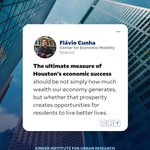
During a presentation of key findings from the report, Center for Economic Mobility Director Flávio Cunha explains what can happen when workers have the skills and credentials to advance, but the opportunities aren’t there.
📊 What are we missing when we measure economic mobility in Houston? Access the full report: kinder.rice.edu/research/eco…
A new Kinder Institute study exploring Houston’s resilience to global market shifts suggests economic opportunity has steadily eroded for Houstonians since the 2014 oil collapse.
The Economic Mobility in the Houston Area report compares Houston to 54 metro areas with less dependence on oil to simulate what the region’s economic growth would have looked like had the collapse never happened. The analysis indicates:
- Residents missed out on $10,700 in income per year from 2015 to 2019
- There were 240,000 fewer private-sector jobs in 2019
- A 10% pay gap for those who stayed employed through the collapse
These findings demonstrate a clearer reality of economic mobility for Houstonians that aggregate measures of regional growth, such as increases in gross domestic product or total jobs, are failing to capture.
📘Full report: kinder.rice.edu/research/eco…

In just a few hours, Kinder Institute researchers will present findings from our first economic mobility report, an analysis examining 15 years of changes in wages, job availability and the region’s leading industries.
Discover what the research reveals about Houston's changing economy and how these insights could inform conversations about pathways to greater prosperity across the region.
This free webinar begins TODAY AT 10 A.M. and includes a live Q&A with the research team.
REGISTER: riceuniversity.zoom.us/webin…

The Kinder Institute’s first economic mobility report is almost here.
How have industry shifts, employment trends and changes in wages shaped economic opportunity across the Houston area over the past 15 years?
Kinder Institute researchers will share findings that offer valuable context for conversations about Houston's economic landscape and pathways to greater prosperity across the region.
Join us for a live presentation and Q&A with the research team.
🗓️ TOMORROW | 10–11 a.m.
REGISTER: riceuniversity.zoom.us/webin…

What does it take to expand economic opportunity for workers in the Houston area?
For organizations focused on workforce development and economic mobility, understanding past changes in employment and earnings can help inform future programs and strategies that support local communities.
Join Kinder Institute researchers for a live webinar presenting findings from the organization’s first economic mobility report.
The presentation will be followed by a Q&A.
🗓️ Tuesday, November 10, 2026 | 10–11 a.m.
REGISTER: riceuniversity.zoom.us/webin…

Despite having one of the nation's largest LGBTQ+ populations, Houston has relatively little local data on the community's lived experiences. The Houston Area L.O.V.E. Survey aims to help close that gap.
A collaborative effort between the Kinder Institute, the Greater Houston LGBTQ+ Chamber of Commerce and the @MontroseCenter , the survey gathered nearly 1,200 responses from across the region.
📊 The Urban Edge explores four key findings and how they contribute to a more comprehensive understanding of Houston's LGBTQ+ community.
kinder.rice.edu/urbanedge/we…

The Kinder Institute’s first economic mobility report offers a new look at the long-term effects of the 2014 oil collapse.
Kinder Institute researchers will explore 15 years of changes in hiring, pay and job turnover, shifts across local industries and how data from less oil-dependent metro areas can help us better understand economic growth in Houston.
The presentation will be followed by a live Q&A.
🗓️ Tuesday, Nov. 10, 2026 | 10–11 a.m.
REGISTER: riceuniversity.zoom.us/webin…

📊 Changing population patterns across the Houston area are reshaping public school enrollment. As neighborhood demographics shift, some local districts face rapid expansion while others experience declining student numbers.
This report from the Kinder Institute analyzes demographic shifts, mobility patterns, and school choice across 68 local districts to help educational leaders plan for the future.
kinder.rice.edu/research/pre…

97
More than a decade after the 2014 oil collapse, how has Houston's economy evolved?
The sharp decline in global oil prices marked a significant turning point for the region, raising questions about employment, earnings and long-term economic opportunity.
Join us live as Kinder Institute researchers present the organization’s first economic mobility report, a 15-year analysis examining changes in hiring, pay and job turnover.
The presentation will be followed by a live Q&A.
🗓️ Tuesday, November 10, 2026 | 10–11 a.m.
REGISTER: riceuniversity.zoom.us/webin…

Kinder Institute research shows that dual-language instruction supports long-term academic growth and lifts overall school performance.
In this study, researchers examined the shift to One-Way Dual Language programs at @PasadenaISD_TX , revealing stronger reading and math outcomes for emergent bilingual students alongside positive impacts on campus ratings.
📝 Read the full report: kinder.rice.edu/research/one…

🏘️ Homeownership in Harris County saw its largest decline in over a decade. At the same time, rising insurance premiums and cost burdens continue to squeeze renters and owners alike.
The Kinder Institute’s 2026 State of Housing report examines the compounding financial pressures facing Houstonians and offers data-driven insights to help build a more resilient region.
kinder.rice.edu/research/202…

After decades of building lives in Houston, thousands of Salvadoran immigrants face uncertainty over their federal immigration protections.
The Urban Edge explores the community’s deep local roots and what potential policy changes could mean for local industries.
kinder.rice.edu/urbanedge/ho…

Houston organizations are finding new ways to address loneliness and strengthen community connections.
In a Q&A with the Kinder Institute’s Urban Edge, @YMCAHouston leader Stephen Ives shares where he’s seeing progress and why he’s optimistic about the region's future.
kinder.rice.edu/urbanedge/qa…

🏙️ Harris County’s housing landscape is changing.
The county added more than 30,000 multifamily units in 2024, while growth in single-family housing was nearly flat — the widest gap between the two in recent history.
The Urban Edge explores what the shift tells us about Houston-area housing:
kinder.rice.edu/urbanedge/ha…

🛒 Kinder Institute research shows 2 in 5 Houston households experience food insecurity, underscoring the need for solutions that go beyond emergency food assistance.
In this Urban Edge commentary, Luz Maria Garcini, director of the Center for Community and Public Health at the Kinder Institute, outlines key actions to strengthen food access and reduce disparities across the region.
kinder.rice.edu/urbanedge/40…

📉 Fertility rates across the Houston area have declined, marking a significant demographic shift for the region.
New research from the Kinder Institute’s Houston Population Research Center explores how fertility patterns have changed by age, race and county — and what those shifts could mean for the region’s future.
kinder.rice.edu/research/dec…
