

The Future of Legal Research, Powered By Super Intelligence.
San Francisco, CA
Joined October 2014
- Tweets6K
- Following349
- Followers5.5K
- Likes16K



Pinned Tweet
“Paul Goldstein, a Stanford Law School copyright professor emeritus who, like Rowling, is also a published novelist, commented on AI training Nov. 10 at the World Intellectual Property Organization's Global Forum for Intellectual Property and AI. Goldstein also compared AI training to using copyright-protectible works as "ideas" to create works that only after creation could infringe another's work.”


Excellent coverage of the ROSS Intelligence petition in TR v. ROSS before the Third Circuit Court of Appeals from @thomsonreuters on Westlaw Practical Law:
content.next.westlaw.com/Doc…

ROSS retweeted

“the Third Circuit’s opinion supports the position that the more the AI is marketed as solving research challenges, the less transformative it becomes with respect to STM content.”
- The decision in TR v. ROSS has far reaching consequences.
🔗 scholarlykitchen.sspnet.org/…

“the Third Circuit’s opinion supports the position that the more the AI is marketed as solving research challenges, the less transformative it becomes with respect to STM content.”
- The decision in TR v. ROSS has far reaching consequences.
🔗 scholarlykitchen.sspnet.org/…
ROSS retweeted
if this is applied to AI training in the United States, training AI will become prohibitively expensive and innovation will freeze. more importantly this would gut fair use in the country which means even more grave consequences for our future. time will tell
“For content owners, ROSS is a powerful new arrow in their quiver: solid precedent that AI companies cannot use copyrighted content just because it’s easy. In fact, Plaintiffs are already citing the court’s “necessity versus ease” standard.” - @Forbes
forbes.com/sites/legalentert…

“For content owners, ROSS is a powerful new arrow in their quiver: solid precedent that AI companies cannot use copyrighted content just because it’s easy. In fact, Plaintiffs are already citing the court’s “necessity versus ease” standard.” - @Forbes
forbes.com/sites/legalentert…

ROSS retweeted
“no decision has a stronger claim to being this year’s worst copyright decision than the Third Circuit’s precedential opinion in Thomson Reuters v. ROSS.”
strong words from @auths_alliance! 👀

“no decision has a stronger claim to being this year’s worst copyright decision than the Third Circuit’s precedential opinion in Thomson Reuters v. ROSS...the court’s ruling could broadly impact authors’ ability to use facts and ideas that first appeared in existing works.”
authorsalliance.org/2026/11/…
ROSS retweeted

An interesting blogpost from @auths_alliance on the amicus briefs filed in relation to the petition for rehearing en banc in TR v. @ROSSIntel. authorsalliance.org/2026/11/…

ROSS retweeted
precisely
“Paul Goldstein, a Stanford Law School copyright professor emeritus who, like Rowling, is also a published novelist, commented on AI training Nov. 10 at the World Intellectual Property Organization's Global Forum for Intellectual Property and AI. Goldstein also compared AI training to using copyright-protectible works as "ideas" to create works that only after creation could infringe another's work.”
“the 3rd Circuit's ruling was cited by 13 of the 26 amicus briefs filed on the side of the plaintiffs in the prominent multidistrict litigation pending against OpenAI in the Southern District of New York. In re OpenAI Inc. Copyright Infringement Litig., No. 25-md-3143.” 👀

Excellent coverage of the ROSS Intelligence petition in TR v. ROSS before the Third Circuit Court of Appeals from @thomsonreuters on Westlaw Practical Law:
content.next.westlaw.com/Doc…
Excellent coverage of the ROSS Intelligence petition in TR v. ROSS before the Third Circuit Court of Appeals from @thomsonreuters on Westlaw Practical Law:
content.next.westlaw.com/Doc…
ROSS retweeted
yup
“By requiring a copier to show it had no alternative to copying under the first factor, and by treating the extraction of unprotected facts and ideas as cognizable harm under the fourth factor, the panel departed from well-established precedent.” - @auths_alliance

ROSS retweeted
📠
“ROSS used headnote-derived questions and graded opinion passages as training examples, then supplied judicial opinions to researchers. For the claimed injury to subscription value, the closer comparison is the information-retrieval function in Authors Guild, not substitute previews in Video Pipeline.” - @JoinFAI

And here's a play-by-play overview of the petition ROSS filed:
“Numerous amici filed briefs in support of ROSS Intelligence’s bid for en banc review by the Third Circuit of the panel’s opinion affirming the grant of summary judgment in favor of Thomson Reuters’ copyright infringement claim.”
Here are some highlights: 1/8 🧵 ↓
chatgptiseatingtheworld.com/…

6
268
“Numerous amici filed briefs in support of ROSS Intelligence’s bid for en banc review by the Third Circuit of the panel’s opinion affirming the grant of summary judgment in favor of Thomson Reuters’ copyright infringement claim.”
Here are some highlights: 1/8 🧵 ↓
chatgptiseatingtheworld.com/…
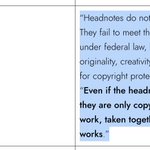
“Headnotes do not enjoy copyright protection...Even if the headnotes are copyrightable, they are only copyrightable as a single work, taken together, not thousands of works.” - @HeatherMeeker4

1
3
60
“the license the panel counted is one a competitor could not have bought. What ROSS’s use cost Thomson Reuters was the ability to exclude a competitor, and copyright law ‘does not confer such a monopoly.’ A monopoly over a work’s function is patent law’s to grant, and only on its ‘more stringent standards.’” - Abraham Kang and Kunal Patel
