






Rasmus Andersson retweeted
As someone who has made countless PLs and compilers: it’s not hard at all, technically speaking. Now that we have coding agents it’s really easy.
Compilers are really hard to write correctly tho, but most recent languages just generate another language (like C) and depend on an existing compiler for that. That’s what Goose does for example.
What’s hard about making a programming language is the design and architecture of it. It’s essentially a puzzle of high dimensionality, ie where one decision affects many other decisions and vice versa.
As a long-time PL hobbyist I think everyone should make their own language, just like I think everyone should make their own TODO app and other personal software
Rasmus Andersson retweeted

Breaking the 500 km/h barrier! ⚡️
The YANGWANG U9 Xtreme has achieved a top speed of 503.17 km/h in Abu Dhabi, becoming the first production car to surpass the 500 km/h threshold.
The FIA has officially recognised this remarkable speed achievement, marking a significant milestone in electric vehicle technology and automotive engineering 🏆
#FIA
fia.com/news/yangwang-u9-xtr…

Rasmus Andersson retweeted

Drag-and-drop makes the digital graspable, but building it well is fiddly enough that many don’t bother. Declarative Dragging (with Josh Horowitz & Jeff Heer, #uist2026 best paper award), lets you make an element draggable just by listing the states dragging it can reach.
The future of software dev might actually be the complete opposite now that we have tools that can improve the quality of discrete, well-defined pieces of software quickly and cheaply.
Instead of spending days of human effort and tens of thousands of dollars in ai compute to build your own brotli (N times for each of your apps?), pool human & ai effort into one impl and just use that. Cheaper, better.
In a few years we might not be programming with text source code even. Things are changing quickly.

Rasmus Andersson retweeted

Hi @rsms—
My background is in business systems, but Inter’s clarity inspired me to build Collab Sans—an open-source rounded derivative—SIL OFL.
Thanks for giving the world Inter!
I’d be honored if you took a look: yugal.one/collab-sans


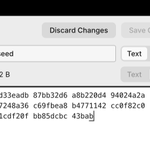
Happy with this little detail in a far-away corner of the upcoming Playbit app: When editing non-text data and typing a partial byte, the matching nibble is underlined as a hint


Rasmus Andersson retweeted

We asked GPT-6 Astra to edit Qwen3.5-0.8B weights to improve math.
It directly changed only 0.016% of weights, fixing 0.8B's reasoning loops & improving math up to 6x and even instruction following 3x, without gradients or training.
We call this Weight-Space Programming: frontier LLMs can now natively read/write neural network weights! 🧵
Blog: rikiyat.github.io/blog/weigh…

Readers added context they thought people might want to know
LLM was given weights explicitly as text in prompt and used code/forward passes (per authors' logs) to ablate Qwen looping direction, a known thinking-mode issue per model card. Primarily fixed repetition in that mode, not general 'natively' improving weights/math.
rikiyat.github.io/blog/weight-sp…
github.com/RikiyaT/lm_und…
huggingface.co/Qwen/Qwen3.5-0…
huggingface.co/RikiyaT/Qwen3.…
Rasmus Andersson retweeted

I think October represents another inflection point in capabilities for coding agents and the models that drive them: Claude Opus 5.5 can now build video games that are actually fun simonwillison.net/2026/Oct/2…

“designing much faster than the others” — this so daft and makes it clear they don’t understand design at all. “Designing fast” (or slow) is just not a thing. If you conflate “producing ui by piecing together stuff” and “design” then the former (which is a form of assembly-line practice) can surely be fast or slow.
What makes the practice of design challenging is not how to put a ui or poster together, it’s what the pieces are, what the message is, what is being communicated, how it all works together.
So many of today’s “design” AI tools focus almost exclusively on the production part, on putting stuff together. I’d love to see an AI design tool that forms a deep understanding of a problem over the course of days or months and works like a creative partner. Call me on my bullshit, thinks about the whole, isn’t concerned really about the final arrangement of elements as much as it would understand the story and the message.

Revolut's designers are moving off Figma.
Storonsky spotted one team designing much faster than the others. What they did:
1. Gave an LLM Revolut's design system at the code level
2. Prompted it to build new flows on top of that system
3. Got a live interface they can click through on a laptop or phone, instead of static frames
Result: 3-4x faster. Now he's pushing it to every designer at Revolut.
His job, as he describes it: find what works in one team and spread it across the company.
Full breakdown here:
productmarketfit.tech/p/revo…
tell your agent:
scan through my email accounts for emails from lists or similar sources. Not directly addressed to me; likely marketing. Put together a list of all sources with an example email link for each. Include buttons that inform you to "unsubscribe me from this"
Rasmus Andersson retweeted

I’m not a recruiter. I don’t get paid to place talent. So I try to find breakout roles for breakout designers in my portcos according to where they might thrive. This is how our collective interests align—to the benefit of all.
Ready for a career move or a design angel? HMU

A special shoutout to @soleio.
Earlier this year, I saw his post offering to help people considering their next career move, so I reached out. We barely knew each other, but he asked me what my 2–3 dream companies were. Linear was at the top of that list.
Without hesitation, he offered to make introductions and continued to be an incredibly thoughtful sounding board as I explored different opportunities.
I was genuinely blown away by his generosity. I hope sharing this encourages others to reach out for help and to pay it forward when they're in a position to do so.


Rasmus Andersson retweeted

Finally summarized what I've been sending to friends in DMs View article

Rust obviously works great with agents because they have intense pre and post training on it. I’ve heard token encoding even has dedicated tokens for some commonly-occurring syntax sequences.
Anyhow, compiling Rust is quite slow, especially if you use 3rd-party libraries. It’s sometimes worse than C++
If you use a lot of 3rd-party libraries and/or work with many worktrees, sccache can make a big difference (it has for me.)
Linking can still be brutally slow. Perhaps @rui314’s mold could help here
If you use macOS you’ll be paying for first launch of newly-built executables because “gatekeeper” will have to check with Apple’s servers before the OS can start your program. If have lots of tests, put them all into one executable.
With C, I can get edit-run cycle down to ~500ms with ThinLTO and 3rd party libs in a dylib (during dev; statically link for release.)
What other tricks are there for improving the edit-run iteration cycle?

