

Managing Partner @Globalive. Co-founder @WINDmobile. Like operating, investing, change. Dislike high government spending, high taxes.
Toronto
Joined April 2009
- Tweets1.2K
- Following2.2K
- Followers1.6K
- Likes924





Goes without saying that this merger makes no sense for Canadian consumers.

Build Canada has published extensive coverage on the topic with author @scheschuk
Read more about how to achieve affordable mobile everywhere in Canada, for good.
🔗: buildcanada.com/memos/afford…

Brice Scheschuk retweeted

This is a thoughtful piece.
I'm genuinely happy for Cohere that they're growing and scaling, but I will admit I've been asking myself a lot of bigger picture questions since this was announced, starting with: what problem does this solve?
Cohere isn't short of capital. Schwarz, Nvidia and Aramco invested. And the $1.68B announced comes after $240M in federal compute funding and stakes from PSP, EDC and BDC in earlier funding rounds.
So if it's not capital, what is the goal? The AI minister himself was quoted in a Betakit article saying the stake gives Ottawa "a seat at the table to control" this technology.
What does that mean? What are the terms of the deal? Is the intent here really for the Government of Canada to control the technology that Cohere is developing? I think Canadians deserve to know what kind of control is contemplated.
Beyond this specific deal, the bigger picture points to an evolving pattern in Canada’s industrial policy.
Equity stakes in private companies have historically only been taken by the Government of Canada in times of crisis to rescue strategically important companies. Most lost taxpayers money, e.g. GM, Trans Mountain, de Havilland. Cohere isn't in crisis, which makes this feel like a new policy direction, not a rescue.
$1.6B in Cohere. A $500M tech fund built to take equity in tech companies. A $1.75B government VC plan. A proposed sovereign wealth fund. Canada Growth Fund. On top of EDC and BDC and our pension funds which have a mandate to invest public dollars.
Ottawa is becoming the owner, the funder, the customer and the regulator of the same companies. That trend towards state-led capitalism is hard to reverse and Canadians should be asking questions abut the long term implications of that direction on our economic competitiveness.
Big picture: Canada wins when markets reward builders, not when ministers pick them.
The better path we might consider is focusing on making Canada the best place in the world to build and scale. Competitive taxes. Faster approvals. Real AI adoption.
We should be focusing on ensuring our most successful companies won't need a federal cheque to stay.

Ottawa is taking an equity stake of up to $1.6B in Cohere, a company with no shortage of private investors.
It follows a $1.75B venture capital plan that entrepreneur groups applauded.
When our entrepreneurs cheer for handouts, 🇨🇦 has a problem
Latest charleslammam.substack.com/p…

Brice Scheschuk retweeted

Our entrepreneurial economy is in freefall.
VC funding is at a decade low. 🇨🇦 founders are leaving. Toronto, Vancouver, and Montreal have shed $66B USD in ecosystem value from their peaks.
Four reforms can turn the ship around.
From @scheschuk: buildcanada.com/memos/capita… 📖

Brice Scheschuk retweeted
"Canada protects its least productive companies and its most unproductive asset class — housing — at the expense of its most ambitious people." - @scheschuk
Let's Build the G7's Fastest Growing Economy.
📰: buildcanada.com/memos/g7s-be…

Brice Scheschuk retweeted
The Liberal Party of Canada under leader Mark Carney has been returned to government with a strengthened minority.
How will they set their agenda?
As a first step, in the next few days, Prime Minister Carney will choose his cabinet – the collection of ministers that lead key parts of the government, e.g. Finance, Defence, Housing, etc.
Since the 1970s, Canadian prime ministers have issued mandate letters to their cabinet to outline government priorities, advise on strategy, and state specific tasks to be accomplished in each portfolio.
In 2015, Justin Trudeau made these letters public. The stated aim was to increase accountability but the reality was very different: Trudeau’s mandate letters were little more than tools for public relations with no clarity about the department’s mission and priorities. Below is an example of one of these letters.
Prime Minister Carney may or may not make his mandate letters public. But, whatever he decides, the letters should be written with an emphasis on immediate action and getting Canada building again.
We have worked with entrepreneurs in our network to craft examples of the kind of mandate letters that could help transform the party’s policy agenda into action. We hope that they will help start a conversation on how this government can turn their bold ambitions into concrete reality.
We will be releasing them later this week.
Review this carefully.

🚨Liberals release costed election platform🚨
➡️ $130B in new spending over 4 yrs
➡️ $28B in undefined spending cuts
Projected deficits:
2025-26: $62.3B
2026-27: $59.9B
2027-28: $54.8B
2028-29: $47.8B
Reminder of past deficits:
2024-25: $48.3B (projected, as per FES)
2023-24: $61.9B
2022-23: $35.3B
2021-22: $90.2B
2020-21: $327.7B
2019-20: $39.4B

1
8
729
This is an important interview by @shaneparrish of @PierrePoilievre. Shane is working to interview @MarkJCarney using the same format. It is important to get past the sound bites and into as much depth as possible with the leaders. Thanks Shane.

Pierre Poilievre (@PierrePoilievre) shares his vision for making Canada the world's best place to build a life—with practical solutions for a more prosperous future.
TKP is not a political podcast—and won't become one. I've invited both major party leaders to share their visions because I'm deeply concerned about how public discourse has degraded into angry soundbites. We've lost the ability to explore complex issues with patience and good faith. This conversation is my small effort to model what better dialogue might look like.
(01:41) Headline vs Reality
(03:55) From Opposition Party to Unifier
(07:05) Parenthood Shapes Priorities
(10:05) Differentiating from the Liberals
(13:44) Economic Value Creation in Canada
(16:48) WEF Opposition Stance
(22:37) Opportunity Has Eroded
(24:07) Balanced Budget Plan
(26:55) Attracting Investments
(34:05) Productivity Gap Explained
(37:30) Tariffs Response Tactics
(39:50) Reducing US Dependency
(42:55) Interprovincial Trade Impacts
(44:20) China
(46:22) Media Accountability Challenges
(50:22) Digital Free Speech Protections
(53:50) Crime
(01:00:40) Access to Health Care
(01:04:55) A modern and effective Canadian military
(01:09:50) AI: balance innovation with protection
(01:12:50) Trust in government post-COVID
(01:14:36) Climate change
(01:17:30) Biggest misconceptions about him
(01:18:30) What success for Canada looks like
This is amazing. Another major new feature launched by @buildcanada. So many have asked how to track campaign promises. Here you go. Cited back to source.


This is big news feature. Please use and let us know what you find. Thanks @lucyhargreaves4
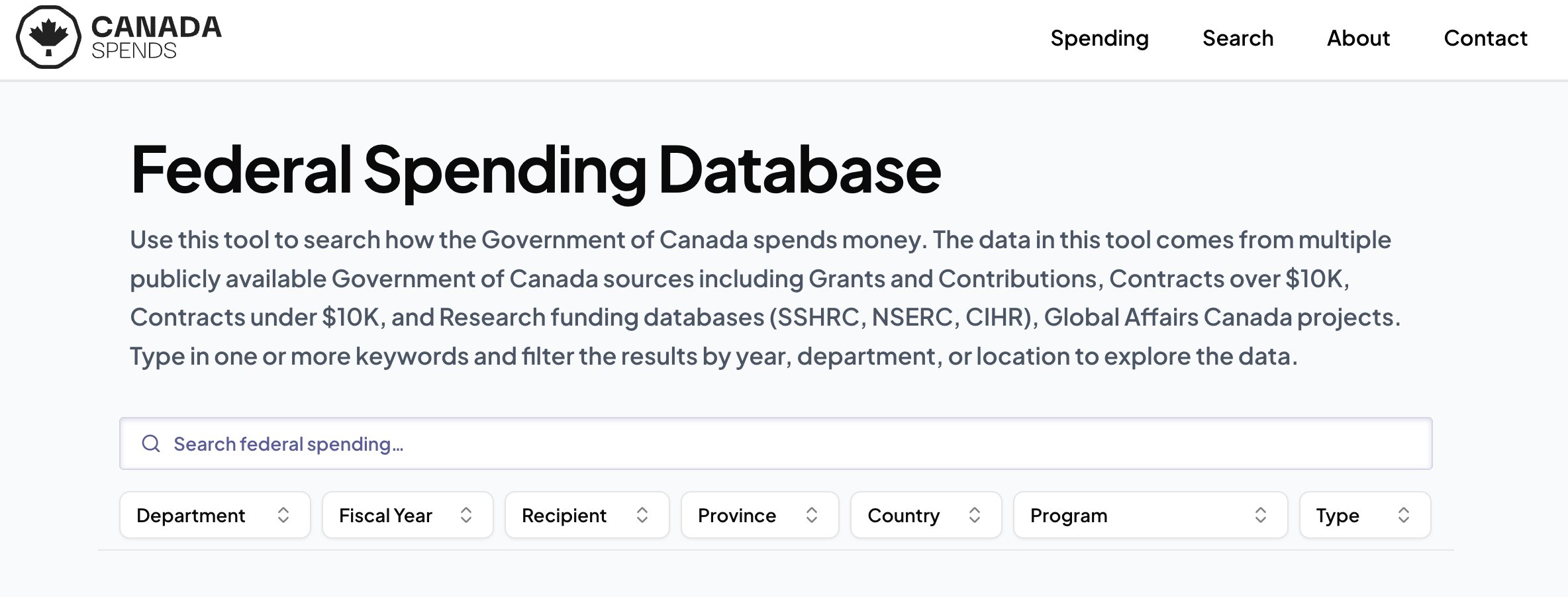
🚨 New Feature Alert 🚨
We just launched a powerful new search tool!
Explore how the federal gov’t spends on grants, contracts & research—all in one place. 🧾💰
✅ Search by keyword
✅ Filter by year, dept, or location
Start exploring 🔗 in 🧵
7
469
Thanks @lucyhargreaves4. I assume this is just a copy paste from The Logic et al. These groups are so lazy. Is this what passes for journalism in 2025? I thought the government was putting out large subsidies to allow them to employ lots and lots of staff...
This quoted post is unavailable.
4
167
Yesterday @buildcanada released memo 23 and it is a big one. @lucyhargreaves4 conducted a mini program review and is proposing many measures to make government more productive. This is mission critical and should be a continuous process in the public sector.
It's time to refocus.
Canada now has the lowest real GDP per capita growth in the G7. Federal government spending has ballooned 45% over the last decade. Our productivity has stagnated, our debt is climbing, and our economy is under threat from a trade war with the United States.
At the same time, services delivered by the federal government are not meeting the standards Canadians expect or deserve. Less than 16% of Canadians feel they get great value from government services.
Policy experts, including former senior public servants, have been ringing alarm bells about challenges confronting the public service, highlighting the need for a reset.
It's time to refocus. For our federal government, this means re-evaluating programs that may no longer serve Canada's best interests.
This process must be done urgently and with transparency. It should be led from within the government by courageous political leaders and with support from our public service. It should be informed by external experts from all parts of our economy and leverage the best talent and technology in the country.
The memo below offers some ideas for how to get started. It identifies $35.1B in potential annual program and operational savings. This is nearly 7% of actual spending and over 50% of the latest $62B operating deficit.
Implementing this plan would mean making hard choices about priorities. But by making tough decisions now, we can ensure the social programs that Canadians value most – like health care, dental care, child care, children's benefits, and benefits for seniors – remain fully funded, while maintaining our commitment to defence and security.
There may be some ideas in here that you disagree with. There are likely things that have been missed. There may be things you’d do differently. That’s okay. The intent is to start the conversation and outline a process and potential opportunities for adjustment that the government can consider.
Now is the time for rigorous assessments and tough decisions. Canada’s economy depends on it.

Today we released the 22nd memo at @buildcanada. We should create a Sovereign Wealth Fund using Canadian resource royalties (and a few other novel funding strategies) to build an investment / compounding machine that will benefit Canadians over a long time horizon. Details below
Canada is one of the most resource-rich countries in the world. But natural resources are finite –you can't keep extracting them forever.
Other nations have been proactive about saving some of the funds generated through natural resources in sovereign wealth funds. These are large pools of money owned by a country, invested in stocks, bonds or other assets, with the goal of saving and growing wealth for the future.
Norway's SWF holds $2.5 trillion CAD. In Canada, we have the Alberta Heritage Fund, but its modest in comparison.
This also exposes Canada to the volatility of markets, with boom-bust cycles that impact families, businesses and investors.
With the accelerating global shift away from fossil fuels, Canada must establish a unified strategy now to capture the value of oil, gas and other non-renewable resources.
How this could work:
1. Foster Partnership Through Shared Benefits – Provinces can choose to join the Fund by putting in their own money. When they do, the federal government matches it—giving provinces more value for every dollar and access to bigger investment opportunities.
2. Legislate the Canadian Sovereign Wealth Fund Act – Create federal legislation that establishes this as an arms-length agency.
3. Implement Diverse Funding Sources – The Fund can be financed through federal revenues (like carbon pricing, royalties, and windfall taxes), provincial matching contributions, and a temporary 1% consumption levy. All funding will be time-limited, transparent, and guided by a clear sunset clause.
4. Return Value to Citizens Through the Canada Dividend – Starting in year 6, 20% of the Fund’s earnings will be paid out annually to all Canadians. The more a province contributes, the more its residents receive—ensuring fairness and public support.
5. Reduce Public Debt for Future Generations – Another 20% of earnings will go toward paying down federal and provincial debt. This eases long-term burdens on taxpayers and builds lasting fiscal strength.
6. Leverage Canada’s world-class investment capabilities – The Fund can use Canada’s top institutional managers (like CPPIB) to invest in global infrastructure and real estate. Strict cost caps, passive index investing, and competitive performance reviews will keep it efficient and effective.
7. Ensure Rigorous Oversight and Transparency – Regular audits, clear reporting, and legal firewalls will protect the Fund from political misuse. Canadian investments will be limited to 10% of the portfolio, with strict repayment rules if returns fall short.
This is our chance to turn Canada's natural wealth into a permanent economic engine. Just as past generations built the roads, bridges, and institutions we depend on today, we now have the opportunity—and responsibility—to build the financial foundation for a stronger, more secure future for all.
Read the full memo below:

We released out 21st memo at @buildcanada. Many issues with the state of readiness of our military and our approach to long term procurement and planning. We need to meet our NATO commitments, but also need a baseline level of military preparedness to defend our sovereignty.
Canada faces a possible great geopolitical threat to our country and yet 72% of our armed forces are overweight and half of our military equipment can't be deployed.
Canada promised NATO we'd spend 2% of our economy on defence. We're not even close. We currently only spend around 1.4%, among the lowest of any NATO member.
The way we buy equipment is broken. Complex procurement systems that require sign off from multiple stakeholders means it takes more than 16 years on average to buy and approve new gear. Imagine trying to fight today’s wars with 2008’s tools.
We also don’t make enough of our own defence technology. Most of our gear comes from foreign companies, who build with their own country’s interests first. Only 1 of Canada’s top 30 companies works with our military. In the U.S., 5 of their top 10 companies do.
If we keep this up, we will lose out on jobs, innovation, and global influence. Worse, we will lose our ability to defend ourselves. But we can turn this around:
1. Create an Office of Strategic Capital to invest more in Canadian defence tech – create and fund a strategic office to help invest in companies working on deep tech and defence innovation
2. Speed up procurement – pass an immediate Order in Council to streamline procurement requirements to be less rigid and faster to meet
3. Form partnerships with military tech partners – collaborate with leading defence tech companies to make Canada the testing ground for new systems. Our Arctic and southern borders in particular are ripe testbeds for autonomous machines and AI.
4. Allow Canadian defence tech to be sold abroad – remove restrictions on selling defence tech to trusted allies and emerging strategic markets
5. Shore up our Armed Forces – Introduce tuition reimbursements, signing bonuses and competitive salaries to boost military recruitment and retention.
6. Commit to non-partisanship – Have all major parties commit to defence strategies in order to maintain long-term continuity
7. Separate DND and CAF – The Department of National Defence should take full responsibility for defence procurement and geopolitical strategy, while the Canadian Armed Forces should focus solely on warfighting and operational readiness.
Through these efforts, Canada can modernize its military, create good jobs, innovate R&D and defend our borders.
Read the full memo below:


3/3 - Last but not least, we need to fix our restrictive real estate zoning rules. We need residential density and our rules are not set up for this.
In most Canadian cities, it remains illegal to build anything but single-family homes on the majority of residential land.
Toronto reserves 70% of residential land for detached houses while Vancouver restricts 76% to single-family homes. Townhouses, duplexes, triplexes and six-plexes are not allowed. This artificial constraint on supply drives prices skyward.
Even when multi-family housing is theoretically allowed, the mechanics of the approval process “kills” projects through bureaucratic hurdles causing extensive delays. The average housing development takes 2-5 years to approve in major Canadian cities, the second-worst of OEC countries.
The consequences are devastating. Since 2000, home prices have grown over 400% in Toronto and at similar rates in Vancouver. In these markets, Canadians now need to spend 28 years or more of their full income to afford a home, compared to 5-7 years in the 1970s.
Let's leverage federal powers to drive reform at all levels of government:
1. Create Housing Municipal Growth Ombudsmen in major centres – Require that all cities with populations over 100k must appoint an independent Housing Growth Ombudsman with the power to fast-track housing approvals.
2. Amend the National Housing Act to establish national zoning standards - Include defined minimums for residential density near transit and job centers.
3. Launch a National Building Code Modernization Initiative – Develop updated national model codes that streamline requirements, standardize approvals across jurisdictions, and incorporate innovations like single-stair mid-rise designs.
4. Forge a Housing Growth Agreement with Ontario and British Columbia – Negotiate formal agreements under the Federal-Provincial Fiscal Arrangements Act to align provincial policies with national housing goals.
5. Reform CMHC mortgage rules to support gentle density – Update lending guidelines to facilitate financing for small apartment buildings, secondary suites, and co-housing arrangements.
6. Establish a Build More Homes Data Initiative – Launch a public dashboard tracking key housing metrics for every major city, including permits issued, approval times, and housing starts relative to population growth.
These reforms will increase housing starts, make more efficient housing forms, dramatically reduce approval times, and put homeownership back within reach for the next generation.
Read the full memo below:

2/3 - We need to sort out student housing. Every post-secondary student I know is struggling with access to housing and rents.
Some of the world's brightest minds study in Canada. Yet, we're failing to build the housing to adequately house them.
An estimated 1.2 million students in Canada struggle to find affordable housing each year. Experts estimate that Canada needs at least 300,000 additional beds nationwide just to meet current demand.
The housing crisis impacts student well-being directly. In Nova Scotia nearly half of students report skipping groceries to cover rent payments. In university cities like Halifax, rents have surged 18% in a single year.
The problem is getting worse. Post-secondary enrolments have almost doubled since 2000, while on-campus hosing construction has stagnated since the 1990s. Universities have increased international enrolment without corresponding increases in PBSAs.
Canada needs to urgently build more student housing, for both our domestic students and international:
1. Adopt and expand Ontario's Bill 185 nationwide through federal-provincial agreements – The feds should work with provinces to implement liberalization of planning rules for PBSAs, and create tax exemptions for student housing projects.
2. Reform CMHC lending policies specific to student housing – Loosen some restrictions on debt service coverage ratios specifically for student housing to make it easier for developers to borrow money to build these homes.
3. Mandate that post-secondary institutions issuing international student visas develop comprehensive housing plans – schools should have a demonstrated plan to accommodate grow before the feds issue visas for them.
4. Create a national student housing data strategy to drive accountability
The student housing crisis threatens one of Canada's greatest assets—our world-class education system. By implementing this national student housing strategy, we can add 300,000 new student beds within five years, improving educational outcomes, boosting economic growth, and relieving pressure on housing markets nationwide.
Read the full memo below:

3
171
1/3 - I fell behind on X last week. @buildcanada published five housing memos and I am going to post the latter three (I posted the first two last week). If all five memos were implemented it would be a game changer for housing policy in Canada.
Canada desperately needs more homes but our regulatory environment actively prevents people from investing in building them.
For example, British Columbia recently enacted 20% anti-home-flipping tax applies to properties held for less than a year. These policies were created with good intentions – to protect housing affordability by discouraging speculation.
But these blunt instruments often fail to distinguish between harmful speculation and investments that increase housing supply. Yes, we've reduced some speculative purchases that would leave homes empty, but we've simultaneously cut off capital that would build the housing we desperately need.
Most new home construction needs pre-sales and/or substantial funding in order to go ahead. Yet, current policies stifle the ways in which builders can raise funds.
The consequences are evident in the numbers. Residential investment is below pre-pandemic levels. Housing starts decreased by 7% in 2023. A lack of new supply translates directly to a worsening housing crisis for Canadian families.
Let's create targeted reforms that maintain protections against harmful speculation while reopening pathways for investment that actually building housing:
- Create a foreign investment exemption for new housing development – permit foreign investment for developments of 4+ units, provided units are made available for occupancy on completion.
- Establish a graduated speculation tax system based on property use – Replace the current one-size-fits-all-approach with a tax system that distinguishes between different property uses. Properties held vacant would face the highest taxes, while properties made available for rent would receive substantial relief.
- Require banks to offer interest rate capped pre-construction mortgages – require Canadian banks to offer financing options that guarantee interest rate maximums for qualified buyers of pre-construction properties, giving them the stability and security they need to invest.
- Direct incentives for investors in areas of need –Remove all restrictions on investments in the neighbourhoods most in need of new housing (in need of revitalization, near public transit etc.)
These reforms maintain important protections against harmful speculation while creating clear pathways for investment that increase the homes we desperately need.
Read the full memo below:

1
16
805
100% agree @harleyf. Thanks @JoelDWatson. Your pen is mighty and I couldn't have said it better.

I don't know @JoelDWatson well, but he totally nails this:
"Canada has suffered a lost decade. Canada needs to build and it needs to enlist its most productive and innovative minds to do it. When they volunteer, don't throw stones if you have nothing to add. Pick up a hammer and work or as I was taught in the army - lead, follow, or get out of the way"
open.substack.com/pub/joelwa…
281
We launched the new @canada_spends website today. Canadian government spending continues to become alot more transparent. I can't believe what we are finding.
This week is housing week at @buildcanada. Five days, five memos. Second is “Build Rental Housing Again” written by @mazyarmortazavi, CEO of @tas_impact. We haven't built rental housing stock at scale in 50 years. Time to change that. Details below.
Canada stopped building purpose-built rentals in the 1980s.
One third of Canadian households rent (up 21% since 2011). Yet we stopped building the homes specifically made for long-term tenancy.
This shortage has sent rents soaring. 1 in 5 renter households now faces a core housing need, meaning they spend over 30% of their income on shelter, live in overcrowded conditions, or in substandard housing.
This crisis particularly affects essential workers – the nurses, teachers, police officers, and service workers our communities depend on.
For example, a newly graduated nurse earning $70,500 in downtown Vancouver would need to spend around $2,500 or approximately 55% of their after-tax income on an average one-bedroom apartment. The alternative – living in a more affordable suburb – might save money but could add 2-3 hours of daily commuting.
This crisis can be addressed through a comprehensive federal approach focusing on three key strategies:
1. Strengthen Canadian Mortgage Housing Corporation Programs – Enhance CMHC programs to provide preferential financing and streamlined application processes for projects that prioritize key workers.
2. Revitalize Tax Incentives for Rental Housing – Offer tax incentives for rental projects that favour long-term affordability, and discourage quick property flips.
3. Introduce a Renters' Tax Deduction – To achieve greater tax parity between renters and homeowners.
4. Optimize the Federal Lands Initiative for Key. Worker Housing – Prioritize properties near hospitals, schools and essential service hubs for key worker housing development.
Through targeted tax incentives, we can add an abundance of new rental housing, ensuring that the very people who serve our communities can afford to live in them.
