







Pinned Tweet
Big news: StackAI is joining @asana!
We created StackAI to empower enterprises with secure, powerful agentic workflows that automate manual processes; Asana created the operating system for human-agent teams.
Now, we're building the place where humans and AI agents execute across every system a business runs on.
Same product, same team, same brand, and way more fuel.
We're just getting started. 🚀
𝗖𝗮𝗹𝗹𝗶𝗻𝗴 𝗮𝗹𝗹 𝗿𝗲𝗮𝗹 𝗲𝘀𝘁𝗮𝘁𝗲 𝗽𝗿𝗼𝗳𝗲𝘀𝘀𝗶𝗼𝗻𝗮𝗹𝘀: StackAI has agents for investment, brokerage, property management and REIT teams.
The agents work inside the systems you already use. 🙌🏻
𝗜𝗻𝘃𝗲𝘀𝘁𝗺𝗲𝗻𝘁 𝗮𝗻𝗱 𝗮𝘀𝘀𝗲𝘁 𝗺𝗮𝗻𝗮𝗴𝗲𝗺𝗲𝗻𝘁 → Agents read OMs, Excel pro formas and market data and draft sourced investment memos in your template. Teams evaluate more deals and decide faster.
𝗕𝗿𝗼𝗸𝗲𝗿𝗮𝗴𝗲 → Pitch more listings and win more mandates with OMs, BOVs and leasing decks that agents build in Gamma or your own slide templates.
𝗣𝗿𝗼𝗽𝗲𝗿𝘁𝘆 𝗺𝗮𝗻𝗮𝗴𝗲𝗺𝗲𝗻𝘁 → Agents pull 50+ cited terms from every lease, triage work orders and report arrears inside Yardi, AppFolio or MRI, so managers can handle more units with the same team.
𝗥𝗘𝗜𝗧𝘀 𝗮𝗻𝗱 𝗽𝗿𝗼𝗽𝗲𝗿𝘁𝘆 𝗼𝘄𝗻𝗲𝗿𝘀 → Agents turn lease libraries in SharePoint into structured data and prepare IC-ready memos, helping teams act on deals faster and catch lease risk early.
Clients are already seeing big changes. One national property manager cut lease review time by more than 70%. One national REIT cut OM review time by 60%.
See how other real estate teams are using StackAI 👇
stackai.com/solutions/real-e…
No doctor wants to fill out prior authorization forms. At Asana's Work Innovation Summit, StackAI's Max Poff and Alberto Arrighi had the room build an AI agent to do it in 30 minutes.
They built the agent in StackAI to:
1. Take in the patient's email address, an audio recording of the visit and the prior authorization form
2. Transcribe the recording with a built-in voice-to-text model
3. Write and run its own code to fill out the form
4. Email the patient a summary of the visit
Then they tested it in real time. With StackAI's VP of Healthcare, Shani Fargun, as the doctor and Max as a patient with severe abdominal pain, they recorded a visit covering his allergies, medication and diagnosis, then hit run.
A couple of minutes later, the completed form and the patient's summary email were ready.
StackAI also kept the patient data protected. We have signed agreements with every major AI model provider on how data is handled. Healthcare teams can run their agents on dedicated servers, in a private cloud or on-site, and every agent can only take the actions its builder approves.
See every agentic workflow you can run in healthcare with StackAI👇
stackai.com/solutions/health…
#AgenticAI #HealthcareAI #EnterpriseAI


Every AI team heading into 2027 👀
(P.S. StackAI customers get a forward-deployed engineer and a no-code platform to turn AI pilots into real use cases—and real results 😉)

October was one for the books at StackAI. Here's everything we shipped:
✅ 50+ new integrations across HR, finance, data and security tools
✅ Self-Healing Workflows, which catch quality drops and test a fix for your team to approve
✅ Sign into apps from chat. Embedded agents push account connection cards directly into conversations.
✅ Schedule Runs on any custom schedule and time zone
✅ New models, including Claude Opus 5.5 and GPT-6 Sol
See the full changelog 👇
stackai.com/changelog?utm_so…

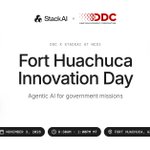
StackAI is heading to Fort Huachuca!
StackAI will join Diné Development Corporation at Fort Huachuca's Innovation Day, hosted by National Conference Services, Inc. (NCSI). The event brings government and industry together to match mission needs with new technology.
Stop by our exhibit to:
→ See how teams build AI agents into complex workflows
→ Securely connect agents to the systems you already use
→ Explore use cases like automating ATO documentation
→ Learn about deployment, audit-ready compliance and human controls
📍 Murr Community Center, Fort Huachuca, AZ
🗓️ Tuesday, November 3, 8:30am to 1:00pm MT
Details and registration in the comments. 👇
#FortHuachuca #InnovationDay #AgenticAI #GovTech

𝗝𝘂𝘀𝘁 𝘀𝗵𝗶𝗽𝗽𝗲𝗱: StackAI's Self-Healing Workflows. Higher-quality agent outputs, without hours of debugging.
Usually, when an agent fails, someone has to dig through the runs, find the cause and fix the workflow by hand.
Self-Healing Workflows take that over and turn it into a simple approval process. When an agent's quality slips, StackAI finds what went wrong, tests a fix and sends it to your team to approve in one click.
You define what the output looks like and with every run, StackAI scores the agent's result against it. When a score falls below its threshold, self-repairing starts automatically.
Then, StackAI:
1. Pulls out the failed cases and explains the cause
2. Proposes a fix in plain language
3. Tests the fix on a draft workflow, not in production, and reruns the evaluation so you can compare scores before and after
Self-Healing Workflows send suggestions automatically, but approval always stays with your team. The result is less time spent debugging and higher quality outcomes.
J.J. Miller, our product lead, gives it a quick breakdown below 👇
Learn more about StackAI's Self-Healing Workflows here --> bit.ly/4zkxoWI

StackAI's deployment team just got bigger. Meet the 3 newest forward deployed engineers.
👋 👋 Yixin(Annie) Liu is based in San Francisco. She recently finished a Master's in Business Analytics at MIT, after studying Applied Mathematics and Economics at UC San Diego. She's excited to help businesses turn innovative ideas into real-world solutions.
👋 👋 Brian Mann is based in New York. He just finished a Master's in Data Science at NYU, and before that he was a data engineer at a healthcare analytics company. Outside of work, you'll find him running, traveling and exploring NYC.
👋 👋 Nathan Wangidjaja recently finished a Master's in Business Analytics at MIT, after studying Computer Science at Columbia University. He's excited to help businesses turn AI into tools they actually use.
Welcome to the team, Annie, Brian and Nathan!
#EnterpriseAI #AgenticAI #Hiring

We just hit 500+ integrations 🎉
That means your AI agents can work with the systems your teams already use, like Google Drive, Notion, Slack, Asana, Airtable, Jira and AWS.
The team has been working toward this for a while, and we're excited to finally share it.
See every integration 👇
stackai.com/integrations?utm…
Our document indexing errors dropped from ~20% to below 0.1% after we moved to Temporal Technologies.
Before an agent can use a customer's documents, our pipeline has to parse and index every file.
On our old setup, when one step failed, the retry started over from the beginning, including paid steps that had already worked.
So we moved the pipeline to Temporal incrementally. Now each stage remembers where it left off, and a retry only re-runs the step that failed.
Parsing costs are down to about a tenth of what they were. And customer complaints about indexing have stopped.
Our CTO Frank Hidalgo and AI engineer Gabriel Mermelstein wrote up how we did it 👇
stackai.com/blog/how-stackai…
Complex AI use cases don’t fail at the build stage. They fail at integration, security and deployment.
Most platforms hand you a builder and leave the rest to your team. StackAI pairs every customer with dedicated experts:
→ An AI strategist who finds use cases where agents pay off and tracks the ROI
→ A forward-deployed engineer who builds custom integrations, deploys on-premise and trains your team
→ Support in Slack, Teams or email, plus live calls when you need them
It starts with a structured proof of value: three use cases in production on the StackAI platform, running on your data and systems.
Learn more on our blog → stackai.com/blog/stackai-giv…
#EnterpriseAI #AIAgents #AgenticAI
What if research and optimization could keep running while your team sleeps?
At @stackai, we used @OpenAI 's latest models in Codex to optimize our browser agent—with minimal hands-on time.
@asana's Command tracked every run and turned the results into updates that shipped to StackAI.
𝗧𝗵𝗲 𝗿𝗲𝘀𝘂𝗹𝘁: 76× cheaper and 5× faster in our week-long experiment.
Every night our agents aren't running feels like a wasted night.
Full story here: stackai.com/blog/how-stackai…
Introducing Custom Actions. Build the exact action your workflow needs, on the apps you already use.
StackAI's native actions cover the common operations: create a record, send a message, look up a row. But the steps that matter most, like setting a priority or applying a naming convention, are unique to how your business works, and they're usually what's missing.
Now you can build it yourself, just by describing what you need.
𝗛𝗼𝘄 𝗶𝘁 𝘄𝗼𝗿𝗸𝘀|
- 𝗗𝗲𝘀𝗰𝗿𝗶𝗯𝗲 𝗶𝘁: pick the app and tell the StackAI agent what the action should do. It reads the app's API docs and writes the schema and code for you.
- 𝗧𝗲𝘀𝘁 𝗶𝘁: run it against a real connection before any workflow depends on it.
- 𝗦𝗵𝗶𝗽 𝗶𝘁: it appears in the builder and every agent's tool list, right next to native actions.
🔒Actions run sandboxed on connections your admins already manage, and each saved version is locked, so IT stays in control and an edit never breaks what's already running.
One example of what Multi-Agent Teams on @stackai can do: a weekly SEO report. ✨
You build one agent and ask it for the report. It works out that the job needs:
- traffic and behavior from Google Analytics
- rankings and impressions from Search Console
- backlinks and competitive position from Ahrefs
- strategy and history from a knowledge base
The agent creates a sub-agent for each, runs them in parallel, and combines the results into one report.
This is the simplest version of it. The same agent handles claims review, diligence, or RFP responses, and it goes well beyond a single report.
Build one agent. It executes the rest.
StackAI retweeted

StackAI launched Multi-Agent Teams! 🤖
Here's the problem we built it to solve 👇
A customer's agent works well when asked to do five tasks. At fifteen it starts getting unreliable. At thirty it's guessing.
Every time you widen the scope, you expand the decision space the model searches on every single call, and every new instruction competes with the ones already there. You're not making the agent smarter… you're making the problem harder.
Now, instead of one model doing everything, an Orchestration system routes each job to a Sub-agent that only knows what it needs to know: its own instructions, its own tools, its own knowledge bases. Narrow scope, fewer wrong turns. They run in parallel, and the Orchestrator brings the results back as one accurate output.
Same models. Same tools. Better architecture.
Multi-Agent Teams are live on StackAI. 🎉
One agent doing everything is a ceiling. So StackAI built the alternative:
1️⃣ An Orchestration System breaks a complex request into specific jobs
2️⃣ Sub-agent specialists execute them in parallel- own instructions, own tools, own knowledge bases
3️⃣ The Orchestration System synthesizes everything into a single, highly accurate output
Any workflow you've already built attaches as a Subflow Tool in the StackAI platform and becomes a specialist agent, nothing to rebuild from scratch.
f.mtr.cool/t3othae6u5
