

Explore billions of distant, uncharted worlds on one of the most detailed starships ever made. [email protected] Press Kit: https://teapawt.net/t.co/HvNA1qhQW8
Somerset. UK
Joined May 2020
- Tweets4.2K
- Following1.5K
- Followers4.1K
- Likes44.9K




Pinned Tweet
There are many great space sims out there. Some feature beautiful ship interiors, some have stunningly realistic galaxies, and others have impressive simulated ship systems. There's even software that allows you to soar through the cosmos seamlessly without any loading screens, but what the space sim genre lacks is a title that features all of the above.
Until now, that is...
Demo: steam.starshipsimulator.co.u…
Discord: discord.gg/eDSQvpgdUX
Ko-Fi: ko-fi.com/starshipsimulator ( You can also buy the Kickstarter tier rewards here)
#spacegame #VR #gaming #pcgames
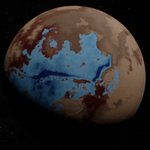
I'm almost done with the planetary model, which now has a full Climate and Geology loop. My goal here is for planetary surfaces to really sell their level of depth from orbit, with rivers that you can follow from source to sea, and forests/plains that are coloured based on the optimal leaf colour for photosynthesis around the host star. I want players to look out of their starship windows and be compelled to explore planetary surfaces on foot, and to see that unique alien flora/fauna in person.
Here's the steps we're going through to generate planetary surfaces;
1 - Genesis initially defines the Gravity, Age, Internal Heat and Delivered Water for a planet from its formation stage.
2 - The atmosphere model decides how much water is on the surface as ocean, and how much is locked in the crust.
3 - Where present, tectonic plates are produced and moved for boundary interaction, driving ridges, rifts and volcanic activity.
4 - Continental height detail is added via noise, and modified by planet gravity. Ocean basins also sink under the weight of water.
6 - Multi-step hydraulic erosion carves the finer details and produces a final global 4096x2048 pixel height map texture.
7 - A 1° global temperature grid is produced, and first defines the snow line. (Available as an overlay on the holo-display)
8 - Wind and ocean currents are calculated. (Available as an overlay on the holo-display)
9 - Typical global cloud cover is defined. (Available as an overlay on the holo-display)
10 - Moisture is carried inland by the wind, and is deposited as rain. (Available as an overlay on the holo-display)
11 - Rain accumulates and drains into the sea, producing Hortonian drainage networks (rivers).
12 - The high resolution erosion and river networks are produced live on the GPU as part of the quadtree, giving us crisp details from the relatively low resolution 4k heightmap texture.
The last steps are sediment being carried by rivers and soil fertility, which will finally drive the foliage. The climate decides where things grow, and the fertility defines how much and what type. This will be visible from orbit as coloured noise/textures, but the exact same data will drive the on-foot biomes and physical asset placement for planetary landings. What you see from orbit will be there on the surface.
The biggest challenge with all of this has been the scale. It's not just getting the physical scale right, for which I am using Earth as a guide, it's also being able to produce on-foot levels of detail on 1:1 scale bodies.
There's a reason no other game is producing detailed 1:1 scale atmospheric worlds... it's really hard!


Something that's hard to get away from with space and procgen in general, is things quickly look samey. One rocky planet generally looks like any other rocky planet, because a ball of rock is a ball of rock.
What I've been wanting from the beginning though is to give each ball of rock some character of its own, so to that end I've been working hard on making the geology of planets as dynamic as possible. I want to be surprised by unique surface features when arriving at a new planet, like interesting mountain ranges, weird flukes of geology, or epic volcanos.
It's not just random noise anymore, we're employing proper geological processes now, including erosion. Next up I need to add proper colour for the surface biomes, and then finally rivers and some rough noise to simulate forests from orbit.


We weren't lying when we said that we wanted Starship Simulator to be as scientifically realistic as possible.😅
👇
Where tectonic activity exists, the tectonic plates now drive the terrain. You get mountains pushed up where plates are colliding, and trenches where they are pulling apart or subducting. You'll also notice island chains along subducting plate boundaries.
Surface biomes are also now implemented, driven by the planet's climate model. Again, none of this is actually textured yet, we're just working on the generation and structure. The different coloured areas in these images represents the surface composition, which along with the climate model will determine things like plant types, rock type, soil type, etc.


I've been hunkered down and busy working on the terrestrial surfaces for Genesis. I'll do a stream on this soon so you can see it all in detail, but for now here's some screenshots of various terrain features. It's all procedural, and quadtree-detailed all the way to the surface. It's worth noting that this is the same terrain we'll be using for planetary landings, just with additional detail noise and rocks/foliage/etc.
None of these planets have textures yet, I'm just working on the structural geology.


Celestial Motion - All stars, planets and moons are now in motion, orbiting their respective centres of mass. They are in proper orbits, with orbital resonances, accurate rotations and tidal locking where relevant. This is a big milestone.
Ship Orbits - Your vessel will now automatically be captured into orbit around celestial objects. When you approach a planet and exit FTL, the direction of your ship's nose will determine your orbital direction. You'll be placed in a perfectly circular orbit, and your orbital velocity will be accurate for your altitude. You are free to fly towards/away from the planet at sublight, and the orbit will update in real time. If you fly perpendicular to your orbit, the orbit's inclination will change accordingly.
Station Orbit Sharing - This is the big one, and it makes pretty much everything else in the game possible. If you exit FTL next to something that is already in orbit, then you inherit that orbit regardless of your nose direction. All objects near one another are pooled and their physics states are moved together along the orbital track. As such, ships can fly around stations and one another, while also moving sideways at 7km/s. Essentially there are three physics layers for space travel.
Celestial motion, orbital motion, and local motion. The celestial layer moves the planets, the orbital layer moves ships/stations along an orbital path, and the local layer allows ships to fly around freely while shooting projectiles at one another. All seamless, all invisible to the player.
I can't overstate how much of a big deal this is. This means we can now add alien stations, other ships, creatures in space, or literally anything else that's orbiting something else.
From here we can start building content!
I know the demo is taking quite a while for this update but we are getting there.
We needed to recreate the entire galaxy (Genesis), so that needed to take a little while. It has put us many months ahead in development, and we have some amazing things (scientifically!) in game now.
👇
The whole formation process from end-to-end is now fully simulated, including galactic metallicity regions, circumstellar disk formation/composition, disk evaporation, planetesimal formation, pebble accretion, orbit clearing, planetary collisions, moon formation (including collision events), gas accretion, planetary migration, and kuiper belts.
O Class stars for example evaporate their circumstellar disks very quickly, stunting planetary formation, while M Class stars have much longer lived inner disks, resulting in rocky worlds crowding their inner regions. Each class of star now forms class-accurate systems. The net result of this is that gas giants are far more rare around lower mass stars, while A Class stars for example have a penchant for forming many Ice Giants.
We also have multi-star systems now, which was actually an interesting solution to a too-many-gas-giants problem. We were capping gas giants at 13x Jupiter's mass, but once we removed that cap we found systems created brown dwarf companions more frequently, and gas giant distribution fell to match the peer-reviewed numbers. And of course we now have real constellations, as you can see from Orion in the attached screenshot.

ALT The Orion Constellation

ALT A Gas Giant illuminated by two stars, with independent lighting and shadows from each star.

ALT Pinching and ring perturbation from shepherd moons.

ALT Ring shadows on the atmosphere and clouds.

Flying into a Gas Giant (Volumetric Depth Layers Test)
Gas giants are where you'll skim your fuel from in Starship Simulator, so we're keen for that experience to be epic every time. You'll also be able to fly down a few layers into the gas giant's atmosphere, because science! Each layer gets progressively darker and more fluid-like as you descend.
As you've noticed, we have been very busy adding the volumetrics to the galaxy, and here is another!
Volumetric Gas Giant Surface Flow Test (Timelapse)
Testing our new planet-wide climate cells system, along with procedural storm lightning.
youtube.com/watch?v=H6IVJ_oN…
Testing our new volumetric atmosphere and cloud system being illuminated by two different stars at once in a binary star system.
youtube.com/watch?v=fiRR4uke…


Testing our new volumetric star tech. Stars in the game are now full 3D objects, not just textured spheres. With endgame shields you will be able to fly into stars, for science or for a tactical advantage.
We're working to expand this tech to create fully volumetric gas giants, which starships will be skimming to collect gaseous fuels.
youtube.com/watch?v=7VFanIBG…

We've been working on our first Shuttle design on streams lately, so we thought it would also be a good time to also start building a proper PID flight controller for both in-space and atmospheric flight. Here's a bit of info about that:
While in space the flight model is fully newtonian, and the flight controller translates control inputs to RCS thruster firings. It does this based on thruster direction, so we can arbitrarily place thrusters around a vessel and the flight controller will handle the control mapping. It also has some autopilot functionality built in already, and is able to use the RCS thrusters autonomously to keep the vessel on target.
In-atmosphere, the Shuttle uses 4 landing thrusters in a manner very similar to a quadcopter. The handling feels a bit like flying a drone, with the addition of some main engines to provide horizontal thrust. The PID controller always tries to maintain a stable hover, so if you flip the shuttle upside down and take your hands off of the controls, it will use the landing thrusters to flip itself over and zero out its vertical velocity.
Everything is using real physics and real thrusters, so damage to a single thruster can immediately be felt in the handling. This also means every vessel will feel unique, because its handling profile is driven by its centre of mass and location of individual thrusters.
Our goal with the flight model is for it to feel meaningful and grounded in real physics, while also being approachable for non flight simmers.
To that end we'll have some flight assist modes that smooth off some of the sharper edges. We'll share more on this when the system is more fleshed out!


Whenever I'm having a tough day, I just rewatch NerdCubed play our game 🤣🥰🤣 and I always feel better 😂
youtube.com/watch?v=gJ5Oou-J…
14
634
