






Pinned Tweet
Blockchain upgrades usually require new software and a coordinated restart across all nodes.
Tau Net introduces technology that allows a blockchain to amend itself without a hard fork, client updates, or downtime.
This demo shows how Tau Net users can upgrade the network's consensus mechanism simply by stating their requirements and agreeing to them.
You can change the law of the Tau Net blockchain right inside a block, ushering in a new era of blockchain and software governance capabilities.
Showcasing Pointwise Revision:
Pointwise Revision is a built-in mechanism that jointly takes new software requirements and the current specification as input. Then outputs a program that consistently satisfies both the new requirement and the maximum of the previous specification.
This allows software to update correctly according to given rules, and it is all handled by providing only the required changes to the software.
Explore testnet alpha here: github.com/IDNI/tau-testnet
2,000 USDT total prize pool.
Our $AGRS trading competition with @origamitech_ is live.
Pair: AGRS/USDT on MEXC
Rankings: eligible trading volume
Ends: 25 Nov, 00:00 UTC
Rules and entry: app.origami.tech/competition…

ALT Official Tau and Origami Tech competition artwork showing 2,000 USDT and MEXC branding on a purple geometric background.
1/4 Good catches from the Tau team in the 9 November commits: rule updates that change behavior, better timing checks and invalid-recipient checks for testnet transactions. 👇
2
7
613
3/4 Tomáš fixed a snag for fresh testnets: the starting block's zero timestamp could block timed-release transfers. Admission now estimates next-block time; final block-time checks still decide inclusion.
github.com/IDNI/tau-testnet/…

1
2
197
4/4 Invalid recipient keys can look well formed. Tomáš's fix rejects them before transactions enter the testnet queue, including after a chain reorganisation. Block checks are unchanged.
github.com/IDNI/tau-testnet/…

2
175
3/4 A policy or governance change can require a fresh rule checker. The testnet's fallback miner lacked a way to restart it. Andrei added that path, rebuilding from the program baseline.
github.com/IDNI/tau-testnet/…

1
3
325
4/4 Updating Tau's commit date and ID used to force unchanged files to recompile. David isolated those details in one compiled file. Less needless rebuild work for contributors.
github.com/IDNI/tau-lang/com…

2
283
3/4 Rule checks now cover block application and replay, including rule offers. Andrei's code rejects reserved inputs and wrong value sizes. Its text checks do not prove a rule is scoped correctly. Merged testnet source.
github.com/IDNI/tau-testnet/…
github.com/IDNI/tau-testnet/…

1
4
2,842
4/4 A practical detail for node operators: Andrei's signature work adds a required Arkworks BLS dependency, with no fallback. New tests compare valid and malformed signatures.
github.com/IDNI/tau-testnet/…

6
2,796
1/3 Lead Dev David removed repeated solver setup and fixed an empty-value crash in Tau Language yesterday. Two useful improvements for developers working with numeric conditions and logic values. 👇
2
15
1,553
2/3 When simplifying numeric regions, Tau created a new solver for each related check. David's change keeps the solver ready and adds or removes conditions as needed, cutting repeated setup work. In development.
github.com/IDNI/tau-lang/com…

1
4
725
3/3 A newly created, empty Tau logic value could crash a check for zero or one. David added guards that treat it as zero, plus a regression test for both checks. A useful catch for library developers.
github.com/IDNI/tau-lang/com…

5
627
Tau retweeted

Round 3: Sun 1 Nov, 12:00 UTC. Taumorrow Chess vs Claude Opus 5.5, 10 games, 5 per colour.
Since 9 : 1 vs Sonnet 5.5 the engine learned from its own positions only, admitted by the logic. About 100,000 characters of Tau formulas, no neural net.
chess.taumorrow.com
People should be able to use Email as intended.
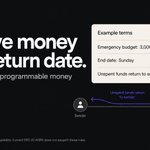
They can with Tau Wallet with their on-chain rules that stop their funds being stolen.
- even if a signed transfer is submitted.
- even if your private key is leaked
The future of self-custody is your rules, enforced on-chain.

The Binance hack shows that we urgently need better fraud prevention for Wallets.
Tau's Wallet enforces your spending rules on-chain, so the node enforces an approved-address rule.
An unapproved transfer is blocked even if the front end is compromised.
This 👇 seems to be caused by teapawt.net/DebugBear/status/21158…
it appears to be an injection attack on the front end. injecting incorrect tx, but showing a valid tx for the user to sign.