

Leading nonpartisan tax policy research and analysis
Washington, DC
Joined October 2008
- Tweets59.7K
- Following890
- Followers69.5K
- Likes14.6K




Pinned Tweet
Tax policy is all about trade-offs.
Our new guide analyzes 86 potential changes to the federal tax code, considering their impact on federal revenue, the long-term debt trajectory, the distribution of after-tax income, and the US economy.
Launch our interactive tool: hubs.ly/Q04r06M-0

Tax Foundation retweeted

With Amendment 3, Florida has a $4.6 billion question to answer in 2027 and am $8.4 billion dollar question to answer in 2028.
taxfoundation.org/blog/flori…


It won't be official for a while, but I think you have to conclude that Florida Amendment 3 has passed.*
* I do tax policy, not election analysis, so take this for what it's worth (not much). But barring some significant reporting errors somewhere, which seem unlikely given the consistency of the results across counties, it looks to have cleared the 60% threshold.
I don't see a particularly plausible path to the remaining outstanding votes changing that. Local governments now need to figure out how to replace about $9 billion in property tax revenue when this fully phases in as of 2028: spending cuts, property tax rate increases on remaining taxable property, raising other taxes and fees, or all of the above.
Tax Foundation retweeted

New from @trparks20 and I @TaxFoundation:
Congress has a rare chance to enact bipartisan IRS reform before the end of the year.
The Taxpayer Assistance and Service (TAS) Act has pro-taxpayer, pro-simplicity reforms that would improve a filing experience many find miserable.

Tax Foundation retweeted

As polls close tonight across the country, @TaxFoundation's state tax policy team will be tracking the results of the major state tax ballot measures live on our website. Check back often here for updates:
taxfoundation.org/research/s…

🗳️ Notable state tax ballot measures to watch tonight: taxfoundation.org/research/s…
#Election2026 #Midterms2026
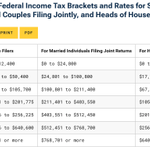
Explore the IRS inflation-adjusted 2026 tax brackets, for which taxpayers will file tax returns in early 2027.
See more: hubs.ly/Q04D2VZJ0

States with no individual income tax (Florida, Texas, Tennessee, Nevada, and others) consistently rank among the strongest gainers, while states with the highest top rates (California at 13.3 percent, New York at 10.9 percent, and New Jersey at 10.75 percent) dominate the list of largest losers.
Explore the data: hubs.ly/Q04D2V2F0

The property tax will never win any popularity contests, but if repealed, backfilling the forgone tax revenue would be exceedingly difficult.
From @JaredWalczak: hubs.ly/Q04D2TV00 #PropertyTax

Lawmakers can constrain the growth of property taxes without creating new problems. But the details matter.
Read more: hubs.ly/Q04D2TtG0

Its Election Day, so Coloradans will get to decide on two competing measures on income taxes: Amendment 87 and Proposition 136.
Read more: hubs.ly/Q04D2Tq00

The Senate recently passed the Taxpayer Assistance and Service (TAS) Act which would ease some burdens for taxpayers and provide valuable data on where complexity arises in the tax code.
Read more: hubs.ly/Q04D6zx70

Washington’s new income tax on high earners doesn’t take effect until 2028, but it is already generating a lot of activity. A measure on the ballot this November, Initiative 645, would reverse the legislature’s decision, preventing the new tax from taking effect.
Read more: hubs.ly/Q04D2SMc0

Today is Election Day, and voters in 17 states will decide on important tax measures. Our new ballot tracker and podcast discussion break down the measures worth watching: hubs.ly/Q04D1Bbv0

What is a tax base and why is it important?
💡 Learn more by watching TaxEDU's video 𝗧𝗮𝘅 𝗥𝗮𝘁𝗲 𝘃𝘀. 𝗧𝗮𝘅 𝗕𝗮𝘀𝗲:
hubs.ly/Q04D2CVS0
The 12-year history of Tax Foundation’s ITCI shows that tax policy is constantly in flux around the world and that tax policy design choices matter for economic growth.
More here: hubs.ly/Q04D2CTN0

Sending a $5,000 payment to the 250 million adults who are eligible to vote in the US would cost $1.25 trillion. hubs.ly/Q04CPd0F0

The government’s borrowing costs are quickly eating up a larger share of federal revenues. At the turn of the century, 11 cents of every tax dollar went to paying interest on the national debt. Today, it is 19 cents.
Learn more: hubs.ly/Q04CPbH90

Join the tens of thousands of readers who rely on us for the latest tax data and analysis: hubs.ly/Q04CPffT0 hubs.ly/Q04CPfHx0

Expensing for capital investment is not a special tax break. Expensing aligns the timing of tax deductions with the timing of actual capital expenditures so that the tax code does not discourage marginal investment projects.
Read more: hubs.ly/Q04CPdN30

Publicly held debt is projected to rise to a new record high of 106 percent of GDP within the next four years and continue to rise to 120 percent by 2036 and 175 percent by 2056.
Read more: hubs.ly/Q04CPfQF0

Taxes are on the ballot in November. Voters in 17 states will decide for themselves how their states raise revenue. Our new ballot tracker and podcast discussion break down the measures worth watching: hubs.ly/Q04CPfKd0