








John Spindler retweeted

Maybe to summarize the basic argument of this essay a different way:
Current AIs are spiky and jagged - worse than humans in most domain, but often as good, or better, in ones with verifiable proxies (for example, math).
One such verifiable domain (I argue) is AI research.
And while the first AIs that dramatically accelerate AI progress will be quite narrow (i.e. probably not able to automate most jobs), the consequences of that accelerated progress will be very general.
And that's because better learning algorithms are very general. For example, GPT-6 (while still being jagged) is just way, way better than GPT-3 at practically everything.
I'm arguing that we're only a couple years away (and possibly only a couple months away) from a process by which (initially) narrow AIs concentrate a jump as big as the one from GPT-3 to GPT-6 into a single year.
And if you got another jump that big, but starting from the base of GPT-7, I think you would end up with AIs that would rapidly become better than the best humans in every field.

John Spindler retweeted

Smith and Montesquieu thought that markets and commerce made us better: that they create an incentive to pursue self-improvement and to create things of value for others. In the positive AI visions, where the labor of humans is made redundant, I find myself wondering how we fare in the presumptive absence of these incentive gradients. Perhaps we are released to a life of freedom, where we can study Mozart and read Dickens, but that still seems complicated: both Mozart and Dickens were themselves deeply commercially-motivated in the production of their work, as were most of the great artists through human history. If the premise is that nobody will need to work or produce, how confident are we that we actually get the next Mozart and Dickens? The relevant question is not the partial equilibrium of whether one individual can pursue a life of enlightened leisure, but the general equilibrium of what form a society as a whole will take on.
One could maybe invoke Periclean Athens or the aristocratic gentleman scientists of Victorian England as a counterpoint. While these individuals were perhaps not motivated by commercial considerations, they were embedded in wider societies shaped by commerce, attendant betterment, and trade: Byron was himself upper class, but he was also surrounded by and writing for an educated bourgeois audience. So we’re back to the equilibrium question. Furthermore, even these individuals were surely motivated by a sense of high-stakes and consequential agency: if they did not apply themselves to their labors, they presumably believed that the work would not otherwise exist. Thucydides was addressing pressing military matters.
So I would like to read more optimistic cases from AI proponents about what a society (vs individual life) looks like if everything goes well: what people do, why they do it, whether humans achieve excellence (and in which domains), and which historical groups we should look to as relevant precedent.
One can perhaps imagine that humans will turn out to have a strong preference for work created by other humans. This may work in certain domains (ceramics?), but for how many will it actually apply? (I’m told that much of what is sold on indie crafts websites is now in fact manufactured in China.) It’s hard to see how this human preference, even if strong, would, for example, save scholarship.
Another idea would be to accept that nobody will become Einstein or Mozart or Byron, and that human excellence as such diminishes, but that there are compensatory benefits (planet brains and Dyson swarms?).
I believe that we can satisfy individual desires, but to what extent will we cultivate behavior worthy of admiration? Will a post-scarcity society mold capable and ambitious people? Which institutions will sustain them and which responsibilities will they have? I’d like to hear more of the equilibrium for the maximalist case spelled out.
John Spindler retweeted

We @bold_lab_ai are making a few big bets and one of them is setting up BOLD itself as a transparent recursive co-improvement system (arxiv.org/abs/2512.05356). We develop new AI methods and other technology that help us work together to accomplish long term ambitious goals aligned with shared values. One of the core issues humanity faces today is that GPUs scale but collaboration amongst value aligned humans doesn't. So it's relatively easy for everyone to end up doing things that nobody individually wants.
If these words mean something to you and you believe it's path worth exploring (rather than accepting the "end of history", please apply! 🦋


We @bold_lab_ai are hiring a large cohort of home and overseas students for Fall 2027 entry. If you’re excited about discovering the next paradigm of open-source AI and want to work on ambitious, exploratory, but scalable ML that empowers humanity, please apply by 1st of December 2026 AOE to maximise chances of funding: eng.ox.ac.uk/study/research-…


John Spindler retweeted

Nvidia alone accounted for 16.4% of all US venture capital dollars in Q2 2026 & 10.0% ($58.7b of $585.2b) over the last four quarters.
Jensen’s departure puts a question mark over 1 in every 6 venture dollars in the US.

John Spindler retweeted

What led our CEO, Elisa Seghetti, into the space of #WorldModels and why she decided to start a company within it? Watch the entire conversation of the Atoms are Back panel at #Wave by @vento_ventures on our Youtube channel. Link below.
John Spindler retweeted

There are many wonderful elements to this story about AI discovering gems in Godel's famously impenetrable notebooks
1/..
theguardian.com/science/2026…

John Spindler retweeted

FutureSearch is hiring senior, not-primarily-technical roles for the first time.
COO, Director of Partnerships / Strategic Projects, Head of Product, others
If you want to predict the future, but in an operational capacity rather than as a researcher, futuresearch.ai/careers/
John Spindler retweeted

One of the things the US (& china) does better than everyone else is productively adopt new technologies.
British & European enterprises so bad at adopting new technologies because reward structures at work are too focused on downside mitigation rather than upside opportunities.
It’s why pretty much every British tech company has the US as its primary market.


John Spindler retweeted

I am confused. The Solow model in economics says economic growth stems from population growth or new technology. The UK is shutting down immigration (and isn’t reproducing fast enough). But it is betting on a new Innovation Nation agenda. However, in the period known as Engels’ Pause during the industrial revolution, wage growth stagnated. It took nearly 100 years for it to come back. We know major tech shifts mean it takes decades for wage growth to follow productivity gains. How will the new Innovation Nation agenda help the average citizen in the UK in the short run (ie, this next decade)?
John Spindler retweeted

David Silver is one of the all-time greats. He was the creator of AlphaGo, which changed the course of history by showing that neural nets could achieve superhuman performance for the first time.
He also has a unique intuition and knack for forecasting when things will happen in AI. With computer Go, he predicted the Lee Sodol outcome 10 years before, right to the year. He got the year right for Starcraft and won a bet inside Deepmind. Same for AlphaProof. Same for the IMO.
David's prediction for superintelligence: 3 years. !!! He has a strong sense that now is the time to build a superleaner, and that superlearners are now possible, thanks to the enormous progress in compute, simulators, autoresearch, and the sophistication of technology in the stack since the AlphaGo days.
What is a “super learner”? A super learner discovers all knowledge from its own experience. Start from nothing (no internet pre-training), and go beyond human knowledge. Drop it into any stream of experience, simulated or physical, and the superlearner learns.
He expects the progress will be rapid. When you get the recipe for a superlearner just right and remove humans from the development loop altogether, a superlearner can learn extremely quickly. Just look at AlphaGo. AlphaGo took two years to develop with humans in the loop. When David and his team at @GoogleDeepMind got the formula for AlphaZero correctly, it surpassed the human-developed algorithms in just a few hours. Human data is a shortcut, but you have to let go of the human data to shoot beyond it.
In January, David left GDM to found @IneffableLabs, a research-led lab with one mission: build a "super learner" that discovers all knowledge from its own experience, and make first contact with superintelligence.
He joins us with co-founder Lasse Espeholt, who built IMPALA and SEED RL, the foundations of scaled-up RL, and now runs Ineffable's compute.
A few things we cover in this conversation.
— What a super learner is: depth (start from nothing, go beyond human knowledge) and breadth (drop it into any stream of experience, simulated or physical). The human brain is the only existence proof
— Why they're giving up human data: AlphaGo took two years with humans in the loop. AlphaZero outperformed it in a few hours. "You have to let go of the human data to shoot past the competition"
— Crucibles: simulated worlds with enough emergent complexity (physics engines, millions of interacting agents) for an agent to rediscover technology, science, maths and language on its own
— Simple rewards, emergent complexity: evolution optimized fitness and got all of life. Don't breadcrumb the objective, give the agent something simple to optimize in a world with a lot to learn about
— Go as the existence proof: one agent is the most boring game imaginable, two agents is "an infinite onion of layers of complexity"
— Why human language is probably not the endpoint for reasoning, and how training on it bakes in a flat earth and the four humors
— Can superintelligence be built in simulation? If the sim is Turing complete, computation, economics, language and maths are all expressible, and it happens 10-100x faster and safer
— Alignment: language-based monitoring is reaching its limits as agents learn to say one thing and do another. Shadow actions, superintelligences monitoring superintelligences, and building a real science of how they interact peacefully
— Accelerate in simulation, pace in the real world: Ineffable will gate real-world deployment on evidence that it goes well
— Timing as the determinant: Silver called Computer Go to the year, then StarCraft, then the IMO. He thinks this is the moment
— Predictions: True superintelligence within three years.
Timestamps:
0:00 – Introduction
1:09 – What held true from Go to today, and what the LLM era changed
3:35 – Why leave DeepMind to start a new lab
5:58 – Why "Ineffable" (and the secret second reason)
7:03 – Lasse's path: scaling RL at DeepMind and Google Brain
9:31 – Defining a super learner and first contact
12:35 – Super learners vs. LLMs that make discoveries
13:59 – Day to day: the RL stack, crucibles and human-journey milestones
16:13 – Don't breadcrumb the objective: simple rewards, emergent complexity
21:16 – What a crucible looks like
24:14 – Go: one agent is boring, two is infinite
25:41 – Will agents rediscover language?
27:22 – Removing human priors: AlphaGo to AlphaZero
32:05 – Keeping human bias out of the crucibles
33:35 – Confidence, timing and super forecasting
36:24 – Is compute the driver?
38:13 – The ceiling on simulation and Rich Sutton's objection
43:44 – Alignment and the science of superintelligence
47:45 – Monitoring agents that don't think in English
51:01 – Pacing the frontier
52:54 – The compute setup: Vera Rubin on GCP
55:18 – Training, inference, simulation and RL scaling laws
57:40 – IMPALA and SEED RL
1:00:58 – 20 people and the compute-per-person ratio
1:04:49 – A research-led culture
1:05:47 – Predictions
John Spindler retweeted

A new UK AI frontier lab in chemistry has just emerged from stealth.
It's the latest startup to be backed by the @UKSovereignAI fund.
The company is founded by Dr. Hatem Helal who believes that if we really want to use AI to discover new drugs we need more data - data that the team at Potential Sciences is developing.
Its mission is to predict how any molecule will behave before it is ever made, by training AI on data generated from the laws of physics, at the accuracy of a lab measurement.
The team are developing an AI model focused on the fundamental laws of physics, rather than previous experimental data. This could make the AI calculations needed to design chemicals 100 times cheaper than at present.
Today they have come out of stealth with over eight figures in funding via equity and compute backed by Sovereign AI (Joséphine Kant), Twin Path Ventures (Nick Slater) and several others.
Very cool.
It's amazing to see more frontier labs coming out of the UK

John Spindler retweeted
And last but definitely not least: THANK YOU to John Spindler (@Twinpathvc) for jumping in as moderator for our closing fireside.


John Spindler retweeted

Maps, drawings, scanned forms: PDFs where the answer is in the image, not the text. The hard case for document AI.
Page Search agent reads the page, zooms in to search it, and cites the exact region it read.
Try it now: search.pageindex.ai/examples…
John Spindler retweeted
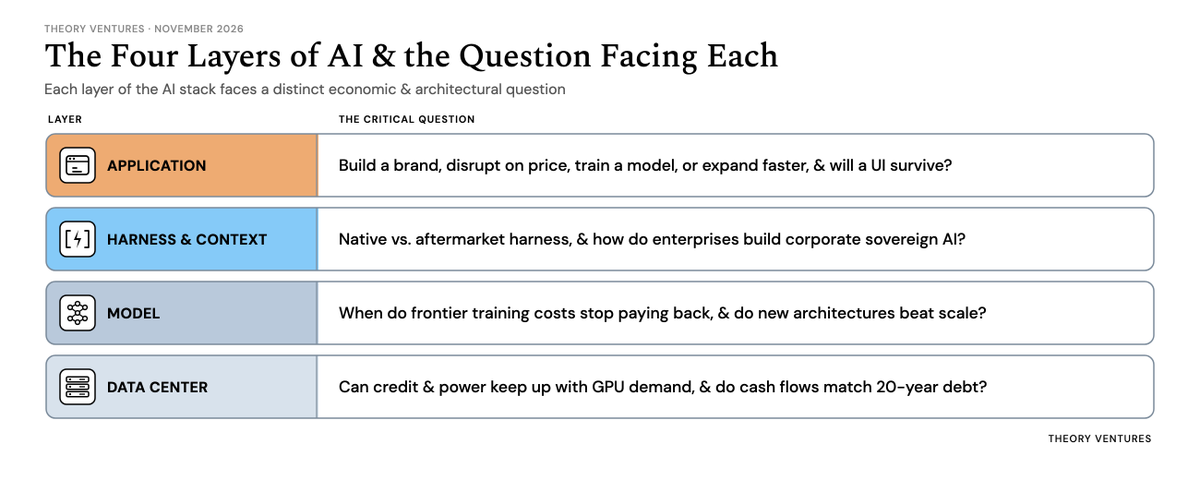
There are 4 layers in the AI stack, each with a fundamental question before it.
John Spindler retweeted

What does sovereign AI actually mean for UK startups? 🇬🇧
Tomorrow, @MeryemArik9 joins @Twinpathvc AI Breakfast Club to discuss infrastructure, open models and the future of UK sovereign AI.
☕ 8:30am, Shoreditch
luma.com/06bpyjsa

John Spindler retweeted

I asked Claude: "What types of businesses outside of the labs will get stronger as raw intelligence explodes?"
Honestly, spot on response.

John Spindler retweeted

This is easily the best one-page summary of marketing myopia I have yet seen.
Off Kilter 237: Regeneration or Dilution?, by @pworthington
offkilter.substack.com/p/off…
John Spindler retweeted
Within the next 6 months, most AI startups will not be able to buy compute. The world’s compute is sold out. evanjconrad.com/posts/end-of…

John Spindler retweeted

this might be my last normal tweet before biotech goes vertical
i'm not a whistleblower. I don't work at Lilly, Novo or any of the big labs
but there is a massive shift happening in human biology right now.
it's sitting in press releases and almost nobody reads them
the last 6 months alone:
- a once-daily pill roughly doubled median survival in metastatic pancreatic cancer (13.2 vs 6.6 months)
- a one-time gene editing infusion cut hereditary angioedema attacks 87%, and 62% of patients stayed attack-free and off all other prevention for 6 months
- a one-time gene edit for cholesterol dropped LDL up to 62%, and it held for over a year
- a personalized mrna vaccine beat keytruda alone in a 1,137 patient melanoma phase 3
- retatrutide hit ~28% weight loss in a phase 3
- an ai-designed drug entered phase 3
- a pill that regrows hair passed its second phase 3
- an immunotherapy that could let some rectal cancer patients skip surgery, chemo and radiation just got fda approved
- a man lived 271 days off dialysis on a pig kidney
- human cells were caught passing chromosome-sized chunks of DNA to their neighbors, and it changes how the neighbors behave
we are on the verge of an era where the human body is a software problem and the update cycle gets shorter everyday
stick around, it's going to get weird
bio/acc