




I've been trying to prove @ericweinstein GU in Lean using AI, but I'm essentially a blind mand in a gladiator coliseum, as I'm no mathematician. As far as I've achieved, GU base structure is consistent a provable, however there's some missing gaps that the math library does not have, that the agent claims are needed to go deeper and complete GU proving:
- Spin cover image = SO₀(7,7): needs the Cartan–Dieudonné theorem plus facts about connected components of matrix groups.
- Submanifold step: needs general "the solution set of nice equations is smooth" machinery for these spaces.
- Global spin lift (w₂): needs characteristic classes, which are basically absent from Mathlib.
- Identifying the Pati–Salam subgroups with Spin(6) and Spin(4): needs abstract spin groups as their own objects, plus isomorphism theory.
Again I emphasize I'm no mathematician, so I'm relaying on this overconfident abstraction, I just wanted to understand where would this experiment lead to. But I wonder it it going on a good path, or should stop wasting tokens?
saga: rage of the vikings came out in 1999. we're rebuilding it from scratch
last time a longship crossed the sea. now the first missions play again, start to finish: raise a village, sail to an island, breed cattle, win
every viking does exactly what he did in the original
all 36 shipped maps of saga rage of the vikings (1999) now replay 1:1 with the original game in our clean room C port, every entity checked tick by tick against the original binary for 1600 ticks
the clip is the port's own renderer: two vikings board a knorr, it rows out, sails across, docks and they land. same frames the original draws

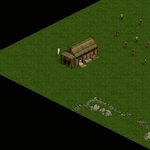
vikings, now properly animated can now walk behind buildings with pathfinding, and they have a shadow too.. ah and buildings now render too
the fog of war is in, coupled with real vikings opening up the map as they walk, the port is progressing along, and getting closer to what once one saw
ground is real now. every tile is four quarters, each a frame from one of six terrain banks, picked by two bytes per quarter in the 1999 index table. read from the disassembly today, rendered tonight. the vikings are still dots, next
clean-room port of saga: rage of the vikings (1999). first frames out of our own simulation, drawn with the original's projection code, ported and judged by running the 1999 exe in an emulator. ground is still flat colour and the vikings are dots, that's next. 4 of 36 maps bit-exact for 200 ticks so far

