

Upholding the values enshrined in the Indian Constitution. Let's get to work!
Bengaluru, India
Joined January 2010
- Tweets16.4K
- Following379
- Followers122K
- Likes2.1K







Amnesty India retweeted

Breaking:
Gauhati HC quashed the NSA Detention of activist Pranab Doley. @scroll_in
Doley, who has been opposing a proposed luxury hotel near Kaziranga National Park, was arrested in July for joining a protest against the hotel.
Amnesty India retweeted

#Breaking
X (formerly Twitter) tells the Delhi High Court that the notices to block the Internet Freedom Foundation and Software Freedom Law Centre (SFLC) accounts were issued by an "imposter" and not the Delhi Police.
X says it has already filed a complaint with the Delhi Police against the imposter, and IFF and SFLC's accounts will not be taken down.
@internetfreedom @SFLCin

Amnesty India retweeted


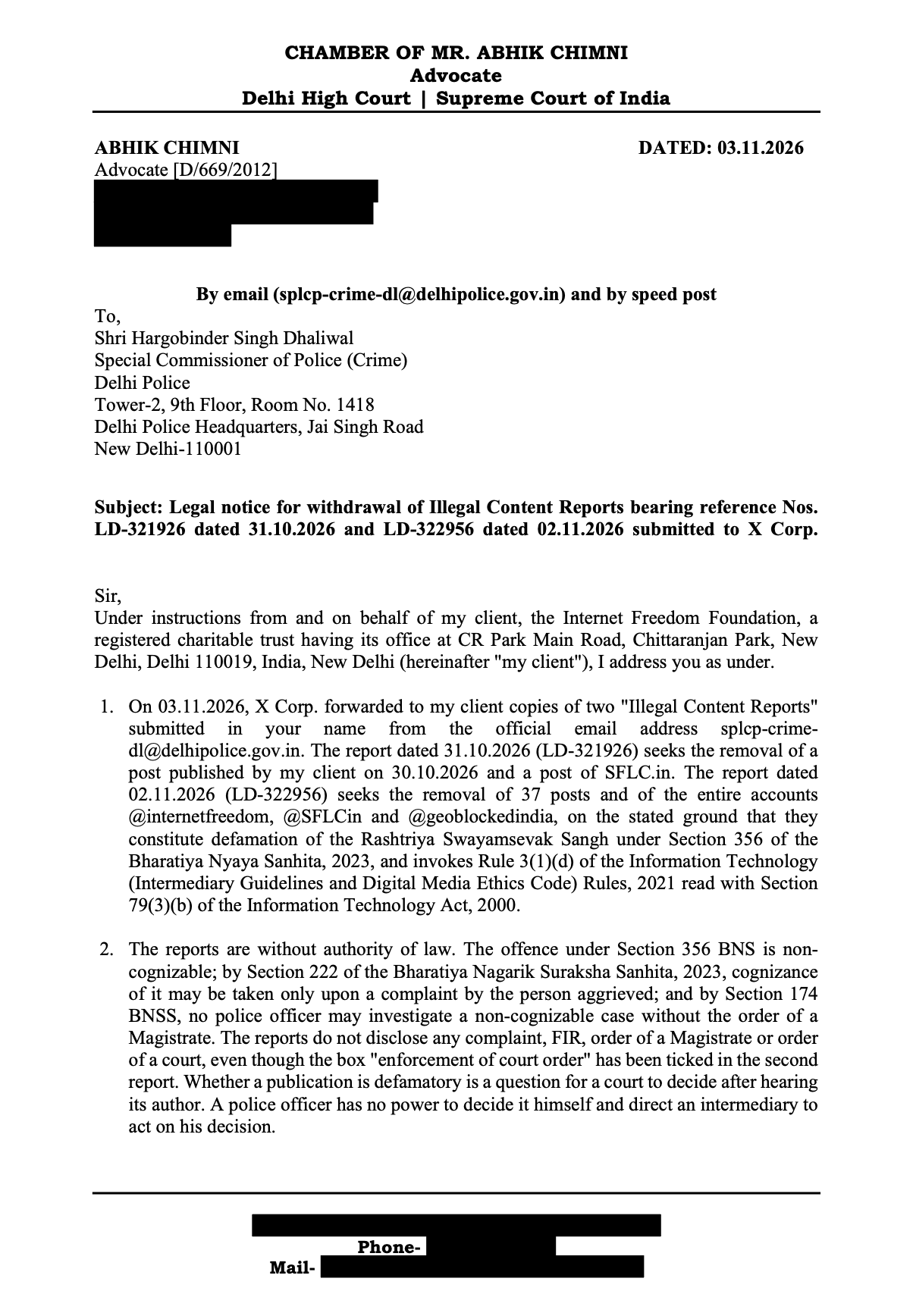
Statement: Legal notice to the Delhi Police and X Corp. over takedown demands against IFF’s account
On 3 November 2026, X Corp. forwarded to us two “Illegal Content Reports” submitted in the name of the Special Commissioner of Police (Crime), @delhipolice. The first, dated 31 October, sought removal of a post we published on 30 October and a post by @SFLCin. The second, dated 2 November, sought removal of 37 posts and the withholding of three accounts in their entirety, @internetfreedom, @SFLCin and @geoblockedindia, on the ground that they defame the Rashtriya Swayamsevak Sangh under Section 356 of the Bharatiya Nyaya Sanhita. The posts in question reproduce and comment on a legal notice that was sent to us. They are protected speech under Article 19(1)(a) of the Constitution. We were given no notice before these reports were filed. We learnt of them only because X forwarded copies.
Today, through our counsel Advocate Abhik Chimni and his colleagues, we served a legal notice on the Delhi Police, with a copy to X Corp.
Our position is simple:
1. Defamation is a non-cognizable offence. The police cannot investigate it without a Magistrate’s order, and cognizance can be taken only on a complaint by the person aggrieved.
2. The reports cite no complaint, no FIR, no Magistrate’s order and no court order, even though the box for “enforcement of court order” was ticked. Under Shreya Singhal v. Union of India, an intermediary can be required to take down content only on a court order or a reasoned government notification. A web form with “hate speech”, “defamation”, “safety/security” and “court order” ticked against 40 URLs, with one sentence of reasons, is not that.
3. Whether something is defamatory is for a court to decide after hearing the author. A police officer cannot decide it himself and direct a platform to act on his decision. Demanding that three accounts be withheld in full is grossly disproportionate to any grievance stated.
We have called upon the Delhi Police to withdraw both reports or disclaim within seven days, to furnish us the complaint and authority on which they were made, and to confirm that no further takedown requests will be made on this matter. If they do not, we will approach the Delhi High Court under Article 226. We have also requested X Corp. to take no action on the reports pending their withdrawal or adjudication.
We are grateful to Advocate Abhik Chimni and his team for representing us in this matter. Redacted copies of the notice are attached.


Amnesty International India stands in solidarity with the Internet Freedom Foundation (IFF), Software Freedom Law Center (SFLC) and geoblockedindia, whose work documenting internet censorship and defending digital rights is now being targeted through police notices seeking the removal of their social media accounts and posts.
The attempt to silence organizations and social media accounts for documenting censorship is deeply alarming. It threatens not only their freedom of expression but also the public's right to know when, why and how access to information is being restricted.
Those who expose censorship must not become its targets.
SFLC's Free Speech Tracker recorded approximately 268 content restrictions and 83 account restrictions in the first 29 days of October alone.
When organizations documenting these restrictions are themselves threatened with account removal, the consequences extend far beyond three organizations. It risks creating a chilling effect across India's digital public sphere, discouraging journalists, researchers and activists from speaking out.
Under the UN Guiding Principles on Business and Human Rights, social media companies have a responsibility to respect human rights, including the right to freedom of expression. They must carefully scrutinize government takedown requests, assess them against international human rights law, provide transparency, and challenge requests that are inconsistent with their human rights responsibilities.
Complying with demands to remove accounts and public-interest documentation without meaningful scrutiny risks enabling unlawful censorship and denying people access to information.
We urge @XCorpIndia to uphold its human rights obligations and protect the voices documenting restrictions on digital freedoms.
Amnesty India retweeted

Please to speak up and share in solidarity. If IFF's account disappears from X we may not be able to reach in future.
Delhi Police asks X to take down IFF's account and posts. IFF will challenge the notices in court unless they are withdrawn.
The Delhi Police has asked X to remove the Internet Freedom Foundation's account, six of its posts, the accounts of SFLC and @geoblockedindia, and posts by 16 other users, on the ground that they defame the Rashtriya Swayamsevak Sangh. The posts document and comment on a legal notice sent in the RSS's name to IFF, SFLC and @geoblockedindia, which demanded that the three stop criticising and documenting government blocking orders. IFF received copies of the two police notices from X on the morning of 3 November 2026.
IFF calls on the Delhi Police to withdraw both notices. If they are not withdrawn, IFF will challenge them in court.
What has happened
On 29 October 2026 at 9:54 PM, IFF, SFLC and the operator of @geoblockedindia received a two-page "legal notice" said to be issued on behalf of the RSS. It asked the three to stop opposing the government's blocking directions, stop documenting restricted content, stop posting details of geo-blocked posts, and confirm in writing within seven days that they would comply. It was signed by an unnamed "Authorised Signatory". Several RSS office-bearers have since said on X that the notice is not authentic. IFF replied to the notice, wrote to the RSS at its official address asking whether it had authorised it, and published both the notice and its reply on 30 October.
On 31 October 2026 at 8:06 PM, the Special Commissioner of Police (Crime), Delhi Police, filed an "Illegal Content Report" with X (reference LD-321926). It listed two posts: IFF's post of 30 October on the notice, and SFLC post of the same day. The stated reason was that the posts are "defamatory towards the Rashtriya Swayamsevak Sangh under Section 356 of the Bharatiya Nyaya Sanhita, 2023". The boxes for "safety/security", "defamation" and "other" were ticked. The fields for the nature of the court order and court order details were left empty. The desired action was "Remove/withhold content".
On 1 November 2026, a second notice arrived in the RSS's name. It said the matter had been handed to the Akhil Bharatiya Adhivakta Parishad, that complaints had been filed in several states, and that requests had been made to block IFF's X account and suspend the organisations. The Delhi Police had made its first request to X the previous evening. IFF did not know this until X told it on 3 November.
On 2 November 2026 at 8:51 AM, the Special Commissioner of Police (Crime) filed a second notice with X (reference LD-322956). It lists 40 URLs. Thirty-seven are posts. Three are the entire accounts of @internetfreedom, @SFLCin and @geoblockedindia. This time the boxes for "Hate speech", "defamation", "safety/security", "enforcement of court order" and "other" were all ticked. The court order fields were again left empty. The stated reason reads: "The posts constitute defamation and illegal content under Section 356 BNS. Under Rule 3(1)(d) of the IT Rules, 2021, read with Section 79(3)(b) IT Act, lawful notices require action within 3 hours."
The 16 other users are @ProdctiveUseful, @PanjwaniManoj, @jidge_, @RatanSharda55, @baxiabhishek, @SchrdingersDbag, @ashleshbiradar, @seemay, @NasirHussainINC, @Being_creat_ive, @AjoyDharmavaram, @othlaw, @_ananyaaa, @AimPoojaind, @incorigibleBhai and @rraoind. Their posts, as far as IFF can tell, comment on the notice or on the notice about it.
X forwarded both notice to IFF on 3 November 2026, at 8:47 AM and 10:03 AM, saying it was doing so "in the interest of transparency" and that IFF may wish to seek legal counsel and challenge the request in court. X's emails do not say that it has acted on the requests. The Delhi Police has not written to IFF, and no court has been approached, as far as the reports disclose. SFLC and @geoblockedindia have separately reported notifications from X about requests from the Uttar Pradesh Police, the Telangana Police and the Delhi Police's Cyber Crime unit, one of them against the whole of the @geoblockedindia account.
IFF's position
IFF condemns this legal action. A police force has made itself the enforcement arm of a private legal notice whose authenticity the organisation it names has not confirmed, and whose demand was that three organisations stop documenting censorship. The notices would deliver exactly what the notice asked for as they would also remove the accounts of the three groups in India that keep public records of what is blocked, and of who ordered it.
The posts in question are about a legal notice sent to us. They quote it, criticise how it was drafted, and say that we will carry on with our work. A person who receives a threat is entitled to publish it and answer it and that is not defamation of the sender.
In the three weeks before the first notice, IFF assisted 86 people whose accounts were suspended or whose posts were withheld in India. SFLC's Free Speech Tracker recorded about 268 content restrictions and 83 account restrictions in the first 29 days of October. @geoblockedindia publishes the orders behind such blocks when platforms disclose them. None of this is unlawful. Documenting censorship and challenging it in court is what the Constitution expects of citizens.
IFF will not delete the posts. If the Delhi Police does not withdraw the notices, we will challenge them in court.
Why the reports are unlawful
Defamation is not a police matter. Section 356 of the Bharatiya Nyaya Sanhita, 2023 is a non-cognizable and bailable offence. Under Section 222 of the Bharatiya Nagarik Suraksha Sanhita, 2023, no court can take cognizance of it except on a complaint by the person aggrieved.
Under Section 174 of the BNSS, the police cannot investigate a non-cognizable offence without an order of a Magistrate. The Special Commissioner of Police (Crime) is not the person aggrieved. The notices disclose no complaint by the RSS and no order of any Magistrate. Whether a statement is defamatory is for a court to decide after hearing its author, with the defences of truth, fair comment and good faith available to that author.
In Subramanian Swamy v. Union of India, (2016) 7 SCC 221, the Supreme Court upheld criminal defamation on the strength of these safeguards. A police officer who asks a platform to remove speech as defamatory has decided the question himself, without a complainant, a court or a hearing.
The posts are protected comment. Exceptions 1 to 3 to Section 356(1) protect the truth published for the public good, opinion on the public conduct of public servants, and opinion on the conduct of any person touching a public question. The posts publish a notice that was sent to us and give our opinion of it. The RSS, if it sent the notice, chose to enter a public question. If it did not, the posts defame no one.
Further, Section 79(3)(b) and Rule 3(1)(d) do not permit this. In Shreya Singhal v. Union of India, (2015) 5 SCC 1, the Supreme Court read down Section 79(3)(b) so that an intermediary acquires "actual knowledge" only through a court order, or a notification from the appropriate government or its agency that unlawful acts relatable to Article 19(2) are being committed. The court said that it would be difficult for intermediaries to judge the legitimacy of the millions of requests they receive, and that the burden must not be placed on them. Rule 3(1)(d), as amended in November 2025 and February 2026, now requires the intimation to come from an officer not below the rank of Joint Secretary or Deputy Inspector General, to be reasoned, and to specify the legal basis and the nature of the unlawful act, subject to a monthly review by a Secretary-level officer. The three-hour window the notice invokes applies to a lawful order that meets these conditions. A web form that ticks "hate speech" and "enforcement of court order" while leaving the court order fields blank, and that gives one sentence of reasons for 40 URLs, is not such an order.
The notices by the Delhi Police are disproportionate. They seek to remove three accounts in their entirety, with years of posts, over six, four and eleven posts respectively. They sweep in 16 third parties whose only connection is that they commented on a public controversy. In Anuradha Bhasin v. Union of India, (2020) 3 SCC 637, the Supreme Court held that any restriction on speech must be necessary, proportionate and the least restrictive measure available, and that orders restricting speech must be published and reasoned. Removing an organisation's entire account for criticising a legal notice fails each of these tests.
The effect is to silence documentation of censorship and providing legal aid to Indian internet users. The accounts named are those that record blocking orders in India. The notice asked them to stop. A takedown request that accomplishes the demand of an anonymous private notice is not law enforcement. It is the use of state power for a private end, which Article 14 forbids.
Our demands
1. To the Delhi Police: Withdraw reports LD-321926 and LD-322956 and confirm the withdrawal in writing to X and to IFF.
2. To the Delhi Police: Disclose the complaint on which the Special Commissioner of Police (Crime) acted, the authority under which the reports were filed, and whether any order of a Magistrate under Section 174 BNSS exists. Disclose every request made to any platform in this matter, including those made by the Cyber Crime unit against @geoblockedindia.
3. To X: Do not act on the reports. If any content is withheld in India, tell the affected user before acting, give them the full request, and name the legal basis. Publish both reports to the Lumen database, as the reporting form itself contemplates.
4. To the Ministry of Electronics and Information Technology and the Ministry of Home Affairs: Have the Secretary-level review required by Rule 3(1)(d) examine these intimations, and tell police forces that Rule 3(1)(d) is not a remedy for defamation, which the law reserves to the person aggrieved and to the courts.
5. To the RSS: State publicly whether it authorised either notice or any complaint to the police. If it did not, say so to the Delhi Police.
If the notices are not withdrawn, IFF will challenge them in court. We will continue to document blocking orders, to publish them, and to provide legal assistance to anyone whose account or post is withheld in India. Nothing in these notices changes that.


Amnesty India retweeted

@amnesty dénonce les interdictions de manifester en France ce samedi qui vont empêcher des milliers de personnes de s’exprimer.
Dans un État de droit, la protection du droit de manifester devrait être la règle, l'interdiction l'exception.
Cette inversion est dangereuse.👇
Amnesty International, CIVICUS, Front Line Defenders and South Asians for Human Rights call on the Indian authorities to release everyone arbitrarily detained for the exercise of their right to freedom of peaceful assembly and ensure accountability for abuses by security forces.
amnesty.org/en/latest/resear…

The Indian government is displaying increasingly authoritarian practices in its response to peaceful dissent. The right to protest is constitutionally protected.
The state’s role is to facilitate peaceful protest, not make it an arbitrary privilege granted by the police. Authoritarian practices take hold when dissent is treated as a threat rather than a right. Dissent is not a crime.
The Delhi authorities must immediately release Cockroach Janta Party (CJP) leaders Saurav Das and Ashutosh Ranka, who have been remanded to five days of judicial custody after trying to protest at Jantar Mantar on Tuesday. Their arrests, following the removal of the site’s designation as an authorized protest venue, raise serious concerns about shrinking space for peaceful protest and dissent in India.
amnesty.org/en/latest/news/2…

Authorities cannot use the criminal justice system to punish people for exercising their right to peaceful assembly. We call for the immediate release of the CJP leaders and an end to the crackdown on peaceful dissent.
By closing Jantar Mantar and restricting peaceful gatherings, the authorities are making dissent increasingly difficult to exercise. A right that exists only on paper, while people are denied places to assemble and face arrest when they try, is a right hollowed out in practice. These restrictions display strong authoritarian tendencies and risk turning public spaces into places where dissent is unwelcome.
Reports of more than 5,000 people including opposition leaders, student union leaders, journalists, and lawyers being detained by the Delhi police point to the desperate attempt by the government to suppress critical voices. The Delhi police is creating a climate of fear.

The authorities must also immediately lift all the arbitrary restrictions imposed in Delhi to restrict people's right to protest, which violate India’s obligations under international law. The Delhi police must not forget that the right to protest is protected in India’s constitution.
Demonstrations should not depend on obtaining prior permission from the police. At most, organizers may be expected to notify the authorities of their plans. We urge the authorities to exercise the utmost restraint and take all necessary steps to protect and facilitate the right of peaceful assembly.