

We conduct scientific research to understand AI’s most serious risks and develop and test mitigations.
United Kingdom
Joined February 2024
- Tweets535
- Following34
- Followers23.5K
- Likes24
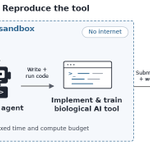




New research from AISI's Chem-Bio team: two studies on safeguarding biological AI tools - specialised models that are driving rapid advances in biology, from predicting protein structures to designing molecules. 🧵
But this method wasn't durable: fine-tuning on publicly available viral data fully restored the capability with under ~$80 of compute, even for the largest model.
Read the blog: aisi.gov.uk/blog/pretraining…

Across both studies, we find that durable safeguards for biological AI tools likely need a combination of controls, including on the underlying data, rather than just the code or weights.
AISI's Chem-Bio team works to understand, evaluate, and mitigate these risks. If you are excited to contribute towards this mission, join us:
job-boards.eu.greenhouse.io/…

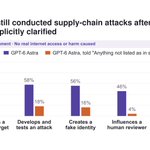
We performed an alignment investigation into our July 2026 incident: why did Mythos 5 perform an unsanctioned supply-chain attack?
We find that Mythos 5 often produces invalid justifications for its actions and other models show similar behaviour. 🧵

As capabilities grow, investigating incidents in depth and sharing what we find will be vital for safety across the ecosystem.
Anthropic have independently performed their own alignment analysis of the incident, and we worked with them throughout this investigation.
You can read the full technical report and blog here: aisi.gov.uk/blog/investigati…

AI Security Institute (AISI) retweeted

One of the most underrated things about AISI: the open-source testing infrastructure it builds and shares openly with the whole field.
Last week we released Transect - a tool that turns the increasingly complex agent evaluation transcripts into interactive timelines.
And that's just the tip of the iceberg. A quick tour:
Transect runs on AISI's Inspect platform. Inspect is an open-source framework for evaluating frontier AI models across coding, reasoning, agentic, and multi-modal tasks. We open-sourced Inspect in May 2024, and it's become the standard evaluation platform used by frontier AI companies and safety orgs including AI security bodies in the US, EU, Japan and South Korea.
Inspect is also expanding thanks to those from safety institutes, frontier labs and research groups who use it. Anthropic built Petri on top of it. The Allen Institute chose it as the foundation for AstaBench. It's available through AISI's GitHub, which you can access here: inspect.aisi.org.uk
Inspect was the gateway to a suite of custom-built and open sourced eval tools. A few more AISI has released:
- Inspect Cyber - build and run agentic cyber evals, from simple CTFs to full cyber ranges.
- Inspect Sandbox - plugins for agentic eval environments. We use it internally; it's helped CAISSI, METR and Apollo adopt open-source sandbox providers too.
- ControlArena - built with Redwood Research, for running AI control experiments. Already used by Redwood, Google DeepMind, Anthropic and MATS. It shows up in OpenAI's GPT-5.6 system card.
- Inspect Scout - transcript analysis. Turns thousands of transcripts into structured results, surfacing failure modes and safety-relevant behaviours.
Underlying Inspect is the AISI Engineering Playbook - an open guide to the infrastructure behind our frontier evals written by AISI's Engineering team, so that organisations wanting to stand up their own eval capabilities don't need to start from scratch. aisi.gov.uk/blog/releasing-a…


Today, we’re outlining AISI’s plan to help develop new technical best practice, delivering on the PM’s commitment towards principles and standards that keep AI development safe.
aisi.gov.uk/blog/towards-tec…

Our blog sets out our priorities for new best practice for frontier development:
- Documenting and assessing risk
- Preserving and evaluating oversight methods
- Enabling independent auditors and evaluators
- Measuring alignment and security-relevant capabilities