

Dedicated to the long-term economic sustainability and growth of the @avax ecosystem. Follow for exclusive updates. RT ≠ endorsements.
Joined February 2024
- Tweets3.5K
- Following96
- Followers25.1K
- Likes11.2K









In a year when global football brought millions of fans together, ticketing is a clear example of blockchain solving a real-world problem: verifiable ownership and authenticity, built into everyday fan experiences.
Activity of this kind, grounded in real demand, is part of what our research agenda sets out to measure 🔺

Sports fans deserve an easier and safer way to purchase tickets.
Francesco Abbate of @FIFACollect explains how blockchain helps verify authenticity, track ownership and give real fans a clearer path from digital collectibles to tickets on gameday.

New research from @CharlesSchwab highlights the quality of activity on Avalanche, from real-world assets to stablecoins, lending, and asset management.
Understanding how that activity creates lasting value for the network is at the heart of our research agenda, and why we created Gross Chain Product to measure that value.
The work continues 🔺

Avalanche Foundation 🔺 retweeted

JUST IN: Charles Schwab identifies Avalanche as a leader in RWAs and institutional use cases.
New research from @CharlesSchwab points to custom L1s and high-utility financial activity as key differentiators for the network.

Fan reward infrastructure continues to be built on Avalanche.
Activity of this kind is what our research agenda aims to understand: how value is generated and flows through the network.
We look forward to following Marquette University’s progress onchain, and on the field 🔺
BREAKING: Marquette University Athletics is bringing fan rewards to Avalanche with Uptop
Today, Marquette joins a growing roster of schools and sports teams on @uptop_xyz. With Marquette Rewards, fans can earn tickets, merch, and experiences with everyday purchases at participating businesses.
More ways to reward, built on Avalanche.

Avalanche Foundation 🔺 retweeted
📣 Avalanche Q3 Ecosystem Call
What to expect: Big tokenization news, growing institutional adoption, summit NYC recap, and more wins across the ecosystem.
Last quarter gave us a lot to talk about, so let’s talk about it.
Join the Quarterly Ecosystem Call tomorrow at 1pm ET for the highlights and a look at what’s upcoming.
Watch live on X tomorrow and RSVP below:

Avalanche Foundation 🔺 retweeted

Moving traditional capital markets onchain isn’t only about efficiency or 24/7 trading. It goes beyond that.
The part I find particularly interesting is access: opening up markets that have been out of reach for much of the world.
That’s what we’re building toward on Avalanche 🔺
Enjoyed joining the stream, @PharaohExchange.
Avalanche’s presence in UAE public infrastructure keeps growing.
Last month, the UAE’s national digital identity system infrastructure launched on Avalanche, serving more than 12 million people.
Now, the Dubai International Financial Centre (DIFC) Courts have introduced a blockchain-based verification system for court orders and hearing records, built on the Avalanche C-Chain.
Together, these two initiatives point to a pattern worth watching: government institutions in the UAE exploring what Avalanche can offer.
This is the kind of real-world adoption we’re delighted to see, and we look forward to following the region’s progress on Avalanche 🔺
BREAKING: Dubai’s @DIFCCourts is using Avalanche to make court orders and hearing records verifiable worldwide in seconds
The courts handled $5.1B across 2,500+ claims in 2025 alone.
Issuance happens on Avalanche in Dubai, while confidential documents stay off chain.
The Avalanche Foundation is delighted to see Team1’s progress continuing to scale around the world.
@Team1JP marks a milestone on two fronts: Team1’s tenth chapter launch globally, and a region where Avalanche continues to build real momentum and a genuine community.
Every new chapter adds value to the ecosystem, and our research agenda is working to measure and support this activity 🔺

Hello Team1 Japan 🇯🇵
Avalanche is winning in Japan with some of the deepest institutional adoption anywhere, across tokenized securities, payments infrastructure and enterprise systems.
We are here to double down on those efforts and empower the community to build the network.
Prior to launching an official Team1 chapter, in Japan we have been actively growing the community and onboarding builders to Avalanche.
・30 events hosted across Tokyo, Osaka, Nagoya, and Fukuoka
・1200 attendees
・18 editions of Avalanche Gourmet Night, our monthly flagship
・4 institutional-focused events
Our mission is to build a Japanese builder community that matches the scale of Japan's institutional adoption, and to support growth across consumer, stablecoins, payments and many other verticals. That means real programs, real pathways, and real outcomes.
While many markets are still running pilots, Japanese institutions are running live systems. Billions in tokenized real estate and corporate bonds now settle on Avalanche.
One of the country's largest payment processors has built on AvaCloud. Japan's biggest banks are exploring tokenized government bonds with Avalanche infrastructure.
Team1 Japan is here to build on those efforts and empower the local community to grow Avalanche too.
Institutions chose Avalanche. Now it's the builders' turn. ヤバランチ🔺
Join our telegram community and Luma below to connect with the community 👇
Validator economics is one of the central questions in our economics research agenda.
According to @eric_lu_sc, the Avalanche Foundation’s Lead Economist, the core question is a two-sided market problem: “how much should validators get paid, and who should pay.”
Watch the clip below as he digs into the thinking.

Recently, @frostledger and I joined the Layer One podcast to discuss the Foundation's research agenda.
One interesting topic that came up: Validator pay is a genuinely hard problem, and most chains haven't actually solved it.
The real question is a two-sided market problem: what are network users actually willing to pay for validation, and what's the minimum validators need to be willing to provide it? We need some kind of equilibrium mechanism to find that price.
There's a second layer to this too. Validation is a public good, validators don't fully capture the benefit of the security they provide, everyone on the network does. Basic economic theory says that means it'll be undersupplied without some kind of subsidy.
Still working through the answer, but this is exactly the kind of question our research agenda is built to take on.
Not just for Avalanche, probably every proof-of-stake chain out there.
Avalanche Foundation 🔺 retweeted
Fundamentals are increasingly what’s making the difference, and that’s exactly the problem our research agenda is working to solve.
We’re building the mechanisms to measure and capture ecosystem value, and distribute it back to strengthen the network.
The work at the Foundation is well underway here 🔺
Here are a few of my takeaways from Token2049 & the Digital Asset Summit Asia.
- Fundamentals is an important return driver now
In a panel discussion with @santiagoroel, @HadickM and @sethginns, they pointed to a "flight to quality": tokens with stronger revenue developments are seeing those developments accrue to the token itself.
This means certain tokens start to look more like equities. Therefore, institutional analysts can now do fundamental analysis on these, which gives investors more clarity if they choose to put the tokens in their portfolio.
- Tokens with better fundamentals are outperforming
The same panel noted that, unlike the previous cycle where top performers tended to be newly issued tokens, legacy tokens with real revenue fundamentals are outperforming the rest this time.
Research presented in a separate keynote backed this more rigorously: looking across a large panel of tokens, it found that those with higher distribution yield (mostly through buyback-and-burn) outperform Bitcoin this cycle.
- What this could mean for cycles going forward
Together, these observations suggest the old "four-year cycle" heuristic may be breaking down. Coming out of this cycle, we may see less synchronised movement across tokens generally, with the strength of underlying fundamentals mattering more than it has before.
- App-Layer vs. L1: Not the same problem
Some of the clearest examples of mature capture-and-distribution models - Aave, Hyperliquid - have been running theirs for a long time by crypto standards, and are arguably the closest comparison to equity-style valuation in this space today.
General-purpose L1s like Avalanche aren't necessarily behind here, though, the capture and distribution question for us is more nuanced than it is for a single application, and how the market responds to that complexity is still something worth watching closely.
- The gap nobody's solved yet
The same question came up in a separate panel with @zeroxkyle, @Tradermayne, @dennis_qian and @andyyy. Their view: revenue remains the key driver this cycle, with Hyperliquid as the reference point - but only for app-layer tokens (Hyperliquid, Aave, Uniswap, Rollbit), not general-purpose L1s.
They didn't explain how L1 tokens should be valued instead, beyond assuming higher app revenue should naturally demand higher L1 security, and therefore higher L1 value.
Most L1 tokens aren't valued by revenue today because they don't capture much of it, and "should" doesn't happen automatically, it needs an explicit mechanism connecting app revenue to L1 value. That's exactly what our research agenda is working to build: a clear link analysts can actually examine, the same way they already do for app-layer tokens.
- What this means for Avalanche
This is exactly the gap our research agenda exists to bridge, strengthening Avalanche's fundamentals and improving the value accrual process.
It matters because, as the panels this week suggested, markets may increasingly reward with a real, explicit link between the value their ecosystem creates and the value that flows back to the token.
Measure, capture, distribute isn't just a framework we talk about, it's the kind of mechanism-building we believe this problem requires.
That said, this is quickly becoming consensus across the industry, not just us: competition is intensifying, and we need to stay strategic about where we focus, balancing impact, effort, and timing.
The work at the Foundation is well underway, and we look forward to sharing more as the work progresses 🔺

Avalanche Foundation 🔺 retweeted
The demand for 24/7 trading is real. The IMF is right.
Markets don’t wait for traditional hours anymore, and more than half of tokenized equity trading already happens outside them.
Avalanche was the number one blockchain by tokenized stock growth in September 2026, according to Token Terminal.
@PharaohExchange is already building on that foundation: 24/7 trading of tokenized U.S. stocks on a decentralized exchange built natively on Avalanche.
This is the kind of infrastructure that’s becoming the backbone of how markets actually work 🔺

More than half of trading in tokenized equities takes place outside regular market hours. The demand for 24/7 access is real. The challenge is building markets that are also deep, liquid, and resilient. Learn more in our GFSR chapter on tokenization: imf.org/en/publications/gfsr…

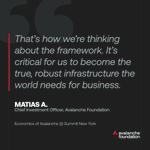
A quote from @frostLedger closing out his keynote at Avalanche Summit New York, on why getting this framework right matters.
Avalanche’s economics research agenda exists to answer: how does a network properly measure the value it actually creates, capture it sustainably without disrupting activity, and distribute it in a way that strengthens the chain for the long term?
As Avalanche evolves into the robust infrastructure the world needs for business, the approach to strengthening the network must evolve with it 🔺

Real-world assets meeting real economic needs.
This is the kind of activity our research agenda is built to measure: real credit flowing against real collateral, not just transaction volume. It's a good example of the Avalanche economy growing from the ground up.
That's the kind of infrastructure that expands the ecosystem 🔺
More than $2B in grain across 12,000+ warehouses in India is coming to Avalanche, connecting millions of farmers to storage, markets, and credit.
Part of that agricultural financing infrastructure is moving onchain with Avalanche.
Together with Finternet, Arya.ag is working with major lenders including Singularity Credit and Aryadhan to make stored agricultural commodities verifiable collateral for credit.
By bringing the underlying records and lending process onchain, lenders can verify collateral and trace financing with greater transparency, while farmers gain access to a more efficient credit system backed by the crops they already own.
Avalanche Foundation 🔺 retweeted
Capture and distribute.
All of it starts with measuring the value in the ecosystem.
This is the foundation everything else gets built on 🔺

Measuring an Onchain Economy 🔺
Matias A. (@frostLedger) explains the framework the Avalanche Foundation is using to measure value in the Avalanche economy.
Gross Chain Product (GCP) works like GDP (Gross Domestic Product): instead of counting transactions, it sums the revenue each project generates because the chain exists, then traces how that revenue connects across projects - revealing why the economy runs the way it does, and what the chain's security currently depends on.
Gross Chain Income (GCI) works like GNI (Gross National Income), going a step further to capture income revenue alone misses - yield backing stablecoins, returns generated inside lending protocols - the value participants actually earn, not just what gets reported as revenue.
Together, GCP and GCI reveal the full value only the chain itself enables.
Once that's measured, the next questions follow: how much can be captured without disrupting the activity that creates it, and how should it be distributed.
This is what the Foundation’s research agenda is built upon.
Watch the full keynote - The Economics of Avalanche, with Matias A. at Avalanche Summit New York ⤵️
youtube.com/watch?v=BGeSstha…

Avalanche Foundation 🔺 retweeted
This is the framework behind everything we're building toward.
Measure what the ecosystem produces. Capture a sustainable share of that value. Distribute it back to the network.
Getting this right isn't optional. It's the foundation for the next phase of Avalanche's growth.
This is how we scale properly 🔺
Measure. Capture. Distribute 🔺
Matias A. (@frostLedger) took the stage at Avalanche Summit New York to detail the economic framework underpinning the Foundation's research agenda.
He addressed three central questions: how value can be measured, how it can be captured without disrupting economic activity, and how distribution can be made more efficient.
Drawing a direct parallel to the fiscal multiplier concept in macroeconomics, where a dollar spent should generate more than a dollar of impact.
The Foundation is examining each aspect of the agenda thoroughly and with rigour, with the aim of making meaningful, long-term changes that strengthen Avalanche.