

Name's Craig | Christian Zionist | Husband | MDiv student @SWBTS | Retired police officer | Asst Director of Security at a church
Dallas, TX, USA
Joined September 2011
- Tweets40K
- Following3.1K
- Followers10.9K
- Likes42.2K




I suppose he wants to prove that God doesn't exist here by proving one can't explain, to his satisfaction, why it's unexplainable without invoking God into the argument.
Truth is, if God doesn't exist, EVERYTHING is fair game because nothing matters. Even those things atheists would say is immoral.
Thoughts @italiathetruth?

“God says homosexuality is a sin.”
Okay, I'm an atheist.
Now explain why two consenting adults loving each other is immoral without quoting scripture.
1
1
80
When I was an officer, I responded to many calls like this where students and even administrators didn't like the content but we, as an agency, NEVER shut them down by arresting anyone unless a completely separate crime existed such as an assaultive offense, etc.
The fact that UT Dallas arrested Mr. Hunter so quickly is clear the administration wanted the arrest made in my opinion and the arresting officer (AO) never questioned it.
I always trained new officers never to let administrators try to dictate how you do your job. Even if the Chief ordered the arrest, if it's not lawful, it shouldn't be carried out. The AO didn't get the memo apparently.
I think the university and agency will lose this one.

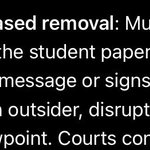
UT Dallas's statement proves our point. @TRussHunter stood in an open plaza with a sign, having peaceful conversations that students themselves wanted to continue. Nobody from the University cared [for more than two hours until someone complained about what his sign said. Then, out of everyone in his group, police arrested only the man holding the sign while he was simply asking questions.
That is not viewpoint neutrality. That is a heckler's veto with handcuffs.
Calling a campus a 'limited public forum' does not repeal the First Amendment. Government may never punish speech because someone dislikes the message. And the University leans on SB 2972 without mentioning that a federal court has already found parts of that law likely unconstitutional, in a case where UT Dallas is on the losing end.
Mr. Hunter committed no crime. We will defend him, and then we will hold the University accountable.

Awaiting Christ ✝️✡️🇺🇸 retweeted

America is entering a post-American exceptionalism era. Israel is entering a post-Zionist era.
The political situation in both countries points to a race toward globalism, where borders, national identity, and heritage are increasingly treated as things of the past.
People today may try to erase Israel’s God-given right, heritage, and memorial in Jerusalem. But the Word of God speaks clearly on this.
Nehemiah left a position of honor in the Persian king’s palace to rebuild the walls of Jerusalem, the ruined city of his forefathers. When Sanballat the Horonite, Tobiah the Ammonite, and Geshem the Arab heard what he intended to do, they mocked him. Why would a man leave the service of a king to rebuild a ruined city so far away?
Nehemiah gave them his answer.
So I answered them, and said to them, “The God of heaven Himself will prosper us; therefore we His servants will arise and build, but you have no heritage or right or memorial in Jerusalem.”
(Nehemiah 2:20)
How should we live in these perilous times? What message should we give to the world?
The answer is simple. Go back to the Word of God! The answers are there. It shows us the way, gives us the truth, and points us to the One who gives us eternal life.
Simon Peter said it best when he answered Yeshua the Messiah.
“Lord, to whom shall we go? You have the words of eternal life. Also we have come to believe and know that You are the Messiah, the Son of the living God.”
(John 6:68–69)
That's the summation of Romans 11, especially in verses 25-29.
The New Covenant in what we call the Middle East is about to be established in Israel (Jeremiah 31:31-40, Daniel 9:24-27)!!!


Awaiting Christ ✝️✡️🇺🇸 retweeted

Christian Zionism is thoroughly biblical.
While the word “Zionism” is modern, the underlying concept of God regathering the Jewish people to the land of Israel in the latter days is woven throughout the Scriptures.
This doesn’t mean you have to agree with every prime minister, political decision, or military tactic.
But every believer in Yeshua should rejoice when they see God fulfilling His promise to the Jewish people!
He is returning soon!
Controversy worse than the truth of Dispensationalism.
Die Hard...is...a...Christmas...movie!!!!
Let the heresies begin!!
😁😆😂🤣
7
20
526


I've had significant muscle loss in my right calf. It's demonstrable.
I can't wait to get back in the gym!
1
2
157
I've thought about writing a book for some time. Problem is, I'm a to the point kind of guy and most books in my opinion is authors just "droning on."
Hence...I've yet to be an author.
6
302
Awaiting Christ ✝️✡️🇺🇸 retweeted

The Messiah Written Into the Pages of Israel’s Scriptures
Centuries before Bethlehem, the prophets had already told His story.
Before a single page of the New Testament was written, before the disciples walked the shores of Galilee, and before the message of Yeshua reached the nations, the Hebrew Scriptures contained an extraordinary prophetic portrait of the coming Messiah.
It was preserved through the Jewish people, recorded by Israel’s prophets, and rooted in the everlasting promises of the God of Abraham, Isaac and Jacob.
Bible prophecy scholar Dr. David Reagan identified 109 distinct prophecies concerning the First Coming of Yeshua within the more than 300 prophetic references commonly cited by Christian scholars.
Yet beyond the remarkable number lies something even more compelling: the convergence of Scripture, history and centuries of Jewish messianic expectation.
Following His resurrection, Yeshua explained His identity through Moses, the Prophets and the Psalms (Luke 24:44).
It is through these same Scriptures that we should examine His messianic claims.
📜 1. The Messiah of Israel
The Hebrew prophets provided extraordinary details concerning the Messiah’s identity, ancestry and ministry.
A descendant of Abraham (Genesis 22:18)
From the tribe of Judah (Genesis 49:10)
From the house of David (2 Samuel 7:12–16)
Born in Bethlehem (Micah 5:2)
A prophet like Moses (Deuteronomy 18:15)
A light to the nations (Isaiah 49:6)
Yeshua’s Jewish identity was not incidental to His mission. It was central to the prophetic promises concerning Him.
He observed Israel’s appointed festivals, taught in synagogues, celebrated Passover and continually directed His listeners toward the Hebrew Scriptures.
From the beginning, God promised that all the families of the earth would be blessed through Abraham (Genesis 12:3).
The redemption of the nations was never intended to displace Israel. It was an expression of God’s faithfulness to the promises made to Israel’s patriarchs.
🏺 2. An Extraordinary Discovery at Qumran
Among the Dead Sea Scrolls is a remarkable pre-Christian Jewish manuscript known as the Messianic Apocalypse (4Q521).
It describes the anticipated age of redemption through miraculous signs, including restored sight, the raising of the dead and the proclamation of good news to the poor.
These expectations closely parallel Yeshua’s response when John the Baptist inquired about His identity (Matthew 11:2–6).
Yeshua directed attention to His works of healing, restoration and resurrection, drawing upon the prophetic language of Isaiah 35 and 61.
Before Christianity emerged, Jewish writers were already associating these extraordinary works with the anticipated age of messianic redemption.
Yeshua’s response was deeply rooted in the Jewish world into which He was born.
🌿 3. The Donkey and the Clouds
One of the most fascinating discussions in the Babylonian Talmud appears in Sanhedrin 98a.
The rabbis recognized an apparent tension between two prophetic portraits:
Daniel 7:13–14 describes a figure arriving with the clouds of heaven and receiving everlasting dominion.
Zechariah 9:9 describes Israel’s King arriving humbly upon a donkey.
Rabbi Yehoshua ben Levi understood these as alternative circumstances surrounding the Messiah’s arrival, depending upon Israel’s merit.
Believers in Yeshua see another explanation: two distinct arrivals of the same Messiah.
Consider the remarkable progression within Zechariah 9 itself.
Verse 9 describes the humble arrival of Israel’s King. Verse 10 describes worldwide peace and His dominion extending to the ends of the earth.
We believe the first was fulfilled nearly two thousand years ago. The second awaits His return.
Peter explains that the prophets searched to understand the relationship between Messiah’s sufferings and the glories that would follow (1 Peter 1:10–11).
The tension between suffering and glory is embedded within the prophetic Scriptures themselves.
🕊️ 4. Messiah ben Yosef and Messiah ben David
Certain rabbinic traditions distinguish between two messianic figures:
Mashiach ben Yosef, a suffering messianic figure who is slain, and Mashiach ben David, the victorious Davidic King.
In Sukkah 52a, the rabbis discuss whether the mourning described in Zechariah 12:10 concerns the death of Messiah ben Yosef or the destruction of the evil inclination.
These later traditions do not teach two comings of Yeshua. Nevertheless, they demonstrate that suffering and triumph have both occupied significant places within Jewish messianic thought.
Consider also the life of Joseph.
Rejected by his brothers, Joseph was subsequently exalted in Egypt before becoming the instrument of his family’s preservation and reconciliation.
Although Genesis does not explicitly identify Joseph as a prophetic representation of the Messiah, believers in Yeshua recognize a beautiful biblical pattern.
The rejected one becomes the deliverer.
The suffering one becomes the exalted ruler.
The apparent defeat becomes the means of redemption.
📖 5. The Servant Who Suffers and Triumphs
Jewish interpretations of Isaiah’s suffering servant have varied throughout history. Many understand the servant collectively as Israel, while others have associated aspects of the passage with an individual messianic figure.
Sanhedrin 98b, for example, applies Isaiah 53:4 to a suffering Messiah.
Significantly, the prophetic passage begins in Isaiah 52:13 with the Servant’s ultimate exaltation before describing His suffering.
Isaiah 53 then describes one who suffers for the transgressions of others, bears their iniquities and is ultimately vindicated by God.
Psalm 22 follows a similarly remarkable progression. It begins with anguish and abandonment but concludes with the nations worshiping the Lord.
And Psalm 16:10 speaks of deliverance from the grave, a passage Peter explicitly connects to Yeshua’s resurrection in Acts 2:25–32.
The resurrection is central to this prophetic portrait.
The Messiah is not merely a righteous sufferer whose life ends in rejection. He is the victorious Redeemer whose suffering precedes His glorification.
⏳ 6. The Significance of the Second Temple
Two prophetic passages deserve particular attention within their historical setting.
Daniel 9:26 describes an anointed figure being cut off before the subsequent destruction of Jerusalem and its sanctuary.
Malachi 3:1 anticipates the arrival of the Lord at His Temple.
Yeshua lived, taught and ministered during the Second Temple period.
Jerusalem and the Second Temple were subsequently destroyed in AD 70.
Although Jewish and Christian interpreters differ concerning the identity of these prophetic figures, the historical relationship between these passages and the appearance of Yeshua deserves thoughtful examination.
The messianic claims of Yeshua are inseparable from the history of Israel.
👑 7. The Promises That Remain
The influential Jewish scholar Maimonides described the anticipated Messiah as one who would restore the Davidic kingdom, rebuild the Temple and gather the dispersed people of Israel.
These expectations raise legitimate questions for believers in Yeshua.
Where is universal peace?
Where is the restored Davidic kingdom?
Where is the worldwide knowledge of the God of Israel?
We should not dismiss these questions by spiritualizing the promises that inspired them.
The prophets describe a future in which:
Israel experiences spiritual renewal (Ezekiel 36:24–28).
Jerusalem becomes a center of divine instruction (Isaiah 2:2–4).
The Lord stands upon the Mount of Olives (Zechariah 14:4).
The nations celebrate Sukkot in Jerusalem (Zechariah 14:16).
The Davidic King establishes everlasting righteous government (Isaiah 9:6–7).
In Luke 4:16–21, Yeshua concludes His reading of Isaiah 61 before its reference to divine vengeance, illustrating how prophetic events described together may be fulfilled at different times.
The birth of the King and the establishment of His worldwide kingdom need not occur at the same historical moment.
🕎 8. Israel’s Story Is Not Finished
Few prophetic passages bring together suffering, recognition, redemption and messianic glory as remarkably as Zechariah 12–14.
Jerusalem experiences divine deliverance. The pierced one is recognized. National mourning gives way to spiritual cleansing. The Lord stands upon the Mount of Olives and establishes His reign over the earth.
These chapters form a magnificent prophetic portrait of Israel’s future redemption.
Jeremiah 31:35–37 connects Israel’s enduring national identity to the very order of creation.
Centuries later, Paul affirms the irrevocable nature of God’s gifts and calling in Romans 11:28–29.
The arrival of the Messiah does not invalidate the covenants that foretold His arrival.
The prophetic hope of Geulah, redemption, encompasses not only individual salvation but also Israel’s restoration and the renewal of creation.
The God of Abraham, Isaac and Jacob has not abandoned His promises.
🤝 9. An Invitation, Not an Abandonment
To my Jewish friends, I recognize that we may understand these passages differently.
I also recognize the painful history of antisemitism, forced conversions and persecution perpetrated by those who claimed to follow Jesus.
That history should never be minimized.
The Jewish people should never have been asked to believe in a Messiah whose followers denied the promises of Israel’s own God.
Paul explicitly warned Gentile believers against arrogance toward the natural branches (Romans 11:18).
My invitation is not to abandon the Hebrew Scriptures or disregard your Jewish heritage. It is to consider Yeshua in light of the very Scriptures the Jewish people have preserved across generations.
Read Moses.
Read David.
Read Isaiah, Daniel, Micah and Zechariah.
Consider the entire prophetic portrait: the suffering and the glory, the humility and the majesty, the redemption and the kingdom.
We believe in Yeshua not despite the promises made to Israel, but because of them.
And we await His return because so many of those promises have yet to be fulfilled.
Bethlehem was not the conclusion of the prophetic story.
Jerusalem still awaits its King.
The Messiah who came in humility will return in glory. The God who fulfilled His promises concerning the First Coming will be no less faithful concerning the Second.
Shalom.
🤖 Made with AI


Awaiting Christ ✝️✡️🇺🇸 retweeted

Not your grandfather’s eschatology.
It’s your great great great great great great great great great great great great great great great great great great great great great great great great great great great great great great grandfather’s eschatology.
a.co/d/0dx4hqdq

