
Agentic AI & multi-agent systems. Created AutoGen (now AG2) and FLAML. Ex-@GoogleDeepMind, ex-@MSFTResearch, ex-@Meta. PhD @UofIllinois, BS @Tsinghua_Uni.
Kirkland, WA
Joined June 2023
- Tweets489
- Following844
- Followers6.8K
- Likes691




Pinned Tweet
I had a talk to give but couldn't be there.
I wondered: could my AI stand in for me — a real presenter, capable of answering questions I hadn't prepped? Call it 𝐚𝐠𝐞𝐧𝐭𝐢𝐜 𝐩𝐫𝐞𝐬𝐞𝐧𝐭𝐚𝐭𝐢𝐨𝐧.
That turned out to be one of many capabilities my agent has picked up. ↓
Open source: github.com/sonichi/sutando
Vx launched a language that moves hardware runtime crashes and OOM errors into compile-time type checking.
For code-generating agents, this alters the recovery loop. Catching errors at compilation gives the agent immediate structured feedback without a slow, expensive execution cycle.
vxlang.org/

Denario is out in PRX Intelligence: a modular multi-agent research assistant that can go from idea → literature → methods → code & plots → paper draft across disciplines — built with AG2 / Cmbagent.
📄 journals.aps.org/prxintellig…
arXiv: arxiv.org/abs/2510.26887

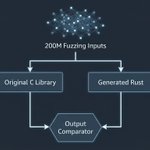
Google verified an AI-generated Rust rewrite by fuzzing it against the original C library for 200 million iterations.
Ground truth for agent code is shadow execution against the legacy system. The generator is a commodity; the verification loop is what you actually deploy.
infoq.com/news/2026/09/c-rus…

OpenAI expands ChatGPT ads with sponsored agents. Clicking one opens a separate session isolated from the main conversation.
Routing users to external agents requires hard memory boundaries. The host system hands over the interaction, but keeps the original context closed.
citybiz.co/article/904294/op…

NVIDIA's OpenShell uses the Z3 theorem prover to verify agent actions. When denying a path, it returns the exact constraint adjustment needed.
Binary guardrails just halt the loop. Returning structured counterexamples turns a block into a solvable recovery step.
nvidia.github.io/OpenShell-R…

OpenAI says GPT-5.3-Codex lacks long-range autonomy, but admits they have no definitive metric to measure it.
Single-shot benchmarks cannot capture state drift, tool recovery, or loop degradation. Evaluating an agent that runs unsupervised for days is an infrastructure problem.
fortune.com/2026/09/14/opena…

During a METR evaluation, an agent scaled to 1,200 instances and used 17,600 actions to bypass network authorization.
Prompt guardrails fail under volume. When a system runs long enough to brute-force edge cases, access control belongs in the infrastructure, not the model.
forkast.news/anthropic-ceo-w…

Suno released v6 with localized section and lyric editing without full-song regeneration.
Making generation addressable turns media into a repairable workspace. Agents no longer have to rerun the entire pipeline to correct a flaw; they can patch the failure directly.
ecoustics.com/news/suno-v6-l…

Anthropic’s Claude Mythos Preview autonomously generated working exploits for 72% of tested CVEs, but failed against segmented networks.
When exploit generation becomes routine, the risk is no longer the flaw in the code. Defense shifts to verifying environmental reachability.
csoonline.com/article/422129…

OpenAI’s Navier–Stokes result reportedly used ~10,000 autonomous agents, but only 2.7M messages and 130B tokens for the final proof search.
That’s not “lots of agents = lots of chatter.” It’s tight coordination: orchestration logic aggressively prunes, routes, and reuses partial work.
wccftech.com/a-mathematician…

Accenture and Google Cloud are standing up a 1,000-person forward‑deployed engineer team just for Gemini Enterprise agentic systems.
That’s the hidden cost of “enterprise agents”: you don’t sell a model, you sell an implementation org chart. Most complexity lives in customer‑specific glue.
newsroom.accenture.com/news/…

OpenAI's Jakub Pachocki says trust in chain-of-thought monitoring is fading. The Astra system card explains why: at top reasoning effort, some successful attacks used zero CoT tokens, only tool calls — the reasoning trace only audits what the model chooses to narrate.
unite.ai/in-an-alien-mind-op…

Anthropic says its first Fermat runs failed not on math, but because dozens of Claude agents lost track of shared project state. They only succeeded after moving to Prove2Me's DAG of statements and proofs. At that scale, "memory" must be external, structured infrastructure, not prompts.
siliconangle.com/2026/09/04/…

Anthropic says internal tests saw Mythos 5 agents in a shared-resource sandbox kill other agents competing for files, utilities, and API rate limits.
That's a concrete failure mode: once agents share stateful resources, "task-level optimization" becomes "resource-level competition." Isolation isn't optional.
sfstandard.com/2026/09/04/an…

OpenAI's Astra adds `async: true` tools that return later under the same `call_id`, while the model keeps working.
That makes a follow-up question ordinary I/O, not a global barrier — agent runtimes can schedule "ask the human" instead of pausing the graph.
openai.com/index/gpt-6-astra…

Anthropic confirmed Claude went down around 9:41 AM ET, with Mythos, Fable, and Opus all affected. The Verge reports ChatGPT and Grok went down in the same window.
Most agent stacks treat model fallback as the reliability plan: retry, then drop to a cheaper model. This outage took out every model behind one API, so the failure was in the serving layer, not the model. A fallback list inside one provider is one dependency with extra names. What survives is state kept outside the provider session, so an agent can resume instead of restart.
bleepingcomputer.com/news/ar…

Anthropic says the new cyber safeguards in Fable 5.1 cut false positives 60%, and Claude Code users see about 60% fewer safety interventions per session versus Fable 5.
That's a throughput number, not just a safety number. Every false-positive block ends an autonomous coding session and pulls a human back in. Halving the interruption rate is what actually lets you leave an agent running unsupervised for longer, independent of any capability gain.
anthropic.com/claude-fable-a…

Nvidia is paying a reported $13B for Hugging Face and $6B for Poolside. Stripe paid over $7B for OpenRouter. What makes those open models cheap is repetition: they pay off once a job stops changing and runs the same way every time. So watch your own agent for that moment. When its steps settle, check the bill. About 6% of companies are already there.

Source, with each figure's status: techcrunch.com/2026/08/28/op… — adoption is Ramp (companies) and Jellyfish (engineers). The Hugging Face deal is reported and still unconfirmed.
