
Technologist that loves building products. Currently, working at @Circle as Developer Relations and Ecosystem Marketing Manager for 🇺🇸
Los Angeles, CA
Joined May 2023
- Tweets1.2K
- Following299
- Followers2K
- Likes1.7K
This is cool! With Proceeds, API providers can now import their OpenAPI specs and paywall their endpoints to accept agentic payments on @arc.
If you’re an API provider, now is the time to start supporting x402 with Circle Nanopayments.
As more applications embed agents to deliver better outcomes for their users, those agents will need to search the web, access specialized AI models, and tap into proprietary data sources, paying for individual API calls in real time.
Circle Nanopayments makes it possible to monetize those high-frequency interactions with gasless, sub-cent USDC payments.
Every API is an opportunity to build a new revenue stream in the agentic economy.


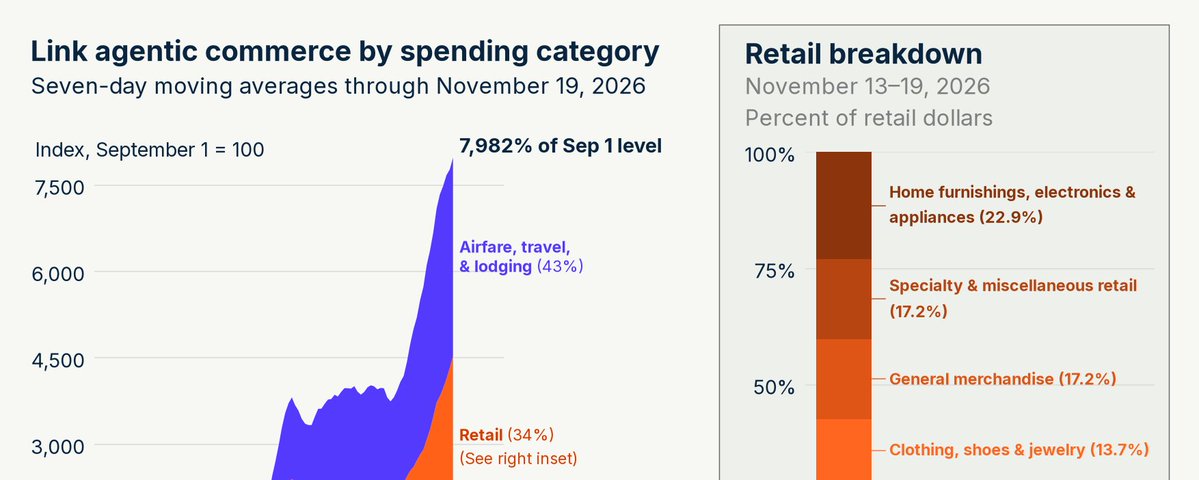
People hate booking travel and lodging for trips so this data makes so much sense.
Everyone's new travel agent will be inside Instinct and Muse booking your next vacation.

We're releasing new @Stripe agentic commerce data today, telling the story so far as we look ahead to the kickoff of the holiday season next week.
6
288
Corey Cooper retweeted

Giving agents USDC and a way to spend it opens up a world of intelligence they can buy from other agents/service providers.
In The Funded Agent Index, we tested how much that changes an agent’s ability to accomplish various tasks, the quality of their work, and the amount of money required to see any changes.
The study covered 7 models, 21 tasks, and 1,470 runs.
Both groups had search and fetch tools; the funded group also had a USDC budget and purchasing tools.
Tasks were chosen where paid services could plausibly help, so results won’t generalize to every task, but the results were pretty impressive.

Corey Cooper retweeted

Today we're launching the Data Marketplace for Agents: 100+ providers that agents and developers can find and pay for per call.
Google organized the world's public information, and agents now search it faster than any person could. But a lot of the valuable data isn't on the open web. Data on people, companies, jobs, finance and real estate is kept by data companies, and agents can't easily reach it.
Most of it is still sold by subscription. That works for a product that calls one source thousands of times. An agent needs a little data from a lot of places, and it shouldn't have to buy three subscriptions to make two requests.
Last November, @berasogut1 and I started @orthogonal_sh to make APIs discoverable and payable by agents. Agents mostly came to us for data, and soon data providers were asking to list with us. So we became a marketplace.
Providers list once, and agents find what they need and pay per call from one balance, over MCP, CLI or API. About 90% of our usage already comes from customers using five or more providers, including @DustHQ, @ZenskarHQ and @foundeers.
USDC is becoming the cornerstone of global online payments, serving as a universal settlement layer that enables seamless conversion between fiat currencies

One integration, many local realities: building fiat rails for stablecoin payments
Learn more: blockradar.co/blog/building-…

Corey Cooper retweeted

If you're going to be the Singapore FinTech Festival, we have a pretty good line up for our half day event on 19 Nov, and I'll be sharing about Arc Studio, what it is and what you can do with it. Drop by if you're interested :)
luma.com/circlesff26


Circle is heading to Singapore FinTech Festival on November 19.
Hear from @KashRazzaghi, explore the Circle Alliance Program, and see Arc Studio in action.
luma.com/circlesff26
Peer has built some of the best developer tools I’ve seen that enable anyone to settle online payments in USDC without adding any friction to the person making the payment.

Traditional checkouts don't have to be your only option.
With @PeerPay_, customers pay peer to peer. You receive USDC payouts immediately in your own wallet, with no card processor to freeze your balance or shut down your account.
pay.peer.xyz

Coaches and scouts can now access circuit stats on players from Nike EYBL, adidas 3SSB, and Under Armour Next.
Try it at textmickey.com
I constantly get questions from developers about what they should build and where the opportunities are.
I’ve been thinking about this a lot over the past two weeks.
Building software has never been easier, especially with AI. But the fundamentals of building something people actually want to use and pay for haven’t changed.
You need to really understand the problem you’re solving. Not just have an idea, but know the problem better than most people. That’s how you build a product that just makes sense to your users because you understand what they need and how they think.
If you’re building a product around data, having access to information that isn’t publicly available to AI agents can be a huge advantage. The harder that data is to get, the more valuable your product can become.
And please, don’t just ship the default Claude-generated design. It makes your product look like everything else being built with AI and can cheapen its perceived value before someone even tries it. Design matters. Taking the time to create a custom experience forces you to think about your customers, how they behave, and what makes your product feel natural to them. Good design is part of understanding your users, not just making things look pretty.
I’d also encourage developers to find their first customer before writing a single line of code. Try to land a pilot customer who can be a design partner from day one. Someone who will actually use what you’re building, give you honest feedback, and help you figure out what matters most before launch.
And probably the biggest thing I’ve learned is you don’t need to build a product that does everything.
Just be great at one thing.
It’s perfectly fine if that’s all your product does for the first few years. You’d be surprised how many people will pay for a product that solves one problem extremely well.
A product that does one thing really well can be a much bigger business than one that does ten things okay.
Corey Cooper retweeted

⚡@ClawRouter_ , BlockRun MCP, and @FranklinRun_ now support payments on @arc.
Your agents can pay per call for models, image generation, and search — all in USDC on Arc.
Start paying on Arc: arc.blockrun.ai/#get-started

Mickey Banks, a domain specific personal AI assistant for college basketball coaches and scouts, is able to credit other scouts work like @OntheRadarHoops all from a text message.
If you need a quick read on a HS basketball prospect, try it at textmickey.com.
College coaches are always on their phones texting about players.
When I was scouting over a decade ago, I remember getting countless messages asking, “What do you think about so-and-so?”
Those conversations mattered. Sometimes, a simple text exchange could help a student-athlete earn a college scholarship. Being part of that process was incredibly rewarding.
Now, with AI, we have an opportunity to scale player discovery and make that same level of insight accessible to coaches, scouts, and fans.
That’s why I built Mickey Banks, a personal AI basketball scout you can text just like you would a real scout.
Ask Mickey about a player and get a quick scouting report, stats, scholarship offers, commitments, and recruiting insights in seconds.
No new apps to download. No complicated platforms to navigate. Just text a question and get an answer.
Making player discovery as simple as sending a text.
Try it at textmickey.com
9
449
Corey Cooper retweeted

Huge!! especially for projects with their own issued tokens looking to make it interoperable across various chains

Applications settle, post collateral, and show balances on the chain where they actually run. If your ERC-20 only lives where you minted it, every other venue needs a one-off bridge or wrapped copy.
With CCTP on Arc you get one economic asset, one bridge identity: burn on source → mint native on destination.
It could be a native crosschain ERC-20 token or a custom issuer-operated ERC-20. Same transfer flow. Fees in USDC. Predictable finality. Issue or hold inventory on Arc, then move it wherever the application needs it.
circle.com/blog/make-your-to…

Corey Cooper retweeted

Arc Studio apps are now easier to share.
You can deploy your app to Netlify, Vercel, or Hugging Face and get a shareable link.
Anyone can open the app, share a specific page, or use it as a starting point for their own version.
Try it today at studio[dot]arc[dot]io
This is a swiss army knife for building complex programmable stablecoin flows without having to deploy smart contracts.

Arc 🤝 @Eco
Eco’s Sauce SDK is live on Arc and coming soon to Arc Studio.
Build stablecoin flows with:
→ Price limits
→ Minimum amounts
→ Approved destinations
The flow executes only when every condition is met. No custom smart contracts to deploy.
Try Sauce: docs.eco.com/sdk-reference/s…

This is very cool. Devs can use @arc Studio and Aomi to test smart contract exploits.

Corey Cooper retweeted

USDC on Arc gives agents a way to pay for the intelligence they use.
Jamie, founder of Alethieum, is building Ando so apps, agents, and robots can access intelligence and pay for it directly.
In this conversation with @bleso_a, Jamie explains why existing payment flows fall short, how MPP-I works, and why he chose Arc for USDC settlement.
Plus, a demo of Ando Wallet with an app, an autonomous agent, and a robot simulation sending testnet USDC.
Chapters
0:00 The Ando story and open access to intelligence
8:31 MPP-I: handling payment without interrupting inference
11:03 Inside the inference and payment flow
23:34 Why Arc: fast finality and USDC gas
32:24 Open access and the Ando Wallet walkthrough
49:06 Connecting OpenCode to Ando
54:02 Hermes manages its own inference
57:57 Ritchie robot simulation
1:02:30 The robot sends testnet USDC; the Circle tools behind Ando
1:08:16 What the agent economy could look like
1:12:03 Jamie’s advice for developers building on Arc
Love to this this type of onchain FX innovation on Arc

You can move a billion dollars onchain in seconds. You still can't move a million dollars into naira, pesos or shillings the same way.
ViFi is onchain FX built on Uniswap v4 hooks. Our testnet is live today on Base Sepolia and Arc Testnet.
Try it: app.vifilabs.xyz
3
270