

We're a charity that gives young people the skills to think and speak for themselves about current affairs through high-quality, topical discussions.
London, UK
Joined May 2014
- Tweets5.4K
- Following751
- Followers2.3K
- Likes2.4K








📣 The Leadership for Change Prize opens for entries next Tuesday, December 1st!
Students have been developing original ideas to tackle loneliness, and now it's time to share them. The most impactful idea will be published in @TheEconomist.
Entries close on 10 January 2027, but we recommend submitting before the Christmas break.
Find out more and watch our tips for success webinar: bit.ly/49cRwOZ

ALT The image features the logo of The Economist Educational Foundation on a dark blue background. Below the logo, the text reads: "Leadership for Change. Empower children to solve the critical issues of their time." Two sets of hands holding smartphones are shown, with a yellow, winding line and colorful dots connecting them.
43
Economist Foundation retweeted

More than 1m children in nearly 100 countries participated in lessons provided by @Econ_Foundation in 2026, thanks in part to donations from Economist readers. Help us reach more in 2027 bit.ly/4ksC4W6
Photo: Sandy Huffaker for The Economist

How much power do young people have on climate change? 🌍
Recently we ran a Topical Talk workshop at @Infosys with 27 Year 8 students from La Sainte Union School in London, using our Headline lesson, COP31: the power of young voices.
Students weighed up a world with strict climate rules against one with none, discussed whether the news should leave us worried, motivated or something else, and debated whether young people will be the most important attendees at COP31. As one student put it: "Young people look towards the future."
After the session, they explored the Infosys Living Labs, meeting a multilingual AI robot, trying AR and VR and seeing a hologram.
Thank you to Infosys for hosting us!


53
On November 3rd Americans voted in the midterm elections, and the Democrats won control of both the House and the Senate. That shifts the balance of power in Washington for the next two years.
What will Democrats do with their new power?
Download this lesson for free: bit.ly/4ksaDvq

1
47
Young people no longer go looking for the news. It finds them.
In a 'By Invitation' piece for @TheEconomist, Sam Freedman, Chair of the Current Affairs Education Commission, explains why education must adapt to how young people now get their news – and why teachers need the time, training and confidence to tackle the topics pupils are already seeing on their feeds.
As he puts it: “there will be no return to the old model.”
The Commission’s full report is out on Wednesday 2 December.
👉 Read Sam’s piece: lnkd.in/eiU3JV7a

Young people online today are “drinking from a firehose of information and struggling to contextualise any of it”, warns Sam Freedman. In a guest essay, he explains how their teachers can help economist.com/by-invitation/…

85
Economist Foundation retweeted
Young people online today are “drinking from a firehose of information and struggling to contextualise any of it”, warns Sam Freedman. In a guest essay, he explains how their teachers can help economist.com/by-invitation/…
Economist Foundation retweeted
“Topical Talk” lesson plans by @Econ_Foundation cover areas such as politics and technology, and touch on sensitive subjects from hate crime to assisted dying. The aim is to give schoolchildren the tools to make up their own minds economist.com/international/…

From Sunderland to the south coast, our Chief Growth Officer Tiffany Smyly has spent the past few weeks in classrooms across England, asking students and teachers how the news reaches young people.
What she heard: young people are hungry to understand the world, but whether school gives them space to make sense of it varies enormously.
The Current Affairs Education Commission’s full report launches on Wednesday 2 December.
Read her reflections from the road on the Commission's website: bit.ly/4t94pmh
#CurrentAffairsCommission


1
61
Economist Foundation retweeted
“The Intelligence” takes a field trip to a primary school to see how @Econ_Foundation is improving young people’s news literacy the world over bit.ly/3VolGM1

Economist Foundation retweeted
As AI transforms how information is found and consumed, teaching children to think critically has never been more important. @Econ_Foundation helps students around the world make sense of the news economist.com/international/…

Children are growing up surrounded by misinformation and polarisation. They need the skills to question what they hear, understand different perspectives and form their own views. Topical Talk gives them the space to do exactly that, with free, weekly news-based lessons reaching more than one million students from 98 countries in the past year.
📣This giving season, we’ve launched our appeal to @TheEconomist's readers, aiming to raise £150,000. For the appeal, The Economist’s journalists went into Topical Talk classrooms in London and San Diego, where students debated the right and wrong ways to use AI and whether news headlines are dividing communities.
Empower young minds for tomorrow – a donation of as little as $2 (£1.50) helps us reach another child.
Read the feature, share this post and support our mission today.
👉 Read the feature: bit.ly/4kEQAKv
👉 Support our mission: bit.ly/4AHiome

ALT A person stands facing a glowing doorway that opens into a brightly colored map of the world. Text reads: "Empower young minds for tomorrow. Help the next generation to think for themselves." The Economist Educational Foundation logos are at the bottom left.
1
3
92
Are young people being heard at COP31?
As the @UN prepares for its big annual conference on climate change, young people around the world are making their voices heard. The young have more to lose from global warming than the old. But how much say do they have in actions to stop it?
Download the lesson for free: talk.economistfoundation.org…
This lesson was supported by @Infosys.

1
94
In July, Elon Musk, the boss of Tesla and SpaceX, spoke to Zanny Minton Beddoes, the editor-in-chief of @TheEconomist, about the future of artificial intelligence. Their conversation ranged from whether AI could outsmart humans within five years to whether it might make money useless.
Use this lesson to help students:
- Develop their understanding of the role AI plays in our lives
- Consider how AI might affect humans in the future
- Debate who should regulate AI
Download this lesson for free:
bit.ly/4yTMiSE

92
🌍 Meet our connection missions
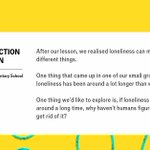
At the end of each Leadership for Change lesson, students complete a connection mission – a chance to reflect on the big questions from the lesson and share an idea from their own classroom.
Teachers post one response on behalf of their class on Padlet, building a global map where students can explore ideas from schools around the world and see how experiences of loneliness, friendship and connection differ across communities.
Here’s one response from Thurgood Marshall Elementary School in Atlanta, Georgia. After their first lesson, students asked: if loneliness has been around for so long, why haven’t humans figured out a way to get rid of it?
Explore more connection missions: talk.economistfoundation.org…

46
In honour of @UNESCO Global Media and Information Literacy Week, we’re asking: should AI do your thinking for you?
Artificial intelligence is becoming part of everyday life. People use it to plan tasks, communicate at work and find information online. Increasingly, AI chatbots are also being used as a source of news. But how can we use AI to support our thinking without relying on it to do the thinking for us?
These teaching resources have been created with support from @Microsoft. The Economist Educational Foundation maintained full editorial control.
Explore the resource for free: bit.ly/4sDxXZi

62
Where do you go when you’re not at home or school? ☕
In Lesson 4 of Leadership for Change, students explore third spaces and how they benefit communities in different contexts. They’ll discuss how the use of these spaces has changed over time, then argue whether they are worth funding over alternative social enterprises.
Download the lesson for free: bit.ly/4hQDHdf
These teaching resources are supported by @ROLEX. The Economist Educational Foundation maintained full editorial control.

1
1
71
We’re proud to have won silver in the ‘Best Educational Programme’ category at the Corporate Engagement Awards, for our partnership with The PA Foundation.
This past school year, our partnership reached more than 23,000 students aged 10–16 around the world. More than 4,400 students joined our live lessons, and four of the six STEAM lessons we co-created ranked among the 15 most downloaded on Topical Talk. Together, they help young people build four essential skills: speaking, listening, problem-solving and creativity.
None of this would be possible without the incredible team at the PA Foundation. Their experts brought engineering and science to life in our live lessons, and their volunteers inspired students at workshops in London and at PA’s Global Innovation and Technology Centre.
Thank you to everyone at @PA_Consulting, and to Communicate Magazine for the recognition. We’re excited about what comes next.

72
From Afrobeats and African fashion to viral dances and food, black culture is enjoyed all around the world. But when cultural ideas become commercially successful, who gets the money – and who gets the credit?
In this lesson to celebrate Black History Month, students will explore how cultural ideas are shared and what makes that sharing respectful or unfair.
Download for free: talk.economistfoundation.org…

52
🌍 Give your students the opportunity to connect with classrooms around the world in our live lesson on October 22nd!
As part of Leadership for Change 2026, students will explore loneliness, friendship and human connection through lively activities, polls and discussions with peers around the world.
They’ll also hear from two brilliant guests: @nyckdevries, champion racing driver, and David Gradon, founder of The Great Friendship Project, and have the chance to ask them questions.
📅 Join us at 10am BST / 9am UTC or 2pm BST / 1pm UTC.
Sign up for free: bit.ly/4zsyqQ3

49
World Mental Health Day is this Saturday 🌍
Keeping up with the news can help us understand the world – but what happens when it starts to feel overwhelming?
Our free lesson on doomscrolling gets students thinking about how the news makes them feel, why negative stories can dominate what they see and how they can develop healthier news habits.
And if you’re exploring this year’s theme of loneliness, friendship and human connection, discover our Leadership for Change programme too.
Explore both for free 👇
Doomscrolling: bit.ly/3UfZGST
Leadership for Change: bit.ly/4ymHh5r
52