

Visual Information Layer of Technology | Janitor @paboxoxyz | All Posts NFA + DYOR
Singapore
Joined January 2022
- Tweets50.8K
- Following7.3K
- Followers47.6K
- Likes39.2K






Pinned Tweet
Why did we build @paboxoxyz from scratch?
Because tokenized stocks run on two different clocks.
The blockchain never stops. Stock markets and their price feeds do closing daily, and pausing on weekends and holidays.
That becomes critical when you use a stock token as collateral: a price from before the close doesn’t tell you what you could sell it for right now.
Most DeFi lending was designed for assets that trade 24/7. Tokenized stocks need lending rules that account for these market breaks.
So we built market hours into Paboxo:
- New borrowing and liquidations pause when the relevant stock market is closed.
- Collateral withdrawals against outstanding debt pause too.
- You can still repay or add collateral.
- Price-dependent actions require fresh oracle data.
We want people to borrow against their stocks without having to sell them. That starts with respecting how the underlying market actually works.
Paboxo v0 is now live on Robinhood Chain Mainnet.
This is our first step.


Paboxo is live: app.paboxo.xyz
Deposit USDG. Earn lending yield. Borrow against Stock Tokens.
Now open for deposits on Robinhood Chain.
Eli5DeFi retweeted
It's pretty interesting thatAI usage can keep growing while some AI businesses become less profitable.
The key is who captures the money, and who carries the risk.
@PanteraCapital’s analysis follows this chain:
Power → Data centers → GPU operators → AI services → Customers
Its illustrative model estimates annual revenue supported by one megawatt of capacity:
- Data centers: ~$2.2 million.
They lease buildings, cooling and power access. Electricity scarcity could support higher rents, but existing 15–20-year leases limit repricing.
- GPU operators: ~$25 million.
They install expensive chips and sell computing capacity. Higher revenue comes with hardware costs, debt and the risk that newer chips reduce older equipment’s earning power.
- AI providers: ~$44 million.
They turn rented computing power into services customers buy, often priced per token, or chunk of text. Their earnings depend on usage, efficiency and competitive pricing.
How to read these numbers: Revenue scales as you stack more service layers on top.
The risk runs upstream:
AI pricing drops → provider margins get pinched → GPU lease obligations come under strain → financing tightens higher up the chain.
More details here ⤵
panteracapital.com/megawatts…

Eli5DeFi retweeted

AAPL and MSFT are now live as collateral on Paboxo!
Both markets expand Paboxo's Stock Token lending lineup on Robinhood Chain, with isolated borrowing positions and USDG liquidity supplied through the shared Earn vault.
Users can deposit AAPL or MSFT Stock Tokens as collateral to borrow USDG without selling their holdings. Borrowers pay interest, while USDG suppliers earn variable yield through the Earn vault, funded by borrowing interest.


And @paboxoxyz will win.

Tokenization is inevitable and @paboxoxyz is prepared for it.

Eli5DeFi retweeted
What if you could access Institutional-grade trading strategies with zero friction?
We are talking the new innovation from @Infinit_Labs, APEX Multi-Strategy (APEX MS)
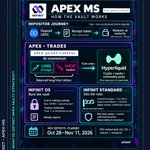
APEX trades. INFINIT OS runs the infrastructure. The INFINIT Standard sets the rules. Three different jobs behind one simple USDC deposit.
Let's dive in to understand INFINIT’s push into institutional-grade trading vaults, starting with APEX Multi-Strategy.
Here’s how the pieces fit:
❶ APEX is the trading desk.
Operated by Apex Quantitative Capital, its AI-led momentum strategy goes long stronger markets and shorts weaker ones across crypto, equities and commodities.
Equity and commodity exposure comes through @HyperliquidX perpetual contracts, rather than ownership of the underlying assets.
❷ INFINIT OS is the operating infrastructure.
It connects strategy research, vault setup, depositor accounting, execution, monitoring, and reporting (powered by INFINIT’s proprietary, battle-tested AI tooling) to ensure standards are maintained and rules are consistently followed.
INFINIT describes 3-of-4 multisig custody, with keys split between INFINIT and the operating team. Trading credentials let managers open and close positions without withdrawal access.
❸ The INFINIT Standard is the rulebook.
Managers must pass screening, demonstrate live trading history, commit capital and declare risk limits. Eligible markets must have at least $100 million in open interest.
The gateway blocks restricted orders; separate monitoring and risk-team review handle mandate breaches, with unresolved breaches leading to paused trading access.
But for depositors, the flow is straightforward:
Deposit USDC → receive a vault receipt token → follow weekly reports → redeem your share at maturity, after fees.
Managers disclose fees and lock-up terms before deposits open. Your receipt token represents a share of the vault’s value, which can rise or fall.
That's it really.
There’s also live performance to examine → APEX’s Oct 6 account report shows a 5.26% realized trading return over 58 days (Aug 10–Oct 6, 2026).
The figure includes trading fees and net funding, and excludes unrealized P&L.
And now if you want to participate, APEX MS2 deposits are planned for October 28–November 11, 2026, with MS1 becomes redeemable on October 28.
With all the hype around institutionalization and DeFi renaissance, the interesting proposition is the combination: professional trading expertise, infrastructure to operate the vault, and explicit rules around the manager.
APEX provides INFINIT with a strategy that people can evaluate. INFINIT provides APEX with the infrastructure to make that strategy accessible.
This creates a potential infinite (pun intended) growth loop: proven managers attract capital; a wider selection of strategies makes the platform more useful; and successful distribution attracts additional managers.
APEX can demonstrate demand for a professional onchain strategy, while INFINIT can make the operating model repeatable across managers.
So, see you on October 28!

ICYMI, @RobinhoodApp just printed all-time-high revenue on the earnings call.
Here are the Q3 2026 highlights:
- Revenue: $1.42B (+12%), a hair under the $1.43B estimate.
- Trading revenue: $867M (+19%).
- Options: $399M (+31%).
- Prediction markets: $173M (6x+ YoY) and now out-earning crypto.
- Crypto: $120M (-55%).
- Gold subscribers: new peak at 5.2M (+34%).
- Net deposits: $15.7B, pushing platform assets up to $396B.
Next up: keep your eyes on @RobinhoodCrypto Chain.
- Robinhood says the chain saw $80B+ in DEX volume in Q3.
- Projects and builders like @ponsdotfamily, @BundleCatAI, @longdotxyz, and soon @paboxoxyz look like they’ll shape what comes next for RHC.
RHC S2 is about to get interesting.


Eli5DeFi retweeted
Institutions moving onchain bring a familiar requirement: knowing how their transactions will be handled.
Who can see an order? When will it be included? Which operators will process it?
@Delphi_Digital’s report on @ETHGasOfficial, founded by Kevin @lepsoe, explores how those requirements could fit within public Ethereum.
The concept is Institutional Blockspace: reserving capacity ahead of time and defining how transactions should pass through it.
An institution submits directly to ETHGas. Participating infrastructure applies its screening and ordering rules, then routes the transaction through an eligible validator. Settlement still happens on Ethereum.
Think of a fund rebalancing its portfolio. It could arrange blockspace and handling conditions before submitting its trades, while continuing to use existing Ethereum contracts and liquidity.
The interesting part is where that control sits.
Institutions can set conditions around their own transaction flow without requiring the entire network to adopt those conditions. Different participants can use different execution arrangements while sharing a settlement layer.
That also creates a market: institutions pay for specific execution conditions, and participating validators earn revenue by supplying the capacity.
It gives the institutional adoption discussion a more concrete focus: how financial activity reaches Ethereum, and what users are willing to pay for predictability.
The next wave in adoption may be less about launching another chain and more about making @Ethereum easier to plan around.


Institutions want their own rules inside Ethereum blocks.
A normal transaction on Ethereum is visible to everyone before it is included. That has pushed many institutions onto private chains with far less liquidity.
@ETHGasOfficial lets them book space in Ethereum blocks ahead of time. Transactions sent this way skip the public mempool and are screened against the institution’s own sanctions rules first. Each institution stays in control of its transactions without leaving Ethereum.
Being seen early is expensive for a fund moving a large position. Traders watching the public mempool can spot the trade and buy first, which pushes up the price the fund pays. With reserved blockspace, the fund can buy a whole block and decide what goes ahead of its trade.
Institutions do not have to leave Ethereum for a private chain to set their own rules.
You can now post $AAPL and $MSFT as collateral on @paboxoxyz!
Quick alpha: we’re not only expanding the lineup of stock assets you can collateralize, we’re also cooking up something genuinely novel stuff.
Can’t share details yet, but it’ll be a first-of-its-kind.
Paboxo isn’t just another lending protocol; it’s the home for tokenized assets.
AAPL and MSFT are now live as collateral on Paboxo!
Both markets expand Paboxo's Stock Token lending lineup on Robinhood Chain, with isolated borrowing positions and USDG liquidity supplied through the shared Earn vault.
Users can deposit AAPL or MSFT Stock Tokens as collateral to borrow USDG without selling their holdings. Borrowers pay interest, while USDG suppliers earn variable yield through the Earn vault, funded by borrowing interest.
What if you could access Institutional-grade trading strategies with zero friction?
We are talking the new innovation from @Infinit_Labs, APEX Multi-Strategy (APEX MS)
APEX trades. INFINIT OS runs the infrastructure. The INFINIT Standard sets the rules. Three different jobs behind one simple USDC deposit.
Let's dive in to understand INFINIT’s push into institutional-grade trading vaults, starting with APEX Multi-Strategy.
Here’s how the pieces fit:
❶ APEX is the trading desk.
Operated by Apex Quantitative Capital, its AI-led momentum strategy goes long stronger markets and shorts weaker ones across crypto, equities and commodities.
Equity and commodity exposure comes through @HyperliquidX perpetual contracts, rather than ownership of the underlying assets.
❷ INFINIT OS is the operating infrastructure.
It connects strategy research, vault setup, depositor accounting, execution, monitoring, and reporting (powered by INFINIT’s proprietary, battle-tested AI tooling) to ensure standards are maintained and rules are consistently followed.
INFINIT describes 3-of-4 multisig custody, with keys split between INFINIT and the operating team. Trading credentials let managers open and close positions without withdrawal access.
❸ The INFINIT Standard is the rulebook.
Managers must pass screening, demonstrate live trading history, commit capital and declare risk limits. Eligible markets must have at least $100 million in open interest.
The gateway blocks restricted orders; separate monitoring and risk-team review handle mandate breaches, with unresolved breaches leading to paused trading access.
But for depositors, the flow is straightforward:
Deposit USDC → receive a vault receipt token → follow weekly reports → redeem your share at maturity, after fees.
Managers disclose fees and lock-up terms before deposits open. Your receipt token represents a share of the vault’s value, which can rise or fall.
That's it really.
There’s also live performance to examine → APEX’s Oct 6 account report shows a 5.26% realized trading return over 58 days (Aug 10–Oct 6, 2026).
The figure includes trading fees and net funding, and excludes unrealized P&L.
And now if you want to participate, APEX MS2 deposits are planned for October 28–November 11, 2026, with MS1 becomes redeemable on October 28.
With all the hype around institutionalization and DeFi renaissance, the interesting proposition is the combination: professional trading expertise, infrastructure to operate the vault, and explicit rules around the manager.
APEX provides INFINIT with a strategy that people can evaluate. INFINIT provides APEX with the infrastructure to make that strategy accessible.
This creates a potential infinite (pun intended) growth loop: proven managers attract capital; a wider selection of strategies makes the platform more useful; and successful distribution attracts additional managers.
APEX can demonstrate demand for a professional onchain strategy, while INFINIT can make the operating model repeatable across managers.
So, see you on October 28!
Check more details about @Infinit_Labs APEX MS Institutional-Grade Vault here ⤵


Institutions moving onchain bring a familiar requirement: knowing how their transactions will be handled.
Who can see an order? When will it be included? Which operators will process it?
@Delphi_Digital’s report on @ETHGasOfficial, founded by Kevin @lepsoe, explores how those requirements could fit within public Ethereum.
The concept is Institutional Blockspace: reserving capacity ahead of time and defining how transactions should pass through it.
An institution submits directly to ETHGas. Participating infrastructure applies its screening and ordering rules, then routes the transaction through an eligible validator. Settlement still happens on Ethereum.
Think of a fund rebalancing its portfolio. It could arrange blockspace and handling conditions before submitting its trades, while continuing to use existing Ethereum contracts and liquidity.
The interesting part is where that control sits.
Institutions can set conditions around their own transaction flow without requiring the entire network to adopt those conditions. Different participants can use different execution arrangements while sharing a settlement layer.
That also creates a market: institutions pay for specific execution conditions, and participating validators earn revenue by supplying the capacity.
It gives the institutional adoption discussion a more concrete focus: how financial activity reaches Ethereum, and what users are willing to pay for predictability.
The next wave in adoption may be less about launching another chain and more about making @Ethereum easier to plan around.
Institutions want their own rules inside Ethereum blocks.
A normal transaction on Ethereum is visible to everyone before it is included. That has pushed many institutions onto private chains with far less liquidity.
@ETHGasOfficial lets them book space in Ethereum blocks ahead of time. Transactions sent this way skip the public mempool and are screened against the institution’s own sanctions rules first. Each institution stays in control of its transactions without leaving Ethereum.
Being seen early is expensive for a fund moving a large position. Traders watching the public mempool can spot the trade and buy first, which pushes up the price the fund pays. With reserved blockspace, the fund can buy a whole block and decide what goes ahead of its trade.
Institutions do not have to leave Ethereum for a private chain to set their own rules.
An AI trader that pays for its own thinking, trades in public, and shares its wins with stakers.
That’s the idea behind @kivoagentxyz.
Kivo connects AI, trading, and token economics into a working loop. Its own token activity helps fund both the capital it trades and the compute it needs to make decisions.
Here’s how it works:
Every 10 minutes, Kivo reads BTC and ETH charts alongside market news. DeepSeek through @orbiodotso weighs the information and decides whether to go long, go short, close a position, or wait.
Code checks position sizes, leverage, stops and targets. @levantolabs’s Sage adds another decision check. Trades execute on @papertrade_xyz using @HyperliquidX prices.
You can follow its reasoning live and inspect recorded decisions and trades. That makes the process easier to evaluate over time.
The funding comes from collected $KIVO (launched on @Moshdottrade) creator fees:
• 50% → trading capital
• 10% → AI compute
• 40% → revenue vault
For stakers, 70% of each winning trade’s payout is allocated in $USDG. Once rewards owed reach $100, distribution starts and streams over seven days.
Trading losses stay with the treasury, without clawing back rewards. Stakers also receive allocations of 70% of $PAPER minted by losing trades, though PAPER isn’t transferable yet.
It’s still early: funding depends on token activity, leveraged trades can lose money, and staking doesn’t protect KIVO’s price. The staking contract is also upgradeable.
The promising part is how the pieces connect: token activity funds an agent’s work, its decisions are visible, and successful trades can reward participants.
This is a concrete experiment in how AI agents could support their own operations.


To put it in context, 60k is equal to:
- Full capacity Emirates Stadium
- Palo Alto population
- London population at 16th century
- Cayman Islands population
Wild.

BREAKING: Microsoft, $MSFT, is offering buyouts to 60,000 workers as part of the company’s efforts to cut costs amid AI adoption, per Bloomberg.
Personnel on select teams in the US, Canada, India, and the UK at a vice president level and below will be eligible.
This reflects ~27% of Microsoft's total workforce.
Update.
Very interesting shift. Some protocols here will probably be mentioned on RHC’s earnings call today.
Personally from this list (NFA + DYOR), I’m watching:
- @BundleCatAI / $BUN
- @ponsdotfamily / $PONS
- @orbiodotso / $ORBIO
- @standard_rsv / $STANDARD
h/t @sparsitydata


I am sorry but this is so out of touch, you better hire another person @vladtenev to run the chain, so far execution has been subpar and seems no one exactly knows what they're doing ffs, 🤣
