

Working on fixing the financial system with reusable KYC. A ruthless empiricist, Co-founder/CEO @OpacityLabs
NYC
Joined November 2021
- Tweets7.3K
- Following3K
- Followers2.8K
- Likes6.7K








Hersh Patel retweeted
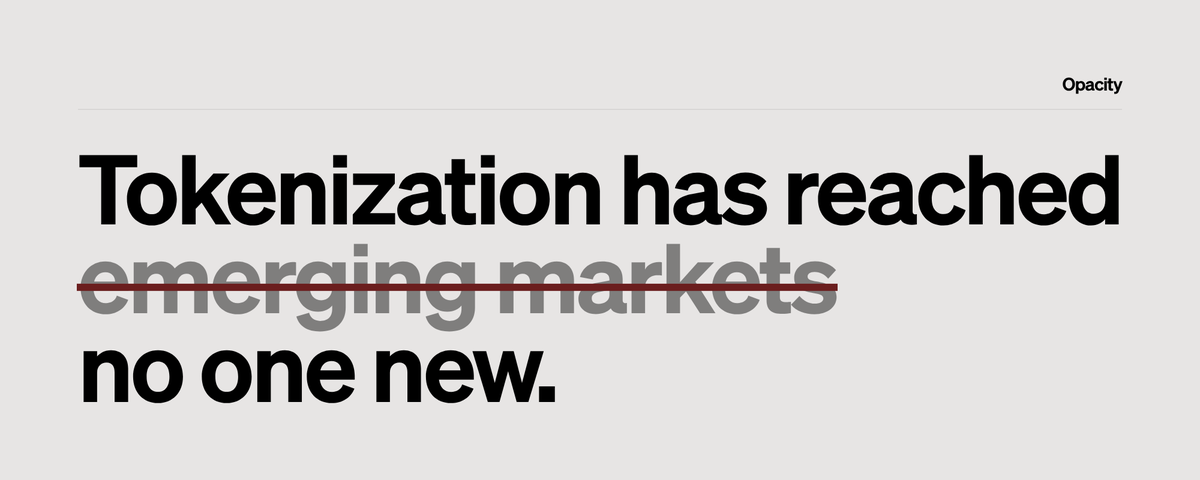
Investors in emerging markets deserve opportunity.
Opacity can verify investors in emerging markets.
The next billion users won't get turned away, they'll get verified.


Hersh Patel retweeted

Five years ago, Breyer Capital was proud to back @colossal in its inaugural $15 million seed financing. When @BenLamm and renowned Harvard geneticist @geochurch founded the company, their ambition to bring back the woolly mammoth captured the world's imagination.
But what excited us just as much was the potential for breakthroughs in genomics, gene editing, and computational biology to transform conservation and advance biotechnology more broadly. Since that first investment, it has been remarkable to watch Ben and the Colossal team turn an extraordinarily ambitious vision into tangible scientific progress.
In just five years, Colossal has pioneered genetically engineered woolly mice and dire wolves, and cloned critically endangered red wolves. Its work now extends to the dodo, Tasmanian tiger, and numerous endangered species, including a new partnership with the U.S. Fish and Wildlife Service to preserve genetic material from thousands of threatened and endangered species.
This week, Warhound, founded by Ben Lamm and Palmer Luckey, emerged from stealth. I'm excited to announce Breyer Capital's investment in Warhound and proud to continue supporting Ben and his team's remarkable work. It's gratifying to see technologies we believed in five years ago finding new applications in conservation, biotechnology, and now national security.
Hersh Patel retweeted

The US Securities and Exchange Commission said Friday that the use of artificial intelligence, private assets and tokenized securities would be among key areas of focus for the agency's examination of Wall Street firms in the current fiscal year. reuters.com/legal/government…

Hersh Patel retweeted

Bingo. I'll have a lot more to say about this, but for now, I'll just say that contained in these words are solutions to everything from growing wealth inequality through political polarization to a range of national security threats - if you have the eyes to see.
AI will hit a wall in the compliance back office, and its not an intelligence problem
theres a difference between intelligence and sensing. Intelligence is what you do with the data, sensing is whether the data is in contact with reality.
Air France 447 is what happens when you confuse them. The plane had plenty of intelligence, a modern flight computer and two trained pilots. Then its speed sensors iced over and started reporting airspeeds that contradicted eachother, and a perfectly good airplane crashed into the atlantic.
Nobody flying that plane was stupid. the instruments were lying, and they were lying confidently. Call them frozen instruments: guages that keep reporting after they've lost contact with the world.
compliance runs on frozen instruments. KYC, underwriting, credit risk all run on PDFs, screenshots, exports and hand assembled attestations. A pdf is a copy with no link back to where it came from. An edited bank statement reads excatly like a real one.
So we put agents on top to read the PDF, click the portal, fill the form and route the exception. The agent still has no idea whether the underlying claim is true, so the best it can do is process fiction faster
The core problem in the compliance back office isnt intelligence, its verification.
Reusable KYC is stuck because people conflate two different things a verification can be:
1. a judgment ("this person is fine")
2. a set of facts with provenance (who recorded what, when, from where)
Medicine keeps these seperate. Dr Alice saying "Bob is healthy" is a judgment. A blood panel stamped with the lab and date is evidence.
If Bob brings Dr Alice's note to Dr Charlie, Dr charlie cant really lean on it. if Bob gets hurt its Dr Charlie's license on the line not Dr Alice's. So he orders the panel again
That's excatly how the BSA works. every institution owns its own obligation and no contract moves that liability to someone else.
Most "re-usable KYC" proposals are asking regulators to let Dr Charlie rely on Dr Alice's note. Nobody in medicine would propose that. Worse, if every Dr Charlie relies on the same Dr Alice, one bad Dr alice corrupts every file downstream
You dont fix the second opinion problem by making Dr Alice's opinion legally binding. You send the bloodwork.
Hersh Patel retweeted

Can attest to this as someone who has built lending in emerging markets.
There are hard unit economics of scale and verifiability that makes a “Maria silva” unviable to lend to in the old world order.
What opacity is proposing, is an orders of magnitude upgrade to the “poverty of verifiability” that can make capital markets work for the rest of the world in a way that was never possible before.
Excited to see a lot of unsexy work fructify for the team over @OpacityLabs ❤️
I'm at Money20/20 in Vegas through Wednesday. Fintechs and asset managers working on emerging-market onboarding, DM me.
Hersh Patel retweeted

Check out @OpacityLabs labs if you want to see how cool the future will be.

Your $NVDA stock token isn't Nvidia stock. It's an IOU from a fintech.
If a fintech in the emerging markets that sold it to you fails, you're a creditor in its bankruptcy. A properly tokenized share is still yours, on a US register.
Why does that matter if the price moves the same?
There's about $51 trillion across all US retirement accounts. That's a lot of money.
If you hold a passive index fund in your retirement account, there are 5 legal entities between you and Apple.
Stop and think about how crazy it is that the system works.
You can comfortably leave money somewhere for 30 years and sleep at night.
Call it unattended trust.
Arguably, this trust we take for granted is why our capital markets are as big as they are. Trust in the system facilitates capital formation.
That's not true everywhere in the world. In places like India, physical gold at home and land are better stores of value than a brokerage account.
That's not because of entrenched cultural norms. People just don't trust the institutions enough to be comfortable with anything better.
Without unattended trust, wealth has to be guarded, so it goes into things you can watch yourself.
Wrapped or synthetic exposure strips out the regulatory regime that has made our markets so robust.
A stock token puts you back on watch. Shares on a US register let you leave them unattended.
People will definitely day trade "stock tokens" for fun, but it's not conducive to compounding wealth over the long term.
The compounding wealth version is a much bigger opportunity if you have the grit for it.
The @SECGov just cosigned that access to markets isn't enough.
Opening the gates for retail access to the private markets we need the assets more transparent.
sec.gov/newsroom/speeches-st…


Hersh Patel retweeted
In BlackRock's annual chairman's letter, Larry Fink wrote that every stock, bond, and fund can be tokenized, and that if they were, transactions that currently take days would clear in seconds, and capital immobilized inside delays could be put back to work.
Be first.


Hersh Patel retweeted

SPY, IVV, and VOO hold the same 500 stocks, but SPY was first, to compete, BlackRock (IVV) and Vanguard (VOO) cut their expense ratios to 0.03% vs SPY's 0.09%. SPY stayed the largest ETF in the world for three decades anyway.
🚨
Does anyone know if @dashiellvosh is really at Franklin Templton?
I got a dm and seems sus
> Institutions do not want to avoid KYC, they want to avoid redundant KYC
banger mcshlanger
@OpacityLabs version: bring the compliance to the liquidity, not the liquidity to the compliance.


One of the core challenges that traditional financial institutions face when growing adoption of their crypto-related products has been the ability to reach KYCed customers who want to purchase these products. However, onchain KYC itself has not fully been solved.
I did a deep dive of current onchain KYC solutions, along with corresponding regulatory frameworks, alongside my @a16zcrypto partner @MicheleKorver. We also discuss the forthcoming Know Your Agent (KYA) landscape and emerging solutions.