

Le principal think-tank français sur les questions stratégiques et la défense / The main French think tank on strategic and defense issues.
Paris
Joined February 2012
- Tweets9.3K
- Following478
- Followers26.5K
- Likes4.1K



FRS retweeted

Retrouvez moi ce soir #Cdanslairlinvité avec @Caroline_Roux pour parler de l’affaire #MBappe et de mon dernier livre. @Ed_Tallandier @RicheNath @FRS_org

☢What does the future hold for nuclear energy in Europe?
Amid rising electricity demand, decarbonisation imperatives and geopolitical tensions, nuclear energy plays a crucial role in Europe's energy security, industrial competitiveness and strategic autonomy.
In her latest publication, Annabelle Livet, Research Fellow at FRS, examines the energy challenges facing the European Union: ageing infrastructure, technological and industrial dependencies, skills shortages, and diverging views among Member States on the role of nuclear energy.
🔎 How can Europe develop a more coherent nuclear energy strategy? 👇🧵


The author identifies several priorities for action:
- Strengthen European coordination of nuclear projects and energy infrastructure.
- Support industrial capabilities and innovation, particularly in emerging nuclear technologies.
- Develop skills and professional mobility across Europe.
- Better integrate nuclear energy into EU energy, industrial and security policies.
📖 Read the full publication: frstrategie.org/en/publicati…
#NuclearEnergy #EnergySecurity #EuropeanUnion #EnergyTransition #StrategicAutonomy


📚 Comment la Chine exerce-t-elle son influence dans le monde ? Et quels sont les enjeux actuels des relations entre Pékin et Tokyo ?
À l'occasion de la parution de son nouvel ouvrage Quand la Chine manipule le monde. L'influence chinoise et ses limites, publié aux @Ed_Tallandier, @VNiquet, maître de recherche à la FRS, participera à une rencontre avec @karyn_nishi, autrice de Femmes du Japon. Libres sous contraintes.
Cette rencontre sera l'occasion de croiser les regards sur la Chine et le Japon, d'explorer les stratégies d'influence chinoises, les relations entre les deux puissances asiatiques et les évolutions politiques et sociétales au Japon.
📅 Mercredi 4 novembre 2026 à 19 h
📍 Librairie Les Alizés, 16 rue des Écoles, Paris 5e.
📖 Découvrez l'ouvrage de Valérie Niquet : frstrategie.org/publications…
#Chine #Japon #Géopolitique #RelationsInternationales #FRS

🇮🇱 Israël peut-il tourner la page Netanyahu ?
🗳️ À la veille des élections législatives israéliennes du 27 octobre, Benyamin Netanyahu brigue un nouveau mandat après dix-neuf années cumulées au pouvoir. Mais dans un contexte politique et régional particulièrement tendu, l'issue du scrutin demeure incertaine.
⚖️ Face à lui, une opposition divisée peine à dégager une majorité parlementaire, laissant entrevoir le risque d'une nouvelle impasse politique.
🌍 Quelles pourraient être les conséquences de ce scrutin sur la politique régionale d'Israël ? Une alternance pourrait-elle changer les relations avec les États-Unis, la politique à l'égard de l'Iran ou encore les perspectives de règlement du conflit israélo-palestinien ?
🎙️ Dans l'émission Géopolitique de @RFI, présentée par @MFChatin, Laure Foucher, maître de recherche à la FRS, revient sur les enjeux de ces élections et l'avenir politique d'Israël, aux côtés d'Alain Dieckhoff, directeur de recherche au CNRS.
🎧 Écouter l'émission : rfi.fr/fr/podcasts/géopoliti…
#Israël #Netanyahu #Élections #Géopolitique #MoyenOrient #FRS #RFI

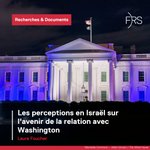
🇮🇱🇺🇸 What does the future hold for the alliance between Israel and the United States?
🗳️ With Israeli elections and the U.S. midterms approaching, the future of the U.S.-Israel relationship has become an increasingly pressing strategic question.
In a new Recherches & Documents, Laure Foucher, Senior Research Fellow at FRS, examines the debates unfolding in Israel over the future of relations with Washington, drawing on interviews with senior officials from the security and political establishments and Israeli experts.
In Tel Aviv, there is a growing sense that an era is coming to an end: U.S. support, long considered as almost automatic, bipartisan and predictable, can no longer be taken for granted. This shift is becoming increasingly apparent among both Republicans and Democrats, albeit to different degrees and for different reasons.
🔎 In response to these changes, Israeli decision-makers are adjusting their narrative while seeking to transform the “special relationship” into a strategic partnership. Their aim is to deepen the integration of the two countries’ defense ecosystems in order to structurally anchor the U.S. commitment to Israel’s security.
⚠️ Yet this strategy has significant weaknesses: it underestimates the extent to which Israel’s own political and strategic choices have contributed to the erosion of U.S. support; Israel’s strategic value to the United States is increasingly being called into question; and deeper military integration addresses neither the erosion of American political support nor, more fundamentally, Israel’s dependence on Washington.
Against a backdrop of protracted regional turmoil, what is new is not the fragility of Israel’s strategic posture, but the weakening of one of the key factors that has long helped compensate for it: unwavering U.S. support.
📖 Read the publication: frstrategie.org/en/publicati…
#Israel #UnitedStates #MiddleEast #Geopolitics #Defense

🚢 Comment la Russie contourne-t-elle les sanctions européennes grâce à sa « flotte fantôme » ?
🎙️ Victor Masson, chargé de recherche à la FRS, est intervenu dans le Journal de 20h de @TF1 pour décrypter le fonctionnement de ces flottes fantômes et les enjeux liés à leur interception.
⚓ Cette intervention fait suite à l’arraisonnement par la Marine française, au large de La Réunion, d’un nouveau navire appartenant à la flotte fantôme russe. Arborant aujourd’hui un pavillon béninois, il naviguait encore il y a quelques mois sous le nom de Kaliningrad.
🛢️ Ces navires sont notamment utilisés pour permettre la poursuite des exportations de pétrole russe en contournant les sanctions européennes. Les interceptions de ce type se sont multipliées ces derniers mois.
📺 Retrouvez l’intervention de Victor Masson : tf1.fr/tf1/jt-20h/videos/la-…
#Russie #Défense #Sanctions #SécuritéMaritime #FRS

🎥 ICYMI: Webinar Replay – "Global energy supplies in troubled waters: what implications for East Asia?"
🌏 How are geopolitical tensions reshaping energy security in East Asia?
Following the energy crisis of 2022, the closure of the Strait of Hormuz has brought global energy supply challenges into sharper focus, raising concerns not only about prices but also about the physical availability of fossil fuels.
As East Asian economies navigate this increasingly volatile environment, what are the implications for their energy security, and how might their energy strategies evolve?
💡 Watch the replay of our webinar, bringing together four experts to explore these challenges and the responses of East Asian countries.
🎙️ Speakers:
- Anne-Sophie Corbeau, @ColumbiaUEnergy
- @jnakanoenergy, @CSIS
- @Tom_Aabm, FRS
- @CartusYou, @TaiwanDset
Moderated by Annabelle Livet, Research Fellow, FRS.
▶️ Watch the full replay: youtube.com/watch?v=ajCSuvZ-…
#EnergySecurity #EastAsia #Geopolitics #EnergyTransition

FRS retweeted

International Webinar | Today at 1.00 PM CEST
Join us as energy experts from North America, Europe, & Asia explore what #energy #security means in practice today: Katie Jereza @ENERGY - Laurent Kueny @Economie_Gouv - Dr. Emi Gui @MonashUni
Moderated by Annabelle Livet @FRS_org

📺 À voir : un reportage de @FranceTV consacré à L’Astrolabe et aux enjeux stratégiques de l’océan Indien.
L’été dernier, Alexandre Taithe, maître de recherche à la FRS, avait embarqué à bord du patrouilleur polaire L’Astrolabe pour une mission de terrain dans les Terres australes et antarctiques françaises (TAAF).
🎙️ Il témoigne de cette expérience dans l’émission de France 5 dédiée aux Outre-mer, C pas si loin, « Océan Indien, une région hautement stratégique ».
De Tromelin aux îles Crozet, puis à Saint-Paul et Amsterdam, cette mission lui a permis d’observer sur le terrain plusieurs enjeux au cœur de ses recherches : politiques polaires, vulnérabilités climatiques des Outre-mer français et impact de l’environnement sur les capacités militaires.
Retrouvez le reportage sur France 5 : france.tv/france-5/c-pas-si-…

📢 Happening today at 2:00 PM (Paris time)!
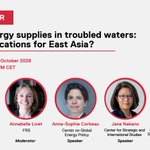
Join our FRS webinar: “Global energy supplies in troubled waters: what implications for East Asia?”
As the closure of the Strait of Hormuz disrupts global energy supplies, East Asian countries face growing challenges in securing their energy needs.
How are geopolitical tensions reshaping energy flows? What strategies are East Asian countries adopting to navigate this increasingly volatile environment?
📅 Today, 20 October 2026
⏱️ 2:00–3:15 PM (Paris time)
With: Anne-Sophie Corbeau, @Tom_Aabm, @jnakanoenergy, @CartusYou
The discussion will be moderated by Annabelle Livet, Research Fellow at FRS.
🔗 Learn more and register: frstrategie.org/en/events/20…
#EnergySecurity #EastAsia #Geopolitics #StraitOfHormuz #Energy

🛰️ Satellites are no longer just strategic assets: they are playing an increasingly central role in military operations.
How could these new architectures reshape the battlefield? And where does Europe stand in this evolving landscape?
🌐 The proliferation of low Earth orbit constellations, high-speed satellite communications, inter-satellite links, and the growing use of artificial intelligence are gradually transforming how armed forces observe, communicate, make decisions, and strike.
🇺🇦 The war in Ukraine already offers a glimpse of this transformation: the accelerated exploitation of satellite imagery and the growing role of space-based communications, particularly through Starlink, have demonstrated how these capabilities can now support military operations down to the tactical level.
📡 In a new “Recherches & Documents”, Philippe Gros, Senior Research Fellow at FRS, examines the ongoing transformation of space architectures and their potential implications for multi-domain operations: intelligence and targeting, deep strikes, air and missile defense, and communications resilience.
🔎 A strategic competition is taking shape. The United States currently holds a significant lead in developing these new architectures, while China is advancing rapidly. Europe possesses substantial capabilities, but they remain largely fragmented and insufficiently integrated to provide the same level of operational support.
📖 Read the analysis: frstrategie.org/en/publicati…
#FRS #Space #Defense #MultidomainOperations #Innovation #Security #Europe

🌏⚡ Don't miss our upcoming FRS webinar: "Global energy supplies in troubled waters: what implications for East Asia?"
As the closure of the Strait of Hormuz disrupts global energy supplies, East Asian countries face growing challenges in securing their energy needs.
How are geopolitical tensions reshaping energy flows? What strategies are East Asian countries adopting to navigate this increasingly volatile environment?
📅 20 October 2026
⏱️ 2:00-3:15 PM (Paris time)
🎙️ Join our panel of experts:
- Anne-Sophie Corbeau, @ColumbiaUEnergy
- @jnakanoenergy, @CSIS
- @Tom_Aabm, FRS
- @CartusYou, @TaiwanDset
The discussion will be moderated by Annabelle Livet, Research Fellow at FRS.
🔗 Learn more and register: frstrategie.org/en/events/20…
#EnergySecurity #EastAsia #Geopolitics #StraitOfHormuz #Energy

FRS retweeted

🌎 FRS wrapped up its #FirstCommittee side-event at #UNGA81 on missile proliferation & arms control!
Thanks to our expert speakers from the 🇪🇺, 🇯🇴, 🇰🇷, 🇦🇹& @NicoleGrajewski, @Himayushiotani, @Wolf_Paes for the rich discussion.
🙏 Thanks to the EU for your continued support!

FRS retweeted
« Le principal atout de la Chine n’est peut-être pas sa puissance réelle, mais sa capacité à imposer l’idée de sa puissance. Cette image est relayée en permanence par les médias, les commentateurs et une grande partie du discours international. Plus encore que les rapports de force concrets, c’est cette représentation collective d’une Chine irrésistiblement ascendante qui nourrit son influence. » à lire dans mon dernier livre : « Quand la Chine manipule le monde, l’influence chinoise et ses limites » @Ed_Tallandier
amazon.fr/-/en/Quand-Chine-m…

FRS retweeted

📢💻 Start of the webconference :
📲🌏 International Crises and the Strategic Semiconductor Industry in Taïwan : Geopolitical Risks and Global Resilience
🎙 @marianneperon, IRIS
📋Join us : iris-france-org.zoom.us/webi…

FRS retweeted
🔴Happening tomorrow!
📢 Register to our side-event in the margins of #UNGA81's #FirstCommittee organised by @FRS_org and @EUatUN on the #HCoC: "Missile Proliferation, New Trends and Role for Arms Control"
📅14 Oct., 13:15 EDT
📍#NewYork
🔗nonproliferation.eu/hcoc/sid…

Quel avenir pour l’alliance entre Israël et les États-Unis ?
Dans un nouveau Recherches & Documents, Laure Foucher, maître de recherche à la FRS, analyse les débats en Israël sur l’avenir de la relation avec Washington, à partir d'entretiens réalisés avec des hauts responsables des milieux sécuritaires et politiques et des experts israéliens.
À Tel Aviv, le constat d’une fin d’époque s’impose progressivement : le soutien américain, longtemps quasi automatique, bipartisan et prévisible, ne peut plus être tenu pour acquis — une évolution désormais manifeste chez les Républicains comme chez les Démocrates, bien qu’à des degrés et selon des logiques différentes.
🔎 Face à ces transformations, les décideurs israéliens adaptent leur narratif tout en cherchant à faire évoluer la « relation spéciale » vers un partenariat stratégique. L’objectif : renforcer l’intégration des écosystèmes de défense afin d’ancrer structurellement l’engagement américain dans la sécurité d’Israël.
Mais cette stratégie a ses limites : elle sous-estime le poids des choix israéliens dans l’érosion du soutien américain ; la valeur stratégique d’Israël pour les États-Unis est elle-même remise en question ; et une intégration militaire accrue ne répond ni à l’érosion du soutien politique américain, ni, plus fondamentalement, à la dépendance d’Israël vis-à-vis de Washington.
Dans un contexte de chaos régional durable, ce qui est nouveau n’est donc pas la fragilité de la posture stratégique d’Israël, mais l’affaiblissement de l’un des principaux mécanismes qui permettaient jusqu’ici de la compenser : l'appui indéfectible des États-Unis.
📖 Lire la publication : frstrategie.org/publications…
#Israël #ÉtatsUnis #MoyenOrient #Géopolitique #Défense

🌏⚡ Upcoming FRS Webinar: "Global energy supplies in troubled waters: what implications for East Asia?"
As the closure of the Strait of Hormuz disrupts global energy supplies, East Asian countries face growing challenges in securing their energy needs.
How are geopolitical tensions reshaping energy flows? What strategies are East Asian countries adopting to navigate this increasingly volatile environment?
📅 20 October 2026
⏱️ 2:00-3:15 PM (Paris time)
🎙️ Join our panel of experts:
- Anne-Sophie Corbeau, @ColumbiaUEnergy
- @jnakanoenergy, @CSIS
- @Tom_Aabm, FRS
- @CartusYou, @TaiwanDset
The discussion will be moderated by Annabelle Livet, Research Fellow at FRS.
🔗 Learn more and register: frstrategie.org/en/events/20…
#EnergySecurity #EastAsia #Geopolitics #StraitOfHormuz #Energy

🇫🇷🇮🇳 Le dialogue stratégique franco-indien à l'honneur !
À l'occasion de son déplacement en Inde, @benjaminhaddad revient sur les échanges franco-indiens, notamment la 3e édition du dialogue bilatéral organisée le 6 octobre à New Delhi par la FRS et @orfonline, avec le soutien du CAPS.
🤝 Un rendez-vous qui contribue à approfondir les échanges stratégiques entre nos deux pays.

At a time of unprecedented momentum in EU-India ties, French Minister Delegate for Europe @benjaminhaddad visited India to strengthen EU-India cooperation, boosted by the France-India Special Global Strategic Partnership. 🇮🇳🇪🇺🇫🇷
A look back ⤵︎