



You can build your own invoice tracker this afternoon.
One prompt to iGPT pulls every invoice, receipt, renewal, and refund from your inbox, ready to be routed to Slack, Sheets, or QuickBooks.
Instantly detect:
- Duplicate billing
- Overspending on team seats
- Upcoming renewals on unused tools
Get the same accuracy as a five-figure subscription, the same coverage as a quarter of engineering, with none of the cost or time.
If you can write a prompt, you can build this.
Walkthrough in the post.
igpt.ai/blog/extract-invoice…
iGPT Skills are live!
Connect, ask, get answers grounded in your real email and Drive.
No more pasting threads, summarizing chains, or briefing the model on who matters.
Skills cover sales, finance, customer success, recruiting, operations, and more.
github.com/igptai/skills
Want to know why your AI hallucinates even when you give it the context?
It's probably using RAG.
RAG chops content into chunks and pulls the ones that look most similar to your question.
That works for documents, but email isn't a document.
Email keeps copying itself into every reply and buries the current state under quoted history. So the model sees real text and reaches the wrong conclusion.
iGPT reconstructs the thread first and returns what actually happened, with citations back to the source
igpt.ai/blog/why-rag-fails-o…

iGPT retweeted

Opus 4.7 dropped this week and it's a real step up from 4.6.
It reads screenshots properly, follows instructions exactly how you wrote them, and can handle long jobs without falling apart halfway through.
Here are 5 prompts that actually use what's new. 🧵
Your agent can now reason across Google Drive in one API call.
Another datasource alongside email and attachments. Together they give your agent the full picture.
- Compare two versions of the same doc and pull what actually changed.
- Check whether what was promised in one doc shows up in another.
- Answer a question that spans forty files without adding them into the context window.
iGPT handles the retrieval, structuring, and context assembly with ~20x fewer tokens.
iGPT retweeted
Calling it the "chat era" is interesting for something that's been around for maybe three years. I don't think we're leaving it behind, I think agents are just adding a layer on top of it.
Chat stays because it's great for thinking, exploring, asking a quick question. Agents handle the structured, repeatable work.
But the part that keeps tripping people up is "process data." Agents can call tools and trigger workflows fine. Getting them to actually understand what's in your communication data, the threads, the attachments, the decisions that got made across months of back and forth, that's still where most of them fall apart.
@iGPTai handles that part. One API call, and the agent gets structured, attributed context instead of raw threads. Who said what, what was decided, what's still open. The "process data" step stops being the bottleneck.

Another week on the road meeting with a couple dozen IT and AI leaders from large enterprises across banking, media, retail, healthcare, consulting, tech, and sports, to discuss agents in the enterprise.
Some quick takeaways:
* Clear that we’re moving from chat era of AI to agents that use tools, process data, and start to execute real work in the enterprise. Complementing this, enterprises are often evolving from “let a thousand flowers bloom” approach to adoption to targeted automation efforts applied to specific areas of work and workflow.
* Change management still will remain one of the biggest topics for enterprises. Most workflows aren’t setup to just drop agents directly in, and enterprises will need a ton of help to drive these efforts (both internally and from partners). One company has a head of AI in every business unit that roles up to a central team, just to keep all the functions coordinated.
* Tokenmaxxing! Most companies operate with very strict OpEx budgets get locked in for the year ahead, so they’re going through very real trade-off discussions right now on how to budget for tokens. One company recently had an idea for a “shark tank” style way of pitching for compute budget. Others are trying to figure out how to ration compute to the best use-cases internally through some hierarchy of needs (my words not theirs).
* Fixing fragmented and legacy systems remain a huge priority right now. Most enterprises are dealing with decades of either on-prem systems or systems they moved to the cloud but that still haven’t been modernized in any meaningful way. This means agents can’t easily tap into these data sources in a unified way yet, so companies are focused on how they modernize these.
* Most companies are *not* talking about replacing jobs due to agents. The major use-cases for agents are things that the company wasn’t able to do before or couldn’t prioritize. Software upgrades, automating back office processes that were constraining other workflows, processing large amounts of documents to get new business or client insights, and so on. More emphasis on ways to make money vs. cut costs.
* Headless software dominated my conversations. Enterprises need to be able to ensure all of their software works across any set of agents they choose. They will kick out vendors that don’t make this technically or economically easy.
* Clear sense that it can be hard to standardize on anything right now given how fast things are moving. Blessing and a curse of the innovation curve right now - no one wants to get stuck in a paradigm that locks them into the wrong architecture. One other result of this is that companies realize they’re in a multi-agent world, which means that interoperability becomes paramount across systems.
* Unanimous sense that everyone is working more than ever before. AI is not causing anyone to do less work right now, and similar to Silicon Valley people feel their teams are the busiest they’ve ever been.
One final meta observation not called out explicitly. It seems that despite Silicon Valley’s sense that AI has made hard things easy, the most powerful ways to use agents is more “technical” than prior eras of software. Skills, MCP, CLIs, etc. may be simple concepts for tech, but in the real world these are all esoteric concepts that will require technical people to help bring to life in the enterprise.
This both means diffusion will take real work and time, but also everyone’s estimation of engineering jobs is totally off. Engineers may not be “writing” software, but they will certainly be the ones to setup and operate the systems that actually automate most work in the enterprise.
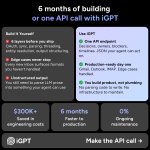
You can skip months of engineering and ship your AI product faster.
iGPT turns email threads and attachments into structured intelligence your AI can reason over.
One call, not six months of pipeline.
Skip the infrastructure and start building
igpt.ai/hub/playground/
If you're making decisions based on what AI tells you is in your email, you're likely working with bad data and don’t know it.
We tested a real business thread across five models and four returned confident, structured, wrong answers. Businesses run on email. If the AI reading it gets it wrong, every decision is built on a guess.
iGPT structures your email, attachments, and docs into intelligence that AI can reason over with one API call.
hackernoon.com/i-gave-5-fron…

iGPT retweeted
Every AI tool promises to give you time back. Speed is only half the game though. The answer also has to be entirely accurate.
I used to manually connect the dots between email and Drive. A feedback thread here, a saved deck version there.
@iGPTai just added Google Drive as a native datasource, deep indexed alongside your inbox.
I asked:
iGPT retweeted
Everyone is building context layers for structured data.
Nobody is building them for the place where most business decisions actually happen: email threads.

Frontier models are exceptionally efficient, intelligent, and useful. For agents, context is now the bottleneck.
Enter the context layer, which bridges the gap from an enterprise's messy data to actionable context, packaged for agents.
We're seeing three distinct verticals emerge in the context layer space:
- Data gravity platforms
- Existing AI data analysts
- New, dedicated context layer companies
Read the full piece by @JasonSCui and @JenniferHli: a16z.news/p/your-data-agents…

Most AI agents that touch email are working off raw data and don't even know what they're missing.
They miss things that actually matter to the deal:
- pricing concerns raised in side threads
- a commitment that quietly got dropped
- the conversation going cold after the proposal
iGPT fixes that layer.
One call returns who said what, what is unresolved, and what needs to happen next.
$10 free credits. No credit card needed
igpt.ai/hub/playground/
Ask:
- Does this invoice match what we agreed to?
- Which deals went quiet after we sent pricing?
- What commitments are we behind on this quarter?
And get instant answers across threads, attachments, and documents, all traced back to the source.
Free for everyone. Founders, employees, freelancers.
Accurate answers and clear actions from your email and web.
Personal Gmail or corporate Outlook, thousands of emails, same speed.
apps.apple.com/us/app/igpt-a…
iGPT retweeted
Turn your email into structured, AI-ready context with @iGPTai
Connect your inbox, ask a question, get clean JSON back.
Here's how to get started.
Everyone is building context layers for structured data.
Nobody is building them for the place where most business decisions actually happen: email threads.
Frontier models are exceptionally efficient, intelligent, and useful. For agents, context is now the bottleneck.
Enter the context layer, which bridges the gap from an enterprise's messy data to actionable context, packaged for agents.
We're seeing three distinct verticals emerge in the context layer space:
- Data gravity platforms
- Existing AI data analysts
- New, dedicated context layer companies
Read the full piece by @JasonSCui and @JenniferHli: a16z.news/p/your-data-agents…