A @columbiacss Research Cluster led by @ps2270 reconstructing 15th-17th c. craft techniques. See #edition640 for yourself: https://teapawt.net/t.co/i0RnRRxotl
Columbia University
Joined December 2014
- Tweets1.5K
- Following284
- Followers1.9K
- Likes1K
18 months after launching #Edition640, we’re excited to share our redesigned digital critical edition! The streamlined design makes it easy to scroll through the manuscript, search through the introductory essays, and find useful resources. Take a look: tinyurl.com/edition640
But the process of creating the edition was just as important as our results. Pedagogy was integrated with original interdisciplinary and collaborative research, opening scientific inquiry to humanities students and vice versa. teaching640.makingandknowing…
Replying to @MakingKnowing
The result was our digital critical edition. It’s not only an online version of the manuscript, it includes multimedia essays, glossaries, and search functions to help readers explore and find new meanings in our work.
Why create a Research and Teaching Companion? To answer that, we flashback to 2014, when Professor Pamela Smith founded the Making and Knowing Project to study a 16th-century French artisanal manuscript via interdisciplinary teaching, research, and digital analysis.
Four years after publishing our digital critical edition, Secrets of Craft and Nature, we are thrilled to share its Research and Teaching Companion! These resources and tools help bring history to life in any classroom. teaching640.makingandknowing…
Looking to bring hands-on history into your classroom? Our Research and Teaching Companion shows how experiential learning can be adapted to any space, learner level, or budget with lesson plans, case studies, and other resources. Discover it for yourself: teaching640.makingandknowing…
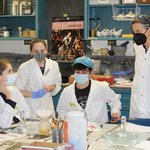
Our students have been in the lab making cochineal lake pigments! Found growing on cactuses in Mexico and South America, the cochineal insect revolutionized pigments and dyes. Trace empire through color and learn how to make pigments at home: tinyurl.com/rtc-cochineal
Our Director Pamela Smith (@ps2270 + @CUHistoryDept) was awarded the Herzog August Library's inaugural Research Prize!
Watch the award ceremony and Pamela's lecture via YouTube. Congratulations to Pamela!
youtu.be/5PgPne5ncnY?feature…
Check out the event recording from our Director Pamela Smith's (@ps2270) April 1 talk at the @GLMosseProgram!
youtu.be/0-RWoOUdUyc?feature…
Among the pigment recipes in #Edition640, 18 entries mention “flesh colors.” What can the concept of “flesh color” tell us about understandings of race and ethnicity in early modern Europe? tinyurl.com/5ehe7n3f
A digital kunstkammer (an early modern collection of art objects) honors women in early modern Europe who overcame social constraints to create medical objects and knowledge. Learn more: tinyurl.com/46e9u9ps
Congratulations to our friend and long-time collaborator, Vera Keller!
Congratulations to Vera Keller, professor of history, for being awarded the Phyllis Goodhart Gordan Book Prize from the Renaissance Society of America @RSAorg. Keller received this award for her 2023 book The Interlopers: Early Stuart Projects and the Undisciplining of Knowledge.
As a text that deals with art making and materials, it’s no surprise the names of colors and pigments are common throughout #Edition640. One student investigated how terms for red colors and pigments are used across the manuscript. tinyurl.com/2z6dyd7f
A visual history project brings the natural world of #Edition640 to life. Learn more about the ecological references used in the manuscript, evolutionary lineages, botanical drawings, and historical climate knowledge. tinyurl.com/ycxt7rnj
It's been 4 years since we published our Digital Critical Edition! But the work isn't done. In-person and on Zoom, we've continued to draft new essays, redesign site functionality, and create more resources for students and scholars.
An announcement five years in the making:
Our digital critical edition is live!!
Check out #edition640 for yourself on your laptop at edition640.makingandknowing.….
Since 2021, students in our lab seminar cap off the semester with exploratory + experimental projects that find new ways to engage with #Edition640. Our spring 2023 projects are now on our sandbox! To celebrate, we’ll be sharing projects past and present. tinyurl.com/53xzxrsz
Recipe collections were a major literary genre for the transmission of technical knowledge through the early modern period. Learn how #Edition640 compares to a slightly older counterpart from German monk Wolfgang Sedelius. shorturl.at/gxO29
What is the meaning of bread in Ms. Fr. 640? The varieties of flours, breads, and methods of making it show that “bread” in the 16th century had different connotations than today. tinyurl.com/mr3nw2pb
Thirty-six entries in #Edition640 mention esmail, a term which is frequently translated as “enamel.” How has the understanding of esmail changed over the centuries? tinyurl.com/mk-esmail
The desire to make black colors runs throughout #Edition640, appearing in recipes for oils, stains, varnishes, pigments, and as a dye. Learn more about the importance of black textiles in the manuscript and early modern society. tinyurl.com/blackdye640
Folio 84v in #Edition640 contains entries on moldmaking and casting and a curious marginal note to “try burnt oysters.” Students used textual research and hands-on reconstruction to decipher this puzzling note. tinyurl.com/mk-oysters