Researchers at the MIT Sloan School of Management identified four domains that warrant guardrails: architecture compliance, innovation management, workforce enablement, and supplier governance. mitsloan.mit.edu/ideas-made-…
For most use cases, AI models aren’t plug-and-play. They require a great deal of customization for an individual company. mitsloan.mit.edu/ideas-made-…
Leading agentic AI transformations requires deep understanding of the technology. Having the right mental model of how AI works under the hood helps leaders move beyond automation to reimagining their business. mitsloan.mit.edu/ideas-made-…
Course offerings like AI-Augmented Work, Economics of Ideas and Entrepreneurship, and Leading Agentic AI Transformation in Organizations anticipate businesses’ future needs. mitsloan.mit.edu/ideas-made-…
Researchers from the MIT Sloan School of Management argue that as AI tools become more widely available, competitive advantage will depend on the trust, data, expertise, operating capabilities, and work redesign that companies build around them. mitsloan.mit.edu/ideas-made-…
Artificial intelligence will transform more jobs than it eliminates outright. The biggest productivity gains will come not from incorporating AI into existing workflows but from redesigning those workflows entirely. mitsloan.mit.edu/ideas-made-…
Organizations are under pressure to innovate amid changing customer demands and continuously fluctuating markets. Artificial intelligence can help — serving as a catalyst for changing work patterns and enhancing innovation and creativity processes. mitsloan.mit.edu/ideas-made-…
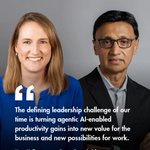
In a recent article, MIT Sloan’s Katherine Kellogg and Rama Ramakrishnan examine what it takes to redesign workflows, prepare employees for evolving roles, and turn AI-enabled productivity into sustainable business growth in the age of agentic AI.
Learn more: bit.ly/3WEjjF0
In his new book, “Boundaries of Tolerance,” MIT Sloan’s Jeffrey Saviano says that AI’s novel risks and “ethical infirmities” have made governance and strategy a leadership necessity. mitsloan.mit.edu/ideas-made-…
Artificial intelligence can draft a memo or summarize a meeting instantly. Deciding which memo matters, whether that summary is accurate, or what to do next still requires human knowledge. mitsloan.mit.edu/ideas-made-…+
The Luce is Ferrari’s first fully electric vehicle. The company sees its release as a technological addition, not necessarily a market shift. mitsloan.mit.edu/ideas-made-…
Given the up-front cost of training models, AI’s advantage is best realized when production occurs at a large scale. As a result, bigger enterprises are far more likely to be early adopters than smaller companies with fewer resources. mitsloan.mit.edu/ideas-made-…
Artificial intelligence is making it easier for organizations to experiment, build prototypes, and launch new applications. But as AI activity spreads across an organization, so can redundant investments, applications that don’t scale, and unexpected operational costs and risks. mitsloan.mit.edu/ideas-made-…
AI can help organizations create more collaborative, repeatable innovation processes, but humans should stay in charge. mitsloan.mit.edu/ideas-made-…
What tasks should AI be trusted with, and when should humans remain involved? Designing those decision rights is one of the defining challenges of the AI era. Researchers at the MIT Center for Information Systems Research have developed a framework to help.
Learn more: bit.ly/4zed20M

ALT The image is an "AI Decision Matrix" from MIT Sloan School of Management, illustrating decision-making based on ambiguity and risk. It includes a 2x2 grid with four quadrants: "Exploratory" (high ambiguity, low risk), "Strategic" (high ambiguity, high risk), "Routine" (low ambiguity, low risk), and "Consequential" (low ambiguity, high risk). Each quadrant outlines how humans and AI should approach decisions with actions: Act, Learn, and Enable. The bottom section explains decision components, participant roles (Human, AI, Both), and approaches based on the decision type.
MIT Sloan professor Eric So compares the AI gravity phenomenon to physical atrophy: Muscles weaken with disuse. Likewise, cognitive skills deteriorate when people stop practicing them. mitsloan.mit.edu/ideas-made-…
For most use cases, AI models aren’t plug-and-play. They require a great deal of customization for an individual company. mitsloan.mit.edu/ideas-made-…
Creating a unique set of controls for every AI application isn’t sustainable. Instead, implement controls where oversight can have the greatest impact. mitsloan.mit.edu/ideas-made-…
There’s an ongoing debate over which kind of world delivers better economic value to consumers and business: one without restrictions on data collection? Or one that favors privacy through regulated data protections? mitsloan.mit.edu/ideas-made-…
Given the up-front cost of training models, AI’s advantage is best realized when production occurs at a large scale. As a result, bigger enterprises are far more likely to be early adopters than smaller companies with fewer resources. @ProfNeilT @DanialLashkari @MITFutureTech
mitsloan.mit.edu/ideas-made-…