

OAK Research is a crypto market intelligence platform that provides research, analysis and data — French account : @OAK_Res_FR
Joined October 2024
- Tweets2.1K
- Following197
- Followers4.6K
- Likes2.4K







Pinned Tweet
🫡 We are proud to announce that OAK Research has been elected to serve on the @ethena Risk Committee.
We would like to thank everyone who supported our application and placed their trust in us. This election represents an important milestone for OAK Research and a new responsibility toward $ENA holders.
Our work will from now on be divided into two distinct areas: our ongoing research and coverage of Ethena, and our Risk Committee work on risk parameters and protocol improvements.
These activities will remain separate and be conducted independently of one another. Through both, we aim to improve transparency, broaden coverage of the protocol’s evolution, and clearly explain the rationale behind our decisions.
We look forward to working closely with the Ethena team and the other newly elected committee members @Kairos_Res and @BlockworksAdv.
Our goal is, and always has been, to support Ethena in the best way possible. We will continue doing so throughout our mandate.
Thank you once again to the Ethena community for its trust.
Let’s ride.

🔗 Our Alpha:
oakresearch.io/en/feed/alpha…
🎁 30% off your OAK Research subscription with the code "1ANOAK" (7-day free trial included):
oakresearch.io/en/upgrade

81
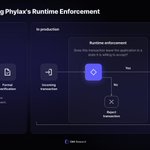
🟣 What if a hack could be stopped before it ever lands on Ethereum?
That's the bet @phylaxsystems is making with @titanbuilderxyz, Ethereum's largest block builder.
As a reminder, most validators don't build their own blocks. They buy them from builders, who decide which transactions go in and in what order. Titan is currently the leading block builder, producing roughly half of all Ethereum blocks on its own.
👉 Phylax's idea is fairly simple. A protocol defines its own rules, for example "no single transaction can withdraw more than a quarter of the vault's funds". When Titan builds a block, it executes every transaction touching the relevant contract and blocks those that break these rules.
In other words, the malicious transaction never makes it into the block, and the team receives a trace of the attempt to fix the vulnerability.
To stop an attacker from simply routing through another builder, a protocol can flag certain functions, such as withdrawals, as "protected". These can then only execute in blocks checked by Titan (or by other builders if they join the scheme).
🔎 The trade-off is that the protocol's security partly depends on a single actor, and even a legitimate withdrawal covered by protected functions has to wait for a Titan-built block, which can slow down some transactions.
We break it all down in our Alpha 👇

1
3
278
OAK Research retweeted
🟣 Why does LlamaRisk want to freeze more than $1 billion in collateral on Aave V3?
LlamaRisk, one of Aave’s risk service providers, published a governance proposal (ARFC) on November 10.
It aims to restrict @aave V3 Core to the most established and most liquid collateral assets, and to gradually steer the other assets toward Aave V4.
According to LlamaRisk, a growing share of the collateral deposited on Core depends on risks external to the token, such as restaking, specific bridges, derivatives in the backing, or leveraged wrapping strategies.
However, on V3, the borrow rate is the same regardless of the collateral deposited, so the protocol cannot charge for these additional risks.
V4 works differently. Liquidity is pooled in a central Hub, to which several markets called spokes are connected, each with its own assets and its own parameters.
Each spoke can only borrow from the Hub up to a cap, which makes it possible to contain exposure to a risky asset within its own market.
On top of this comes the Risk Premium. Each asset receives a risk parameter, and the riskier a borrower’s collateral, the higher their borrow rate.
A borrower depositing rsETH would therefore pay more than one depositing WETH.
This is why @LlamaRisk proposes to keep only the most liquid and most established assets on Core, and to migrate the others to V4.
Core would thus retain WETH, wstETH, weETH, cbETH, ethereum:0x2260fac5e5542a773aa44fbcfedf7c193bc2c599, cbBTC, USDC, USDT, GHO, DAI, XAUt, ethereum:0x7fc66500c84a76ad7e9c93437bfc5ac33e2ddae9 and LINK, as well as ethereum:0x4c9edd5852cd905f086c759e8383e09bff1e68b3, sUSDe and syrupUSDT.
The assets affected by this migration represent $1.33 billion in collateral for $1.03 billion in debt, and fall mainly into two categories:
◻️ High-leverage ethereum:native loops
rsETH and osETH, with more than $940 million in collateral and $862 million in WETH debt. Most of these positions are 12 to 14x leverage loops in the ETH E-Mode, and they are highly concentrated. Typically, on rsETH, the three largest positions hold 69% of the debt.
◻️ Low-leverage stablecoin borrowing
LBTC, tBTC and rETH, with around $377 million in collateral for $160 million in debt, mainly in stablecoins and spread across several hundred addresses.
The rest (eBTC, BTC.b, tETH, LDO, mUSD and a PT) weighs less than $8 million.
To carry out this migration, LlamaRisk therefore proposes a three-step plan.
1) First, these assets would be frozen so that their exposure stops growing. Their LTV would be set to zero, including in E-Mode, and it would no longer be possible to deposit them or borrow against them.
Existing positions would remain in place. Moreover, rsETH and tBTC are already frozen.
2) Next, the idea is to encourage existing positions to leave on their own. The reserve factor of frozen reserves with more than $20,000 in debt would be raised to 99%, which removes almost all of the yield for those depositing these assets.
wstETH, weETH and cbETH would also be added to the rsETH E-Mode, so that loops can switch to a collateral retained by Core without having to repay.
In parallel, LlamaRisk would help issuers and the largest borrowers migrate to Core or to V4.
3) As long as an asset’s exposure is decreasing, no further action would be taken. If it does not decrease, a third step would apply, different for each of the two groups.
For low-leverage stablecoin borrowing (LBTC, tBTC and rETH), the liquidation threshold would be lowered in increments of 2 points maximum.
These positions have enough margin to absorb it, and each increment must not make more than $2 million, or 5% of the remaining collateral, liquidatable.
For high-leverage ETH loops (rsETH and osETH), this is not possible, as a 2 to 5 point reduction would be enough to liquidate the majority of positions.
@LlamaRisk therefore instead proposes to increase the WETH borrow rate for these loops, by up to 100 basis points, in increments of 50 bps per month maximum.
Other WETH borrowers would be reimbursed for this increase via Merkl.
This migration does, however, come at a cost for the DAO. According to LlamaRisk, it would lose around $3.7 million in gross revenue per year, including $1.85 million on rsETH.
In our view, this is the price to pay to reduce the risks weighing on Core and make the protocol safer for all of its users.
The full proposal can be found below 👇

Following the introduction of the Aave Risk Framework, the deprecation of low-adoption reserves and the oracle deprecation for long-tail assets, we’ve published the next strategic step: an ARFC to reposition Aave V3 Core around established and liquid collateral.
The proposed first step curbs new exposure to the assets in scope. Existing positions stay open and can unwind gradually; the plan is designed to minimize impact to existing users.
governance.aave.com/t/arfc-r…

🟣 Why does LlamaRisk want to freeze more than $1 billion in collateral on Aave V3?
LlamaRisk, one of Aave’s risk service providers, published a governance proposal (ARFC) on November 10.
It aims to restrict @aave V3 Core to the most established and most liquid collateral assets, and to gradually steer the other assets toward Aave V4.
According to LlamaRisk, a growing share of the collateral deposited on Core depends on risks external to the token, such as restaking, specific bridges, derivatives in the backing, or leveraged wrapping strategies.
However, on V3, the borrow rate is the same regardless of the collateral deposited, so the protocol cannot charge for these additional risks.
V4 works differently. Liquidity is pooled in a central Hub, to which several markets called spokes are connected, each with its own assets and its own parameters.
Each spoke can only borrow from the Hub up to a cap, which makes it possible to contain exposure to a risky asset within its own market.
On top of this comes the Risk Premium. Each asset receives a risk parameter, and the riskier a borrower’s collateral, the higher their borrow rate.
A borrower depositing rsETH would therefore pay more than one depositing WETH.
This is why @LlamaRisk proposes to keep only the most liquid and most established assets on Core, and to migrate the others to V4.
Core would thus retain WETH, wstETH, weETH, cbETH, ethereum:0x2260fac5e5542a773aa44fbcfedf7c193bc2c599, cbBTC, USDC, USDT, GHO, DAI, XAUt, ethereum:0x7fc66500c84a76ad7e9c93437bfc5ac33e2ddae9 and LINK, as well as ethereum:0x4c9edd5852cd905f086c759e8383e09bff1e68b3, sUSDe and syrupUSDT.
The assets affected by this migration represent $1.33 billion in collateral for $1.03 billion in debt, and fall mainly into two categories:
◻️ High-leverage ethereum:native loops
rsETH and osETH, with more than $940 million in collateral and $862 million in WETH debt. Most of these positions are 12 to 14x leverage loops in the ETH E-Mode, and they are highly concentrated. Typically, on rsETH, the three largest positions hold 69% of the debt.
◻️ Low-leverage stablecoin borrowing
LBTC, tBTC and rETH, with around $377 million in collateral for $160 million in debt, mainly in stablecoins and spread across several hundred addresses.
The rest (eBTC, BTC.b, tETH, LDO, mUSD and a PT) weighs less than $8 million.
To carry out this migration, LlamaRisk therefore proposes a three-step plan.
1) First, these assets would be frozen so that their exposure stops growing. Their LTV would be set to zero, including in E-Mode, and it would no longer be possible to deposit them or borrow against them.
Existing positions would remain in place. Moreover, rsETH and tBTC are already frozen.
2) Next, the idea is to encourage existing positions to leave on their own. The reserve factor of frozen reserves with more than $20,000 in debt would be raised to 99%, which removes almost all of the yield for those depositing these assets.
wstETH, weETH and cbETH would also be added to the rsETH E-Mode, so that loops can switch to a collateral retained by Core without having to repay.
In parallel, LlamaRisk would help issuers and the largest borrowers migrate to Core or to V4.
3) As long as an asset’s exposure is decreasing, no further action would be taken. If it does not decrease, a third step would apply, different for each of the two groups.
For low-leverage stablecoin borrowing (LBTC, tBTC and rETH), the liquidation threshold would be lowered in increments of 2 points maximum.
These positions have enough margin to absorb it, and each increment must not make more than $2 million, or 5% of the remaining collateral, liquidatable.
For high-leverage ETH loops (rsETH and osETH), this is not possible, as a 2 to 5 point reduction would be enough to liquidate the majority of positions.
@LlamaRisk therefore instead proposes to increase the WETH borrow rate for these loops, by up to 100 basis points, in increments of 50 bps per month maximum.
Other WETH borrowers would be reimbursed for this increase via Merkl.
This migration does, however, come at a cost for the DAO. According to LlamaRisk, it would lose around $3.7 million in gross revenue per year, including $1.85 million on rsETH.
In our view, this is the price to pay to reduce the risks weighing on Core and make the protocol safer for all of its users.
The full proposal can be found below 👇
Following the introduction of the Aave Risk Framework, the deprecation of low-adoption reserves and the oracle deprecation for long-tail assets, we’ve published the next strategic step: an ARFC to reposition Aave V3 Core around established and liquid collateral.
The proposed first step curbs new exposure to the assets in scope. Existing positions stay open and can unwind gradually; the plan is designed to minimize impact to existing users.
governance.aave.com/t/arfc-r…

🟣 Who really collects the money from stablecoins?
In the first half of 2026, @circle paid out $819M to its partners, which is 59 cents for every dollar of revenue, for just 7 cents of net profit.
But that money doesn’t go to blockchains or DeFi, it goes to whoever controls users and their balances:
▫️ @coinbase keeps 100% of the revenue from USDC held on its platform and 50% of what’s generated elsewhere, which came to $324.6M in Q2, nearly half of Circle’s reserve income
▫️ @binance signed a five-year deal with Circle in September, along with a $100M equity stake
▫️ @Paxos shares up to 100% of USDG’s yield with the 150+ members of its Global Dollar Network
DeFi, which gives stablecoins their utility, walks away empty-handed. The $8.25B of stablecoins deposited on @aave generate roughly $270M a year for Tether and Circle, but nothing for Aave.
As for blockchains, they’re even the ones paying to attract stablecoins, like @arbitrum with 100 million $ARB in incentives to join Paxos’ network.
@HyperliquidX is the only one to have made a major issuer back down. Since May 2026, Circle and Coinbase have been passing along roughly 90% of the yield on USDC held on its platform.
But it got there as an exchange, not as a blockchain, because users leave their funds there and it chooses the reference stablecoin of its markets.
Our full analysis is in our article below 👇


1
6
537
🟣 Tokenized stock TVL in DeFi recently topped $300M, and Pendle is now the leading platform in the sector (with Uniswap V3 and V4 counted separately).
Over the past year, tokenized stock TVL in DeFi has absolutely exploded, rising more than 2,200%. Yet despite that growth, only 6% of existing tokenized stocks are currently deployed in DeFi.
@pendle_fi recently became the platform with the highest TVL in this vertical, with $53.5M today, ahead of @kamino Lend ($45.5M), @Uniswap V4 ($45M) and Uniswap V3 ($30.4M).
In practice, its TVL is almost entirely (99.8%) made up of STRCx, @xStocksFi’s tokenized version of @Strategy’s STRC preferred stock. It’s worth noting that more than 93% of that figure comes from PTs held by a Safe that appears to be linked to @apyx_fi.

4
377
Read the full analysis here: oakresearch.io/en/analyses/i…

133
🟣 Are the protocols that generate the most revenue really the best investments?
For the past two years, there’s been a lot of talk about revenue and buybacks in crypto.
The idea is simple, a protocol that generates a lot of revenue should, in theory, be a better investment than a project that generates none.
On paper, that makes sense, but is it really what we see in the market?
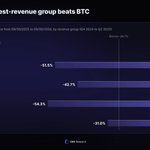
To find out, we ranked these protocols by the revenue they generated between October 2024 and September 2025, then looked at how their tokens performed over the following twelve months, and the results are quite interesting:
▫️ The 6 most profitable protocols (Hyperliquid, Pump(.)fun, Sky, Aave, Aero and Jupiter) show a median performance of -9.7%, versus -26.7% for Bitcoin
▫️ The other groups, ranked by revenue level, all do worse, with performances between -31% and -54%
At first glance, investing in the protocols that earn the most money looks like a pretty effective strategy.
Except that holding up better than the market doesn’t necessarily make for a good investment.
Even those six tokens show a negative median performance, with huge gaps between them, +101% for $HYPE versus -42% for $AAVE.
Above all, the players that generate the most revenue in crypto aren’t even in this ranking, simply because they don’t have a token.
In reality, a protocol’s profitability isn’t enough to tell whether its token is a good investment.
You also need to understand where the revenue actually goes, how much of it reaches holders, whether new token emissions cancel everything out, and whether the current valuation leaves enough upside.
That’s exactly what our latest Premium article is about.
We analyzed the market’s main profitable protocols, from @HyperliquidX to @aave, including @ethena, @Uniswap and @Pumpfun, to understand why some tokens perform and others don’t.
We also share a framework for evaluating a token before investing, with the questions to ask and the indicators to watch.
👉 Discover our full analysis on OAK Research Premium and get 30% off with the code 1ANOAK (link in the comments).

Read our full analysis here: oakresearch.io/en/feed/alpha…
Get free access to the Alpha Feed with a 7-day free trial, or enjoy 30% off with the code 1ANOAK: oakresearch.io/en/upgrade

84
🟣 Nvidia down 6% following the latest revelations involving its CEO, Jensen Huang.
Allegations of Chinese espionage, an internal investigation, the risk of further US restrictions… Here are the 5 key things to know.
1) Suspicions of Chinese interference
US intelligence suspects Alice Huang, a Chinese businesswoman and former executive at one of Nvidia’s Singapore-based customers, of having been recruited by Beijing to approach Jensen Huang and influence his stance on chip exports to China.
2) A story taking a personal turn
The Financial Times has reported that the two were allegedly romantically involved. Yesterday, Jensen Huang admitted in an internal email that he had been unfaithful to his wife.
Nvidia’s board has launched an independent investigation, but so far, there is no public evidence that any espionage operation was successful.
3) Washington at the center of the story
Jensen Huang has spent several years advocating for continued US chip exports to China, arguing that overly strict restrictions would benefit Huawei.
The affair could undermine his influence in Washington, as several lawmakers are already demanding answers.
4) Commercial risks remain difficult to assess
China accounted for just 8.2% of Nvidia’s revenue last quarter.
The immediate risk therefore remains limited, but Washington could use the affair as an opportunity to tighten restrictions on chip sales across Southeast Asia.
5) Jensen Huang’s future under scrutiny?
Having led Nvidia for 33 years, the founder remains central to the company’s strategy and governance, and no public succession plan is currently in place.
An eventual departure, which we consider highly unlikely, could raise significant questions for investors.
Nvidia’s November 17 earnings and the congressional briefing scheduled for November 18 will be the next key dates to watch as the story unfolds.
In the meantime, we’ve put together a comprehensive analysis of the information currently available and its potential implications for $NVDA shareholders in our latest Alpha (available in the comments).

1
3
384
Read the article on our website: oakresearch.io/en/reports/se…
115
🟣 @trondao hosts half of on-chain $USDT, and yet @tether earns ten times more than it does.
Around half of on-chain USDT circulates on Tron, or $92.5 billion, and nearly 90% of the network’s revenue reportedly comes from this single stablecoin according to @Blockworks.
In principle, this is therefore the ideal situation for a blockchain. USDT is used there primarily for transfers, which generates a huge number of transactions, and therefore fees.
Yet the split remains very unbalanced. For every dollar of USDT hosted on Tron, Tether earns about 3.3 cents per year thanks to the interest on its reserves, while Tron only collects 0.33 in fees.
In Q3 2026, this represented about $745 million for Tether, compared to $77.8 million for Tron.
The gap widened even further at the end of August 2025, when Tron made its transactions more than two times cheaper. In the three weeks that followed, its daily fees fell by 40%
In our view, this decision is hard to separate from the arrival of @Plasma, launched less than a month later with free USDT transfers.
Tron ultimately held on. Since Plasma’s launch, USDT hosted on Tron has grown from $75.7 to $92.5 billion, while stablecoins on Plasma fell back from 6 to 1.3 billion.
However, it kept its users by agreeing to earn less on each transaction. For Tether, on the other hand, this episode changed nothing. Whether USDT circulates on Tron or on Plasma, its reserves earn it exactly the same.
If even Tron can’t manage it, can a blockchain really hope to capture a share of the value of the stablecoins it moves?
We go over the whole story between Tron, Tether and Plasma in our full article, available below 👇

3
9
561

🔴 This Thursday, Wall Street had its worst session since Covid. The Nasdaq 100 dropped 6.36%, the S&P 500 lost 4.35%, and some semiconductors shed as much as 20% in a single day.
Yet just a day earlier, the market was climbing, seemingly relieved to have the election uncertainty behind it. So how do you swing into full panic in 24 hours?
The likely trigger: a handful of local election results that reignited fears of a serious slowdown in data center construction.
In our view, those fears are overblown. But more importantly, they're not the real reason behind Thursday's crash. The real culprit is leverage.
We break it all down in our latest analysis 👇

1
4
575

🟣 OAK Research can now connect directly to your AI.
Claude, ChatGPT, Cursor… Once connected, your assistant relies on our data and research to answer your questions about the markets.
A few questions to try:
▫️ What does the OAK Index say about $BTC accumulation right now?
▫️ Compare @aave and @Morpho on TVL, fees and revenue
▫️ How are the top @HyperliquidX traders positioned on ETH?
With a free account, it can access prices, protocol data, stocks and ETFs, our articles, the news and the economic calendar.
With OAK Premium, it also reads the Alpha Feed, the Daily Recap, the OAK Index, our portfolios, the best DeFi yields, Hyperliquid Smart Money...
To connect it on Claude or ChatGPT:
1️⃣ Open Settings, then Connectors
2️⃣ Choose “Add custom connector” and paste the URL : oakresearch.io/api/mcp
3️⃣ Click Connect and sign in with your OAK Research account
Ready in a minute. Your assistant only reads our data, read-only, and can never change anything on your account.
All the details and guides for Cursor, Claude Code and VS Code are on our dedicated page, linked in the comments 👇
🟣 New all-time highs for volume, open interest and unique traders on HIP-3 yesterday.
You couldn't miss it. Yesterday, AI and semiconductor stocks crashed across Wall Street, dragging the major US indices down with them.
As is often the case, HIP-3 was a big winner, setting 3 new records:
◻️ $9.14B in volume (+0.9% over the previous ATH)
◻️ $4.70B in OI (+2.9%)
◻️ 41,923 unique traders (+15.2%)
Unsurprisingly, more than 98% of the volume went through @tradexyz. The platform's most-traded contracts were:
◻️ XYZ100 - $1.19B in volume - 13.2% of total volume
◻️ SP500 - $935M - 10.4%
◻️ SKHX - $812M - 9.0%
◻️ SOXL - $713M - 7.9%
◻️ SNDK - $672M - 7.5%
With $9.14B traded on the day, HIP-3 made up 49.6% of all perp volume on @HyperliquidX, nearly as much as crypto perps.


OAK Research retweeted
🟣 Why does Solana earn more than Ethereum with ten times fewer stablecoins?
In Q3 2026, Ethereum hosted an average of $146 billion in stablecoins, compared to less than $16 billion for Solana.
Yet, over the same period, @solana generated $62.9 million in fees, almost twice as much as Ethereum with $34.6 million.
The reason is that a blockchain doesn’t get paid for the stablecoins it hosts. It only collects fees when those dollars move, with each transaction.
Having the largest supply therefore brings in nothing in itself, what matters is the number of transactions and their fees.
Typically, on @ethereum, that’s precisely the problem.
Since the Dencun upgrade, a large share of activity has moved to Layer 2s, and the transactions that remain on Layer 1 cost much less than before with the successive gas limit increases.
Stablecoins are admittedly still just as present, but they generate far fewer fees for the blockchain.
For issuers, it’s exactly the opposite. @tether and Circle invest the reserves backing their stablecoins, largely in U.S. Treasury bills, and earn interest on the entire supply.
Whether the dollars move or sit idle, they earn the same.
@circle figures show this clearly. Between Q2 2025 and Q2 2026:
◻️ USDC on-chain volume increased by 151%, to $14.8 trillion.
◻️ Average supply grew by 25%.
◻️ Reserve income only increased by 5%.
The explosion in activity therefore brought almost nothing to Circle.
Its revenue was mainly held back by the Fed’s rate cuts, which brought the yield on its reserves down from around 4.15% to 3.49%.
In other words, an issuer’s revenue depends on the size of the supply and the level of interest rates, whereas for blockchains, it depends on transaction volume and fees.
And with competition between blockchains pushing them to be ever faster and with ever lower transaction fees, one question arises: can a blockchain still hope to capture a real share of the value of stablecoins?
We break it all down in our full article, available below 👇
