

Oryx—The International Journal of Conservation publishes leading research on biodiversity, conservation practice & the socio-economic dimensions of conservation
- Tweets2.9K
- Following860
- Followers5.3K
- Likes2K
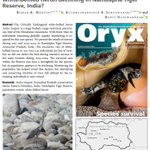


ALT Title and abstract of the article 'Is the population of the Critically Endangered white-bellied heron declining in Namdapha Tiger Reserve, India?', alongside an image of the species, a map of the study area and the cover of issue 58-6 of Oryx, in which the article is featured.

ALT Top left: queen conch nursery. Right: First page of the article and the cover image of the November issue of Oryx, featuring a queen conch. Bottom left: diagram of natural yield of the queen conch from protecting wild breeding populations.

ALT First page of the article 'A multi-scale approach unveils the ecology of the Critically Endangered Sardinian long-eared bat' and a map of the study area and occurrence records in Sardinia.
ALT Top left: queen conch nursery. Right: First page of the article and the cover image of the November issue of Oryx, featuring a queen conch. Bottom left: diagram of natural yield of the queen conch from protecting wild breeding populations.

ALT A queen conch on the sea bed, with the text ‘New issue, species survival'.

ALT Title and Abstract of the paper, in English and Spanish. Below is an image of one of the camera traps, and one of the signs used to deter theft.

ALT Camera trap image of a clouded leopard walking through a forest.

ALT Title and abstract of the paper 'Tigers on thin ice: traffic mortality incidents and Amur tiger conservation in the Russian Far East', with a camera trap image of an Amur tiger walking through the snow, and a map of the study area in Russia, showing the locations of tiger road accidents.

ALT A pack of African wild dogs and the words 'We are hiring: Editorial Officer'
ALT A pack of African wild dogs and the words 'We are hiring: Editorial Officer'

ALT Title and abstract of the article 'Tiny habitats of tiny species: the importance of micro-refugia for threatened island-endemic arthropods'. Below the abstract is an infographic showing the process of filtering IUCN Red List assessments, identifying Critically Endangered arthropods confined to micro-refugia, and finally extracting species-specific threat information coded into categories within assessments.

ALT Camera-trap image of a guina on 21 May 2024.

