

Dr. Mark Storey MD - Radiation Oncologist. @OKProtonCenter. Background: #MDAnderson @VanderbiltU @BMESociety #RadOnc My blog: https://teapawt.net/t.co/4S0MeQiWEI
Oklahoma City, OK
Joined June 2019
- Tweets4.5K
- Following442
- Followers1.7K
- Likes8.8K






Mark Storey retweeted

Good Lord, we're doing this again?
As always: OF COURSE we should aim to limit the use of this (or any) diagnostic modality as parsimoniously as possible.
I didn't even need to download the PDF to know who the senior author of this paper is.
Dr. Rebecca Smith-Bindman cofounded the hilariously named Alara Imaging and is its current CMO.
Alara Imaging is the "measure steward" for federal CT radiation dose quality measures...which are tied to reimbursement for hospitals and clinicians.
This is a sprawling issue I won't get into here, but ISN'T IT INTERESTING AN OTHERWISE UNREMARKABLE DATABASE STUDY SUCH AS THIS ONE WAS PUBLISHED IN JAMA.
Moving on...
There are several issues in this paper, but let's just go with the classic:
Why in the world are kids getting head scans in the first place??
That's not common and thus creates the unavoidable confounding "chicken or the egg" question. Did the scan cause the tumor, or did the tumor (or preceding risk factors) cause the scan?
Everyone knows this, and every study of this flavor tries to "correct" for it. This paper is no different.
Here, they excluded all imaging performed within 2 years before diagnosis from their risk models and audited the clinical reasons for scans delivering at least 1mGy of brain radiation.
They state that only 4% of brain tumor patients (36 of 900 children) had scans with a recorded tumor-suggestive symptom (excluding headache) that stayed in the primary analysis.
Because those retained symptomatic scans occurred an average of 6.3 years before diagnosis, the authors concluded that pre-existing tumors were unlikely to explain their findings.
But...that can't actually be true.
Clinical reasons for imaging were unavailable for one US health system and for all outpatient scans in Ontario (40% of Ontario exams), even though Ontario accounted for ~87% of all brain tumors in the study.
So 4% is the bare minimum, we actually have no idea what the ceiling is.
But.
Even more importantly.
THEY DIDN'T EXCLUDE HEADACHE AS THE SCAN INDICATION???
Headache. HEADACHE.
BY FAR the most common symptom in PEDIATRIC BRAIN TUMORS.
That's like doing a study on influenza and not excluding fever, or arthritis and not excluding pain.
I won't even get into the strange timing elements of this paper (excess brain tumor risk peaked 2 to 4 years after exposure...) because the entire study is farcical by not excluding headache in attempting to correct for confounders.
Great job everyone.
Great job.

A head CT exposure as a child is associated with a 1 in 1266 chance of radiation-induced brain tumor later.
These findings support careful clinical justification when pediatric imaging using ionizing radiation is indicated
jamanetwork.com/journals/jam…

This is literally one of the few standing - treat beyond the tumor instances. As I've argued, it too shall eventually fall into the singularity.

pubmed.ncbi.nlm.nih.gov/4302…
脊椎SBRTはやっぱりコンツーリングと最適化作業が何となくストレスなのでsegmentのコンツーリングでなくGTVにmarginが基本で楽にコンツーリング出来るなら楽だし骨折も減るだろうし恐らく症例増えれば神経障害も減りそうだしそれでlocal control不良じゃないなら助かる…

Mark Storey retweeted

pubmed.ncbi.nlm.nih.gov/4302…
脊椎SBRTはやっぱりコンツーリングと最適化作業が何となくストレスなのでsegmentのコンツーリングでなくGTVにmarginが基本で楽にコンツーリング出来るなら楽だし骨折も減るだろうし恐らく症例増えれば神経障害も減りそうだしそれでlocal control不良じゃないなら助かる…
The march towards more (relative) dose in what in see and less dose elsewhere continues. All sites - everywhere - our Singularity. When HN and breast collapse, many more will fully appreciate the path.

Now in @JAMAOnc:
We report 5y outcomes post 30 Gy elective RT (total 70 Gy CCRT) for 276 pts w/ HPV-related OPC #hncsm at @MSKCancerCenter #radonc
LRC 97.0%
OS 90.8%
PFS 85.9%
DMFS 91.2%
@imrtlee @xrtGenomics @seanmmcbride @CJTsaiMDPhD @EChrisDee
👉 shorturl.at/liqpP

For those following along - progressed to a one shot prompt is now where we are - we'll see how this holds up DASL-HiCaP prediction for ESMO.
See feed or highlights etc for more info on the framework.

250
If I were still practicing, I'd have a single Grok bot assigned per patient - tracking every new input - monitoring everything added to the chart. Daily report - obviously checked and verified by a review bot.
IT would be getting a daily visit until this was approved.
Regardless of thoughts on when / if protons have value - 30% site of service proposal is still crazy.
Thought we had momentum towards removing this type of discrepancy.

If you can't look ahead and see the Singularity as I've discussed, don't know what to say... First add, then substract. Now 6 months ago...
LUNAR Trial:
pubmed.ncbi.nlm.nih.gov/4286…

4
3
1,293
Next goal is integration with a couple of Grok bots who are watching X - creating lists to add. Ranking the list of candidates which I then feed into the CLI because I still think the harness there is stronger for the work. Goal is a relatively low work loop. Crazy world.

14 of 18 truly prospective calls correct. Importantly the pre-set discrimination line (pretty visible where it would be from image below) held. Every call above it remained accurate (7 for 7). All four misses below (7 for 11).
Basic trends continued further - upper right best. Lower left worst at meeting endpoints. Quadrants drawn previously continue to hold along with the discrimination line.
Simple concept - use this structured analysis to review your trial design and look for ways to simply ask the same question better. More to follow on the Substack as I put together a complete document of the 18 calls - what went right and why CNS and our historical slant (probably too much in favor of too much treatment in the brain) appears responsible for all 4 of the misses.
A week later and more digging through the data, and I'm more certain - it is the end of the era in CNS to treat beyond what you see.
2
307
14 of 18 truly prospective calls correct. Importantly the pre-set discrimination line (pretty visible where it would be from image below) held. Every call above it remained accurate (7 for 7). All four misses below (7 for 11).
Basic trends continued further - upper right best. Lower left worst at meeting endpoints. Quadrants drawn previously continue to hold along with the discrimination line.
Simple concept - use this structured analysis to review your trial design and look for ways to simply ask the same question better. More to follow on the Substack as I put together a complete document of the 18 calls - what went right and why CNS and our historical slant (probably too much in favor of too much treatment in the brain) appears responsible for all 4 of the misses.
A week later and more digging through the data, and I'm more certain - it is the end of the era in CNS to treat beyond what you see.

FYI - here were the final results with 36 votes. 2/3rds moving aggressively towards multiple fractions - the question appears to be in small lesions.
Post A071801 - post op brain cavity single fx vs. 3 fraction. Will you treat single fraction?
0%Yes
67%No
33%If small, <2cm
0%cost, efficiency reasons
36 votes • Final results 2
539
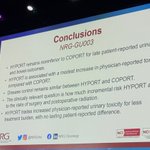
Digging through data and slides from a busy ASTRO - I think this slide over-states the data and math. The 5 yr data does not support NI for EPIC urinary outcomes.
Bullet point 1. The two year primary endpoint DID exclude non-inferiority - barely. Mean difference of -0.9 and a CI (-4.63 to 2.83) that excluded their own 5 point EPIC NI metric.
So in the 5 year data - a few things progressed - the physician data showed worse outcomes. AND the patient mean drifted more inferior as well. To -2.3 from -0.9. People dropped out and so the confidence interval widened - now -7.7 which now covers a 5 point relative drop. Can't use the slide SD - have to convert to a 95% CI - that is the metric a NI uses.
P value alone here is not sufficient to state "remains non-inferior". I believe this is classic absence of evidence being worded on a cooperative group slide as evidence of absence.
I'm not talking about the higher dose etc - just literal read of the conclusions vs. the data.
I know most will think this is just in the weeds stuff, but precision is important. Maybe they had a broader 5 year definition of NI but I couldn't find it.
Anyone agree or did I miss something?


cc-009 and MAVERICK - do we have good CBC data weekly or biweekly through the treatment period and say 2 week beyond EOT? My modeling says lymphopenia might be a driving force for the OS.
@PDBrownOnc
Post A071801 - post op brain cavity single fx vs. 3 fraction. Will you treat single fraction?
0%Yes
67%No
33%If small, <2cm
0%cost, efficiency reasons
36 votes • Final resultsSunday - MAVERICK, CC009, FIRE-SCLC and the non-small cell study for completeness.
A story about where we were 30 years ago and the data driven progress since.

5
471
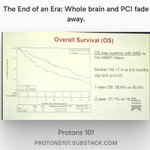
these are AI derived curves - don't use them. for example - the presented OS curve . 10 bookmarks - just sayin....


NRG CC009 Trial
First randomized phase III comparison of SRS vs hippocampal-avoidant WBRT + memantine specifically in SCLC brain metastases
Trial with Double surprise
Primary end point = Fails
Secondary end point = Astonishes

3
9
3,470
