

Official account of Ray Dalio, founder of Bridgewater Associates, author of #1 New York Times bestseller 'Principles,' professional mistake maker
Joined August 2009
- Tweets7.6K
- Following93
- Followers2.6M
- Likes221





What is the impact of raising rates?
The government just keeps borrowing, and everybody else gets squeezed out. For households and corporations, it really depends on whether you have the money.
If you have plenty of money, you're the last to be squeezed out. But the lower 60% of the population and companies without the financial capability to borrow will feel it first. As credit becomes tighter, businesses see less activity and profits, which directly impacts stock prices.
#InterestRates #Investing #RayDalio
It is harder to run an idea meritocracy in which disagreements are encouraged than a top-down autocracy in which they are suppressed.
But when believable parties to disagreements are willing to learn from each other, their evolution is faster and their decision making is far better. #principleoftheday

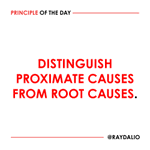
Proximate causes are typically the actions (or lack of actions) that lead to problems, so they are described with verbs (I missed the train because I didn't check the train schedule).
Root causes run much deeper and they are typically described with adjectives (I didn't check the train schedule because I am forgetful).
You can only truly solve your problems by removing their root causes, and to do that, you must distinguish the symptoms from the disease. #principleoftheday

Remember that for an organization to be effective, the people who make it up must be aligned on many levels—from what their shared mission is, to how they will treat each other, to a more practical picture of who will do what when to achieve their goals.
Yet alignment can never be taken for granted because people are wired so differently. We all see ourselves and the world in our own unique ways, so deciding what’s true and what to do about it takes constant work. #principleoftheday

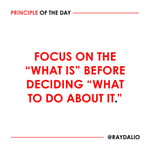
It is a common mistake to move in a nanosecond from identifying a tough problem to proposing a solution for it.
Strategic thinking requires both diagnosis and design. A good diagnosis typically takes between fifteen minutes and an hour, depending on how well it's done and how complex the issue is.
It involves speaking with the relevant people and looking at the evidence together to determine the root causes. #principleoftheday

I'm often asked what to pay attention to there are two big things:
First, pay attention to the bond market and the cost of money, because that is the backbone to everything. Keep an eye on the Treasury yield and the spreads in relationship to that.
Second, pay attention to the concentration that is existing in one thing right now: AI. Whether or not you think AI is in a bubble, you have to recognize the amount of concentration risk. There is a lot stuck on one thing for the economy and the markets.
Because all of that is risky, I want to have less concentration on one thing and more diversification right now.
I provide a more thorough explanation on the US bond market in my latest article. You can find it here: xitter.cf/RayDalio/status/211007…
#BondMarket #AI #Investing #RayDalio

To encourage people to bring their mistakes into the open and analyze them objectively, managers need to foster a culture that makes this normal and that penalizes suppressing or covering up mistakes.
We do this by making it clear that one of the worst mistakes anyone can make is not facing up to their mistakes. #principleoftheday

The greatest tragedy of mankind is holding an opinion in your head that is wrong. It stands in the way of so many people making decisions well and operating well with each other.
It is such a tragedy because it is so easily fixed. All you have to do is put it out there and stress test it. Acknowledge the possibility of being wrong, and ask how to properly stress test that opinion. By stress testing it, you raise your probabilities of being right.
The education system, and so many things in society, reward always being right. But holding onto that mindset stands in the way of taking in all the information out there that can really help you.
#RayDalio #DecisionMaking #Principles
The most common mistake I see people make is dealing with their problems as one-offs rather than using them to diagnose how their machine is working so that they can improve it.
They move on to fix problems without getting at their root causes, which is a recipe for continued failure. A thorough and accurate diagnosis, while more time-consuming, will pay huge dividends in the future. #principleoftheday

Many complaints either fail to take into account the full picture or reflect a closed-minded point of view. They are what I call "chirping," and are generally best ignored. But constructive complaints may lead to important discoveries. #principleoftheday

Tolerating a problem has the same consequences as failing to identify it.
Whether you tolerate it because you believe it cannot be solved, because you don't care enough to solve it, or because you can't muster enough of whatever it takes to solve it, if you don't have the will to succeed, then your situation is hopeless. #principleoftheday

People typically feel bad about their mistakes because they think in a shortsighted way about the bad outcome and not about the evolutionary process of which mistakes are an integral part.
I once had a ski instructor who had also given lessons to Michael Jordan, the greatest basketball player of all time. Jordan, he told me, reveled in his mistakes, seeing each of them as an opportunity to improve. He understood that mistakes are like those little puzzles that, when you solve them, give you a gem.
Every mistake that you make and learn from will save you from thousands of similar mistakes in the future. #principleoftheday

You only have so much time and energy; make sure you are investing them in exploring the problems that, if fixed, will yield you the biggest returns. #principleoftheday

Everyone has his or her own principles and values, so all relationships entail a certain amount of negotiation or debate over how people should be with each other. What you learn about each other will either draw you together or drive you apart.
If your principles are aligned and you can work out your differences via a process of give-and-take, you will draw closer together. If not, you will move apart. #principleoftheday

In my book How Countries Go Broke: The Big Cycle, I laid out in detail the classic mechanical dynamic that serves as a template to explain how countries go broke, and I gave my projections for what would likely happen so that one could compare both of those with what is actually happening. My hope was that doing so would help people understand what is happening and anticipate what would likely happen and would motivate policy makers to make beneficial changes.
Since June 2025 when I published that book, the progression of the actual numbers and the bond market has been broadly consistent with the template and projections. Because of the seriousness of what is happening, I am compelled to lay it out again by conveying the linkages and the numbers, which I have done in my latest article. As always, I welcome your questions and thoughts.
"I can't get enough sleep" is not a problem; it is a potential cause (or perhaps the result) of a problem.
To clarify your thinking, try to identify the bad outcome first; e.g., "I am performing poorly in my job."
Not sleeping enough may be the cause of that problem, or the cause may be something else--but in order to determine that, you need to know exactly what the problem is. #principleoftheday

Remember this: The pain is all in your head.
If you want to evolve, you need to go where the problems and the pain are. By confronting the pain, you will see more clearly the paradoxes and problems you face. Reflecting on them and resolving them will give you wisdom.
The harder the pain and the challenge, the better. #principleoftheday

You need to be precise, because different problems have different solutions.
If a problem is due to inadequate skill, additional training may be called for; if it arises from an innate weakness, you may need to seek assistance from someone else or change the role you play. #principleoftheday

If you just keep doing, you will burn out and grind to a halt.
Build downtime into your schedule just as you would make time for all the other stuff that needs to get done. #principleoftheday
